
DeFi Tax in the UK: What You Actually Owe
DeFi tax in the UK is one of the most misunderstood areas of personal finance right now. Millions of people hold crypto, earn staking rewards, trade NFTs, and collect airdrops without ever asking what HMRC thinks about it. The short answer is that HMRC does have a view, it is detailed, and ignoring it is not an option. Whether you lent tokens to a liquidity pool last year or simply staked ETH and forgot about the rewards, every one of those events likely has a tax consequence. This guide walks through the main DeFi activities, how HMRC categorises them, and what you need to do before your Self Assessment deadline. Nothing here is legal advice, but it covers the framework you need to understand your position.

How HMRC Approaches DeFi Tax Generally
HMRC does not treat crypto as currency. It treats most crypto assets as capital assets, similar in legal character to shares or property. That single fact shapes almost everything that follows. When you dispose of a crypto asset, you are making a capital disposal for Capital Gains Tax purposes. When you receive crypto as income, whether from staking, lending, or an airdrop, HMRC typically wants Income Tax instead.
HMRC's General Approach to Crypto
The challenge with DeFi is that many transactions blur the line between the two. Wrapping a token, depositing into a protocol, or receiving a liquidity pool token in exchange for your underlying assets can all involve a disposal even when you never touched a pound. HMRC's cryptoassets manual is the authoritative reference, and it makes clear that substance governs over form. If the economic reality of a transaction is that you gave up one asset and received another, a disposal has likely occurred regardless of what the protocol calls it.
There is also a practical record-keeping dimension. HMRC expects you to know the pound sterling value of every crypto receipt and every disposal at the time it happened. For active DeFi users, that can mean hundreds or thousands of individual data points across a single tax year. Maintaining accurate records from day one is far easier than reconstructing them later.
Record-Keeping and Summary Table
The table below summarises the general tax treatment for the most common DeFi activities.
| Activity | Likely Tax Treatment | Tax Category |
|---|---|---|
| Staking rewards received | Taxable as income on receipt | Income Tax |
| Selling staking rewards later | Disposal of a capital asset | Capital Gains Tax |
| Liquidity pool deposit | Possible disposal of underlying tokens | Capital Gains Tax |
| Liquidity pool rewards | Taxable as income on receipt | Income Tax |
| Airdrop received | Taxable as income if linked to services | Income Tax or CGT on disposal |
| NFT sale | Disposal of a capital asset | Capital Gains Tax |
| Crypto trading (buying and selling) | Disposal on each sale or swap | Capital Gains Tax |
Crypto Staking Tax: Is Staking Taxable in the UK?
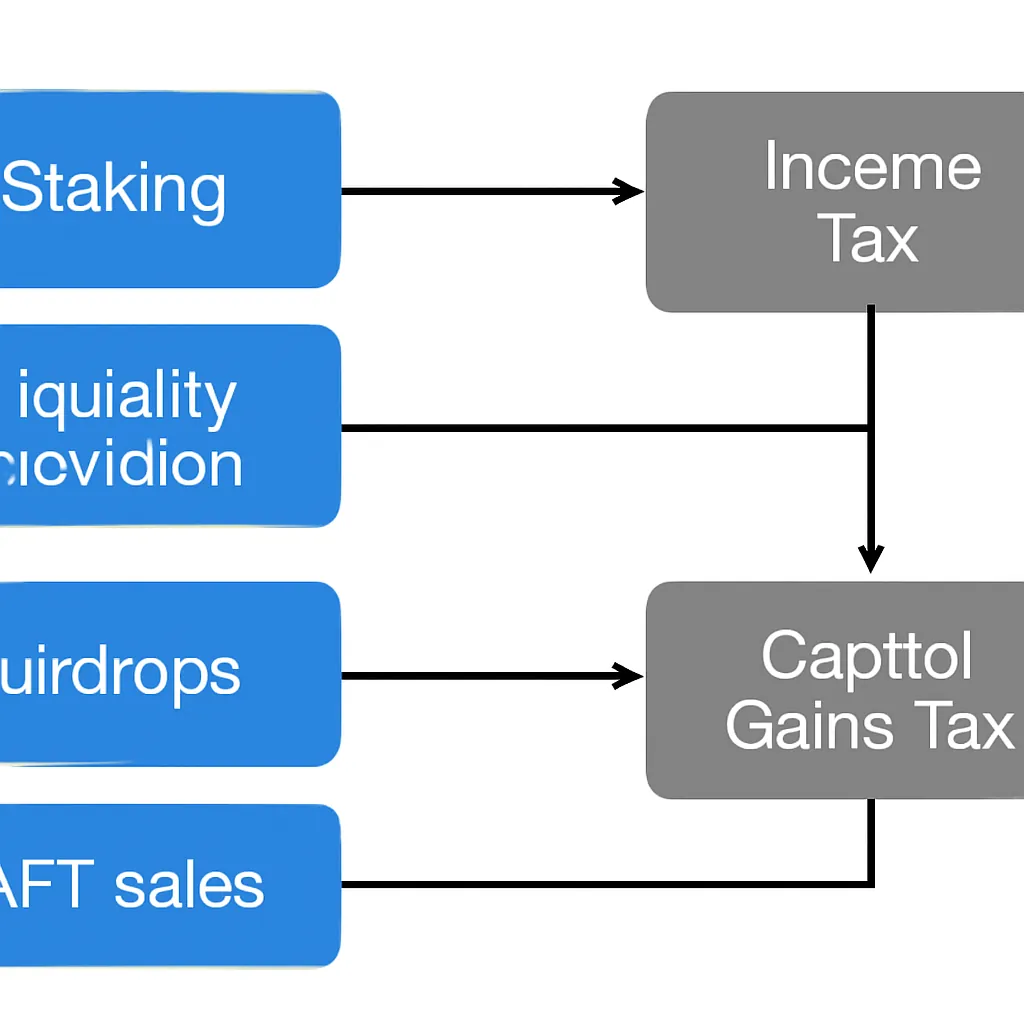
Yes, staking is taxable in the UK, and the question of is staking taxable comes up constantly. HMRC's position is that staking rewards are generally taxable as miscellaneous income at the point you receive them. The pound sterling value of the tokens on the day they land in your wallet is the figure you report as income. That income then becomes your cost basis for the tokens. When you eventually sell or swap those tokens, any gain above that original income value is subject to Capital Gains Tax.
Staking Rewards as Miscellaneous Income
There is a nuance worth understanding. HMRC distinguishes between staking where you are actively providing a service to a network and situations where the arrangement more closely resembles a loan or savings product. For most retail stakers using platforms or native protocol staking, the miscellaneous income route applies. If your staking activity were so substantial and organised that it constituted a trade, the rules shift toward trading income, which carries different allowances and reliefs. Very few individual retail participants reach that threshold.
Calculation and Common Mistake
The crypto staking tax calculation therefore involves two steps: recording the income value on receipt, and tracking the subsequent disposal when you sell. Failing to record the income at receipt is the most common mistake, because people only think about tax when they sell. By that point, the original receipt date and value may be difficult to reconstruct.
How Are DeFi Rewards Taxed Beyond Simple Staking
Understanding how are DeFi rewards taxed means going beyond staking into lending, yield farming, and liquidity provision. Each activity has its own texture under HMRC rules.
Lending and Yield Farming Treatment
When you deposit tokens into a lending protocol and receive interest-style returns, HMRC's approach broadly mirrors the staking analysis: income on receipt, capital gain or loss on later disposal. The key question is always whether the arrangement involves a disposal of the underlying tokens. If depositing your tokens into a protocol means you legally transfer them in exchange for a receipt token or pool token, HMRC is likely to view that as a disposal of the original tokens. The receipt token becomes a new asset acquired at whatever market value existed on the day of the transaction.
Complexity and Professional Judgement
Yield farming compounds this further. A typical yield farming cycle might involve depositing Token A, receiving LP tokens, staking those LP tokens in a rewards contract, receiving Token B as a reward, and then withdrawing everything at a later date. Each step can involve a taxable event. The sheer complexity is why many UK DeFi users unknowingly accumulate unreported gains and income across a single year without realising it.
HMRC has not published exhaustive guidance covering every DeFi protocol structure, so professional judgement and careful record-keeping fill the gap. The overriding principle remains: if the economic substance of an event looks like income, report it as income; if it looks like a disposal, report it as a capital event.
Crypto Airdrop Tax: What HMRC Expects
Crypto airdrop tax in the UK depends on why you received the airdrop. HMRC draws a line between airdrops that are simply gifted to you with no expectation of anything in return, and airdrops that come as a reward for some action, whether that is holding a specific token, completing a task, or participating in a protocol.
Distinction Between Gift and Reward Airdrops
If the airdrop is a straightforward gift with no strings attached, HMRC has indicated it may not be taxable as income at the point of receipt. Instead, the tokens enter your holdings with a nil or negligible cost basis, and any gain on disposal is fully subject to Capital Gains Tax. If the airdrop is connected to services you provided or actions you took, HMRC treats the fair market value on receipt as miscellaneous income, and you pay Income Tax on that value immediately.
Practical Implications and Table
In practice, the distinction matters significantly. A protocol airdropping tokens to wallets that interacted with it during a specific period is likely rewarding past behaviour. That is the category HMRC would scrutinise most closely as income. A completely random promotional distribution with no participation requirement is more likely to fall into the capital-only category, though even then the cost basis issue means your eventual disposal could trigger a large gain.
| Airdrop Type | Income Tax on Receipt? | CGT on Disposal? |
|---|---|---|
| Free gift, no participation required | No (nil cost basis applies) | Yes, on full disposal proceeds |
| Reward for services or activity | Yes, on market value at receipt | Yes, on any gain above income value |
NFT Tax and Crypto Trading Tax in the UK
NFT tax follows the same Capital Gains Tax logic that applies to other crypto assets. Buying an NFT and later selling it for more than you paid generates a chargeable gain. The gain is calculated in pounds sterling, using the sterling equivalent of your acquisition cost and your disposal proceeds on the respective dates. If you minted an NFT and paid gas fees to do so, those fees typically form part of your cost basis. If you sold an NFT and paid a platform fee, that fee reduces your disposal proceeds.
NFT Swaps and Valuation Challenges
Things get more complicated when NFTs are received as rewards, given away, or swapped for other NFTs rather than sold for fiat. A swap of one NFT for another is still a disposal of the first NFT at market value. If you cannot establish the market value of an NFT because it is illiquid or unique, you will need to use the best available evidence of fair value, which may include floor price data at the time of the transaction.
Crypto Trading Tax and Share Pooling
Crypto trading tax covers every swap, sale, or exchange of crypto assets, not just conversions to sterling. Swapping Bitcoin for Ethereum, for instance, is a disposal of Bitcoin at the sterling value of Ethereum received on that day. The UK's share pooling rules apply to crypto, meaning your cost basis is calculated as an average across all acquisitions of the same token, with specific rules for same-day and thirty-day same-asset repurchases that prevent straightforward bed-and-breakfasting strategies.
The Annual Exempt Amount and Self Assessment
Every UK individual has an annual Capital Gains Tax exempt amount. Gains within this threshold are not taxable. Gains above it are taxed at the rates applicable to capital assets, which vary depending on whether you are a basic or higher rate taxpayer. Income from staking, airdrops, and DeFi rewards counts toward your total income for the year and can push you into a higher tax band.
Self Assessment and Reporting Obligations
You must report crypto gains and crypto income through Self Assessment. If you have not previously filed a Self Assessment return, you may need to register with HMRC. Crypto income and gains should be disclosed even if you did not convert to sterling during the year. The deadline for online Self Assessment returns is 31 January following the end of the relevant tax year. Late filing and late payment both attract penalties and interest.
Thresholds for Mandatory Reporting
One practical point: even if your total gains are below the annual exempt amount, you may still need to report them if your total disposal proceeds for the year exceeded a certain threshold. Checking the current threshold each year before deciding not to file is important, because the rules around mandatory reporting are not the same as the rules around whether tax is actually owed.
| Tax Category | Rate for Basic Rate Taxpayer | Rate for Higher / Additional Rate Taxpayer |
|---|---|---|
| Capital Gains Tax on crypto | Lower rate | Higher rate |
| Income Tax on staking / DeFi rewards | 20% | 40% or 45% |
Illustrative Scenario
This scenario is illustrative. It does not describe a real person or client, and the figures are examples only.
To illustrate how this applies in practice, consider the following scenario:
Priya is a software developer based in London who has been active in DeFi for two years. During the last tax year she staked ETH and received staking rewards on a monthly basis, provided liquidity to a decentralised exchange and received LP tokens plus trading fee rewards, and sold two NFTs she had purchased earlier in the year. She also received a governance token airdrop from a protocol she had used regularly.
Priya assumed she only owed tax when she converted crypto to sterling. She had not reported her staking rewards as income, had not considered the liquidity pool deposit as a disposal, and had not tracked the airdrop at all. When she started using CryptaTax to import her wallet transactions, the software identified each taxable event, assigned pound sterling values using historical price data, and separated income events from capital events automatically. The result was a clear breakdown she could feed directly into her Self Assessment return, with a record trail she could present to HMRC if asked. What had seemed like an overwhelming pile of wallet history became a manageable filing within a single afternoon.
Frequently Asked Questions
What is DeFi tax and does it apply to me?
DeFi tax refers to the tax obligations that arise from decentralised finance activities such as staking, liquidity provision, yield farming, and token swaps. In the UK, HMRC treats most crypto assets as capital assets and taxes income from DeFi activities under Income Tax. If you have used any DeFi protocol during a UK tax year, you almost certainly have reportable events.
Is staking taxable in the UK?
Yes. HMRC treats staking rewards as miscellaneous income, taxable at their pound sterling value on the day you receive them. When you later sell or swap those staked tokens, any gain above the income value you already reported is subject to Capital Gains Tax. Both steps require record-keeping from the moment rewards arrive in your wallet.
How are DeFi rewards taxed differently from regular staking?
The principles are similar: rewards received are income, and later disposals are capital events. The added complexity with broader DeFi rewards is that depositing tokens into a protocol can itself trigger a disposal of the original tokens. This means DeFi users often have more taxable events than they realise, even before they withdraw anything.
What is the NFT tax treatment in the UK?
NFTs are treated as capital assets under HMRC guidance. Selling or swapping an NFT is a disposal, and any gain above your acquisition cost is subject to Capital Gains Tax. If you received an NFT as a reward for services, the market value at receipt is also taxable as income. Gas fees paid on minting or sale can typically be factored into your cost and proceeds figures.
How is crypto airdrop tax calculated?
It depends on the nature of the airdrop. If you received tokens as a reward for past activity or participation, HMRC treats the market value at receipt as miscellaneous income subject to Income Tax. If the airdrop was a completely unsolicited gift with no participation requirement, no income arises at receipt, but your cost basis is nil and the full disposal proceeds are a chargeable gain later.
Do I need to report crypto if I never converted to sterling?
Yes. HMRC's rules require you to report disposals and income regardless of whether you converted to sterling. Swapping one crypto for another is a disposal of the first asset at its sterling market value on the transaction date. Staking rewards are income on receipt in sterling terms. The absence of a bank transfer does not remove the tax liability.
What records do I need to keep for DeFi tax in the UK?
You need the date of every transaction, the type of transaction, the amount of crypto involved, and the pound sterling value at the time. For disposals you also need the original acquisition cost. HMRC can request records going back several years, so maintaining a complete transaction history from all wallets and exchanges is essential. Using software that imports and values transactions automatically saves significant time.
What happens if I missed reporting DeFi income in previous years?
HMRC has a disclosure facility that allows taxpayers to come forward voluntarily and correct past returns. Voluntary disclosure typically attracts lower penalties than errors found during an investigation. If you have unreported crypto income or gains from previous years, taking action proactively is usually better than waiting to be contacted by HMRC.
Is crypto trading tax different from DeFi tax?
Crypto trading tax and DeFi tax follow the same Capital Gains Tax framework for disposals, but the activities that trigger income tax events are more varied in DeFi. A straightforward crypto trader typically deals mainly with capital gains and losses. A DeFi user also accumulates Income Tax obligations from staking rewards, liquidity mining returns, and airdrops connected to services, making the overall picture more complex.
When is the Self Assessment deadline for crypto tax in the UK?
For online Self Assessment returns, the deadline is 31 January following the end of the relevant tax year. The UK tax year runs from 6 April to 5 April. So for activity in the 2024 to 2025 tax year, the online filing deadline is 31 January 2026. Late filing attracts an automatic penalty, and late payment attracts interest and further charges.
Source: CryptaTax