
Crypto Staking Tax in the UK: What You Actually Owe
Crypto staking tax is one of the most searched and least understood topics for UK crypto holders. HMRC does not treat staking rewards as an afterthought. It has published specific guidance on how rewards are taxed when you receive them and again when you eventually sell them. That means most people who stake crypto face two separate tax events on the same tokens. Get either one wrong on your Self Assessment return and you risk an underpayment, a penalty, or both. This guide covers staking, DeFi rewards, NFTs, airdrops, and crypto trading tax in plain English, so you know exactly where you stand before the 31 January filing deadline arrives.
How HMRC Classifies Crypto for Tax Purposes
Before getting into staking specifically, it helps to understand the foundation HMRC builds everything else on. Cryptoassets are treated as a form of property in the UK, not as currency. That single classification drives almost every tax outcome. Because crypto is property, disposing of it triggers Capital Gains Tax in most cases, and receiving it as income triggers Income Tax when the source is something like staking, mining, or an employer payment.
Four Broad Categories for Individuals
HMRC uses four broad categories for individuals: exchange tokens such as Bitcoin and Ether, utility tokens, security tokens, and non-fungible tokens. The category matters because it can affect whether a receipt is income or capital in nature. For most retail stakers, though, the relevant distinction is simpler: did you receive tokens in return for a service or activity, or did you receive them as a return on locked capital? HMRC's answer to that question shapes the Income Tax treatment entirely.
Crypto Staking Tax: the Two-Stage Charge
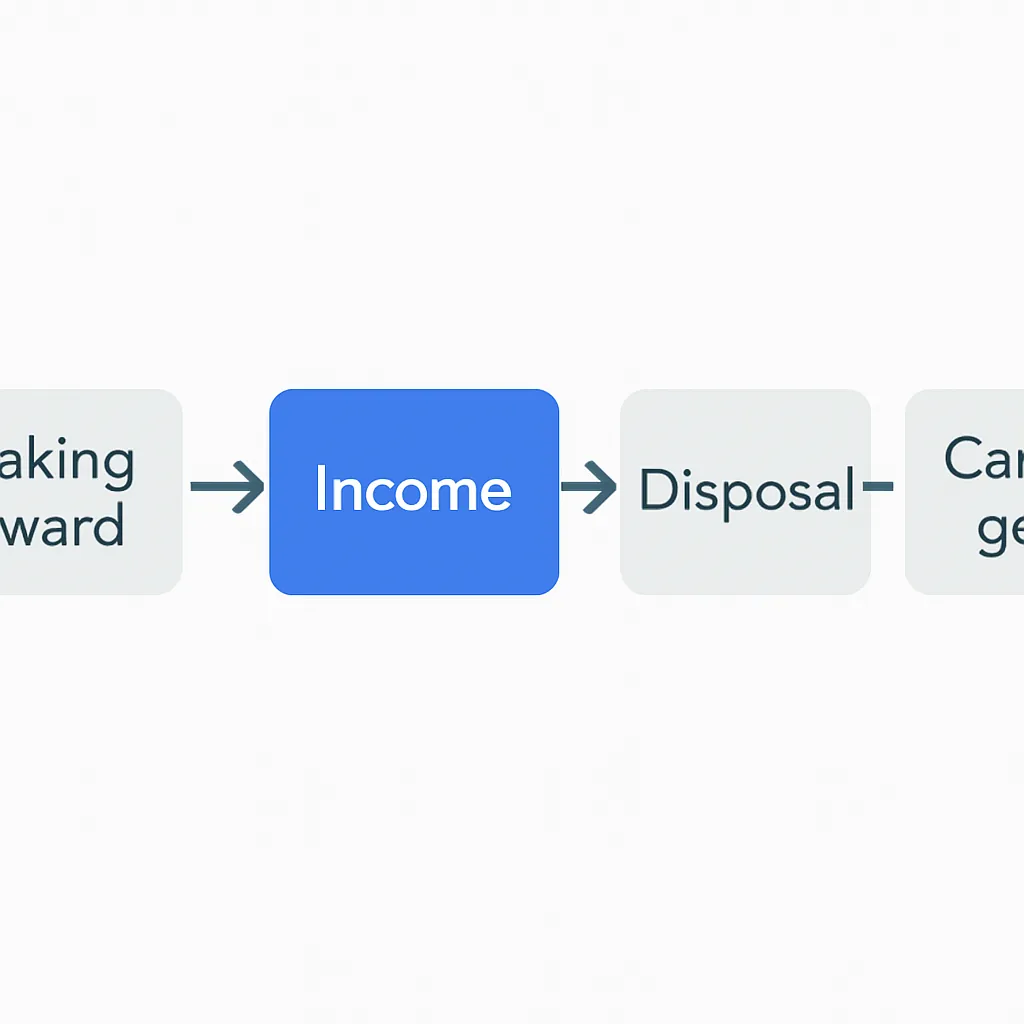
Staking rewards in the UK are generally subject to Income Tax at the point of receipt. HMRC's position is that where an individual stakes tokens and receives rewards as a result of that activity, those rewards are miscellaneous income. You declare the sterling value of the tokens on the date you received them, using the pound equivalent at that moment. That value then becomes your cost basis for any future disposal.
Income Tax on Staking Rewards
The second charge arrives when you sell, swap, gift, or otherwise dispose of those reward tokens. At that point, any gain above the original sterling value you already declared as income becomes subject to Capital Gains Tax. The annual CGT exempt amount has been reduced significantly in recent tax years, so even modest gains can now fall within scope. Ignoring either stage is a common mistake, and HMRC's Connect system increasingly cross-references exchange data to catch discrepancies.
Capital Gains Tax on Disposal
| Tax Event | When It Happens | Tax Applied | Value Used |
|---|---|---|---|
| Receiving staking rewards | Date of receipt | Income Tax (miscellaneous income) | Sterling fair market value on receipt date |
| Disposing of reward tokens | Date of sale, swap, or gift | Capital Gains Tax | Proceeds minus cost basis (value at receipt) |
Is Staking Taxable When Tokens Are Locked?
A question that comes up constantly is whether staking is taxable when you cannot immediately access the rewards. The lock-up period does not shelter you from Income Tax. HMRC's view is that the charge crystallises when you have the right to the tokens, not when you choose to unstake or move them to a different wallet. If a protocol credits rewards to your staking account daily, each daily credit is technically a separate income receipt.
Taxability During Lock-Up Periods
This matters practically because it means you need a record of the sterling value of every reward receipt, not just the total at the end of the year. Exchanges and staking platforms do not always provide this data in a usable format, which is one reason many filers end up with gaps in their records. Keeping a contemporaneous log, or using software that pulls historical price data automatically, is the most reliable way to avoid reconstructing everything at filing time.
Record-Keeping for Each Reward
| Scenario | Income Tax on Receipt? | CGT on Disposal? |
|---|---|---|
| Proof-of-stake rewards (liquid) | Yes | Yes |
| Staking rewards in a lock-up period | Yes, when credited | Yes, on later disposal |
| Liquid staking tokens received (e.g. stETH) | Depends on structure | Yes, on disposal |
| Mining rewards (hobby level) | Yes, miscellaneous income | Yes, on disposal |
How Are DeFi Rewards Taxed in the UK?
DeFi tax is more complex than staking on a centralised exchange because the underlying legal relationships are less clear. When you provide liquidity to a DeFi protocol and receive yield, HMRC's guidance suggests the treatment depends on whether you have disposed of the original tokens in the process. If you deposit ETH into a protocol and receive a liquidity pool token in return, HMRC may treat that exchange as a disposal of ETH at market value, triggering CGT immediately, before you have seen any yield at all.
Complexity of DeFi Tax Treatment
The yield itself, whether paid in governance tokens, protocol fees, or the same asset you deposited, is then treated in a similar way to staking rewards: income at the point of receipt, capital gain or loss on later disposal. How are DeFi rewards taxed when the protocol automatically reinvests yield on your behalf? Each reinvestment may be a separate receipt and disposal event. The number of taxable transactions can therefore be much larger than the number of times you personally interacted with the protocol. Tracking these accurately without automated tools is extremely time-consuming.
NFT Tax and Crypto Airdrop Tax in the UK
NFT tax follows the same general framework as other cryptoassets. Buying an NFT is not itself a taxable event, but purchasing it with crypto that has appreciated in value creates a disposal of that crypto. Selling or trading an NFT triggers CGT on the gain over your cost basis. If you create and sell NFTs as a trade, the profits may instead be subject to Income Tax and National Insurance as self-employment income, which carries a materially higher combined rate than CGT for most people.
Tax on Buying and Selling NFTs
Crypto airdrop tax depends on why you received the tokens. Where an airdrop requires you to perform a task, provide a service, or participate in a promotion, HMRC treats the receipt as miscellaneous income. Where tokens arrive with no conditions attached and no expectation of anything in return, HMRC has suggested there may be no Income Tax on receipt, though you will still pay CGT when you dispose of them using a nil cost basis. The distinction sounds clean but is often murky in practice, particularly with retroactive airdrop claims that reward past protocol usage.
Crypto Trading Tax: Shares Pooling and Same-Day Rules
Crypto trading tax in the UK applies the same pooling rules used for shares. Every time you buy the same token, your purchase is added to a single pool, and your average cost per unit is recalculated. When you sell, the gain is the difference between the sale proceeds and the appropriate portion of the pool cost. This sounds straightforward, but two anti-avoidance rules complicate things significantly for active traders.
Pooling Rules for Crypto Trading
The same-day rule means that if you buy and sell the same token on the same day, the buy is matched directly against the sell rather than going into the pool. The bed-and-breakfast rule extends that to purchases made within 30 days after a sale. Both rules were designed to prevent investors from crystallising artificial losses by selling and immediately rebuying. For crypto traders who use dollar-cost-averaging strategies or who rebalance frequently, these rules can create surprising mismatches between expected and actual tax outcomes. Keeping accurate timestamps on every trade is essential.
Illustrative Scenario
This scenario is illustrative. It does not describe a real person or client, and the figures are examples only.
To illustrate how this applies in practice, consider the following scenario:
Priya is a software developer in Manchester who has been staking Ether on a proof-of-stake validator for about eighteen months. She also holds a small portfolio of NFTs purchased with ETH and has claimed two DeFi protocol airdrops. At the end of the tax year she realises she has never recorded the sterling value of her staking rewards on the date each batch was credited. She has receipts for her original ETH purchases but nothing granular for the rewards themselves.
Using CryptaTax, Priya connects her wallet addresses and exchange accounts. The platform pulls historical price data for each reward receipt date, calculates her miscellaneous income figure, and identifies the two disposal events created when she swapped her airdrop tokens for stablecoins. It also flags that one of her NFT purchases was made with ETH that had a much lower cost basis than its value on purchase day, meaning she had an unreported CGT event on the ETH disposal she had not considered. With a complete picture finally in front of her, Priya files an accurate Self Assessment return and avoids the penalties that would have followed an omission.
Frequently Asked Questions
Is staking taxable in the UK even if I have not sold my rewards?
Yes. HMRC treats staking rewards as miscellaneous income at the point you receive them, regardless of whether you have sold them. The sterling value on the date of receipt is what you declare as income. A second tax event, Capital Gains Tax, applies later if you sell or dispose of the tokens at a higher value than when you received them.
Do I pay crypto staking tax on every individual reward payment?
In principle, yes. Each time rewards are credited to your account or wallet, that is a separate income receipt. In practice, many stakers group daily or weekly rewards and use an average price for a short period, but you should keep records that support whatever method you use. HMRC expects you to be able to reconstruct the calculation if asked.
How is DeFi tax different from standard staking tax?
DeFi tax is more complex because depositing tokens into a protocol may itself be treated as a disposal, triggering CGT before any yield is earned. How are DeFi rewards taxed once received? Similarly to staking, as income at market value on the date of receipt. The number of taxable events can be large if the protocol automatically compounds or reinvests your position.
What is the NFT tax position for UK holders?
NFT tax in the UK is primarily a Capital Gains Tax matter. Buying an NFT with appreciated crypto creates a disposal of that crypto, and selling or swapping an NFT triggers CGT on any gain. If you are creating and selling NFTs as a business activity, the profits may be taxed as trading income instead, which is subject to Income Tax and National Insurance.
Is crypto airdrop tax always Income Tax?
Not always. Where an airdrop requires you to do something, perform a task or engage with a platform, HMRC treats it as miscellaneous income. Where tokens arrive with no strings attached, there may be no Income Tax on receipt, but you will still face CGT on disposal, calculated from a nil cost basis. The practical distinction can be hard to pin down for retroactive airdrops.
How does crypto trading tax work under the UK pooling rules?
Crypto trading tax uses a shares-pooling approach. Each token type has its own pool, and your average cost per unit is updated with every purchase. Gains on disposal are calculated against the pooled average cost. The same-day rule and the 30-day bed-and-breakfast rule override the pool for matched transactions, which can affect traders who buy and sell the same asset frequently.
What records do I need to keep for my Self Assessment crypto return?
You need the date, type, and sterling value of every transaction: purchases, sales, swaps, staking reward receipts, DeFi yields, airdrop receipts, and NFT trades. You also need the cost basis for every asset you hold. HMRC can request up to six years of records in certain cases, so keeping a complete transaction history is not optional.
Can HMRC find out about crypto I have not declared?
Yes. HMRC participates in international data-sharing frameworks and has issued information notices to UK-based crypto exchanges requiring them to hand over customer data. HMRC's Connect system can match exchange records against Self Assessment returns. Voluntary disclosure before HMRC opens an enquiry will generally result in lower penalties than being caught through an investigation.
Source: CryptaTax