
Crypto Staking Tax in Germany: What You Actually Owe
Crypto staking tax is one of the most searched questions among German crypto holders, and for good reason. Germany's tax treatment of crypto is more nuanced than most countries, with a one-year holding rule that can legally reduce your bill to zero, but only if you understand how it works. Whether you earn staking rewards, trade tokens, receive airdrops, or take part in DeFi protocols, the German tax office, the Finanzamt, treats each activity differently. Getting the details wrong costs money. This guide explains exactly what is taxable, when it is taxable, and what you need to track to stay compliant, covering staking, trading, DeFi, NFTs, and airdrops in plain language.
How Germany Taxes Crypto: The Core Framework
Germany does not treat cryptocurrency as a currency for tax purposes. Instead, the Finanzamt classifies most crypto assets as private assets, similar to how it treats foreign currencies or certain commodities held by individuals. This classification sits under Section 23 of the German Income Tax Act, known as the Einkommensteuergesetz or EStG. Gains from selling private assets are taxable as miscellaneous income unless you have held the asset for more than one year before selling.
The One-Year Holding Period Rule
That one-year holding period is the single most important rule in German crypto tax. Sell or swap a coin you have held for over twelve months and the entire gain is tax-free, regardless of the amount. Sell within twelve months and the gain is added to your taxable income for the year and taxed at your personal income tax rate, which can reach up to 45 percent plus the solidarity surcharge. There is also a small annual exemption for private disposal gains, currently set at 1,000 euros per person, below which no tax is owed even on short-term gains.
FIFO and Record-Keeping Requirements
Every purchase, sale, swap, or receipt of crypto creates a taxable event or at least a record you need to keep. The cost basis method used in Germany is FIFO, first in first out, meaning the oldest coins you hold are treated as the first ones sold. Accurate record-keeping from day one is not optional; it is the foundation of a defensible German crypto tax return.
Crypto Staking Tax: When Rewards Become Income
Crypto staking tax in Germany follows a straightforward principle at the point of receipt: staking rewards are treated as income when you receive them. The value of the reward in euros at the moment it lands in your wallet is added to your taxable income for that year. You pay income tax on that amount at your marginal rate. This applies whether you stake Ethereum directly, delegate to a validator, or use a centralised exchange's staking product.
Tax on Sale of Staking Rewards
The second tax event comes when you eventually sell or swap those reward tokens. At that point, the one-year holding period rule applies again. If you received staking rewards and held each batch for more than twelve months before selling, the disposal gain is tax-free. If you sell within twelve months of receiving them, you pay tax on any gain above the 1,000-euro annual exemption. The cost basis for each batch of rewards is the fair market value in euros on the day you received them.
There is an important debate in German tax circles about whether staking extends the holding period of the underlying staked asset. The prevailing view, supported by guidance from the Federal Ministry of Finance, is that staking does not extend the holding period of the original coins you locked up. That means coins you held for over a year before staking can still qualify for tax-free disposal after the standard twelve-month period. Always confirm the current position with a qualified tax adviser, as interpretations can shift.
Impact on Underlying Staked Assets
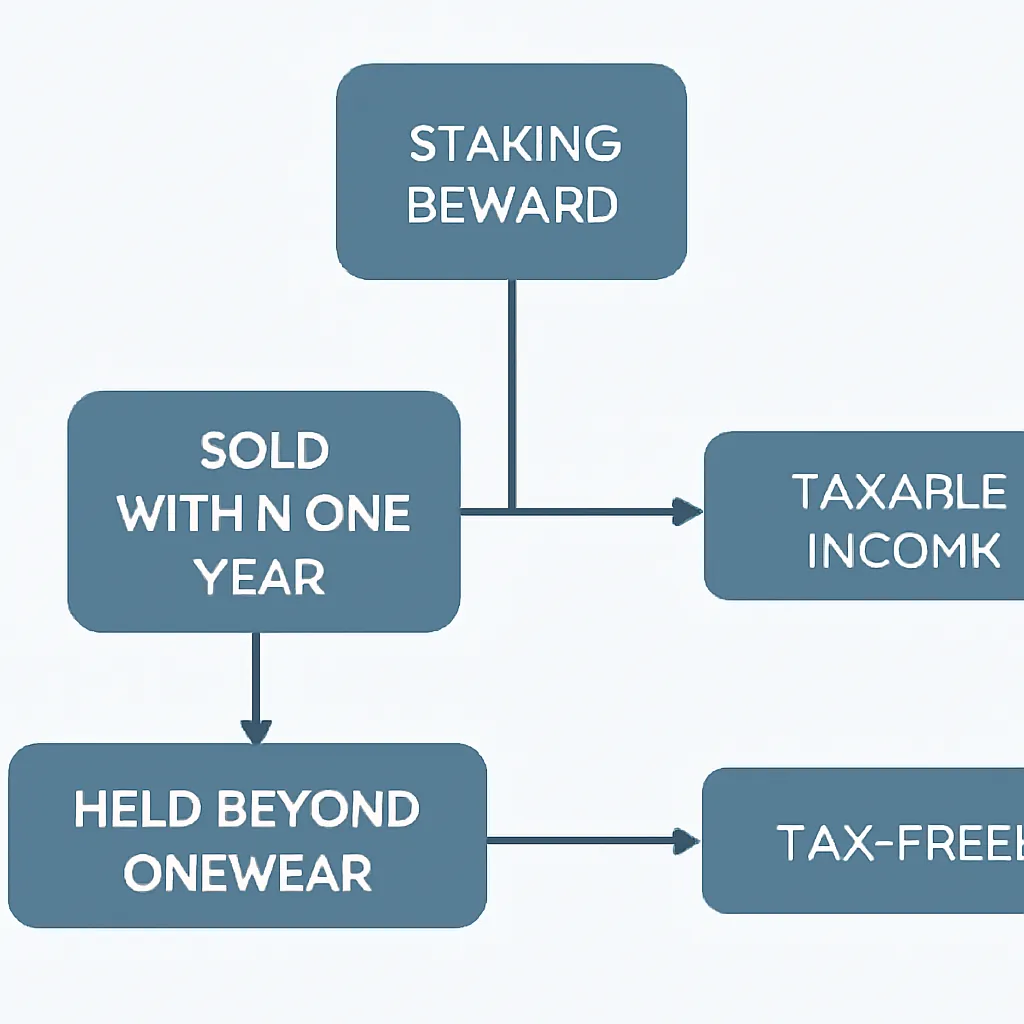
The table below summarises the two-stage tax treatment for staking rewards.
| Stage | Tax Event | Tax Treatment |
|---|---|---|
| Reward received | Yes, income at receipt | Taxed as miscellaneous income at marginal rate |
| Reward sold, held under 12 months | Yes, disposal gain | Gain taxed at marginal rate, 1,000 euro exemption applies |
| Reward sold, held over 12 months | Disposal, but exempt | Tax-free under Section 23 EStG |
Is Staking Taxable for DeFi Protocols Too?
The question of how are DeFi rewards taxed comes up constantly, and Germany does not yet have a single definitive answer for every DeFi structure. The general principle is that if you receive tokens in return for providing a service, whether that is liquidity provision, yield farming, or lending, those tokens are likely treated as income at receipt, just like staking rewards. The Finanzamt looks at the economic substance of what you are doing, not the label the protocol gives it.
Taxable Events in Liquidity Pools
Liquidity pool positions add a layer of complexity. When you deposit two tokens into a liquidity pool and receive LP tokens in return, this is widely regarded as a taxable swap event. You are disposing of the original tokens, which starts the clock on a new holding period for the LP tokens. When you later withdraw your liquidity and receive tokens back, that is another disposal. Any impermanent loss you have suffered does not automatically create a deductible loss; the tax position depends on the actual values at each swap point.
Other DeFi Rewards as Income
Yield farming rewards, governance token distributions, and interest earned from DeFi lending protocols are all broadly treated as income in the year received. The same logic applies: income tax on receipt, then capital gains rules on disposal. Germany's tax authority has acknowledged the complexity of DeFi but expects taxpayers to apply existing rules as closely as possible until more specific guidance emerges. Keeping a transaction-level log of every DeFi interaction is the only way to reconstruct your position accurately at filing time.
Crypto Trading Tax: Gains, Losses, and the Holding Rule
Crypto trading tax in Germany is governed by the same Section 23 framework. Every time you sell one cryptocurrency for euros, or swap one cryptocurrency for another, a disposal event occurs. The gain or loss is calculated as the sale proceeds in euros minus the cost basis in euros, calculated using FIFO. Fees paid on transactions are generally deductible from the gain, reducing your taxable amount.
Offsetting Losses and FIFO Implications
Losses from short-term disposals can be offset against gains from other short-term disposals in the same tax year. If your losses exceed your gains, you can carry the net loss forward to future years, but you cannot offset crypto losses against income from employment or other income categories. The offset is ring-fenced within the private disposal gains category.
Practical FIFO Impact on Traders
One practical implication of FIFO is that frequent traders with large holdings can find that swapping a token inadvertently triggers a taxable gain on coins they purchased much earlier at a low price. Understanding the order in which your coins are treated as sold is critical before you make any large trade. Using software that calculates your FIFO position in real time helps avoid unexpected tax bills.
| Crypto Activity | Taxable Event? | Tax Category | One-Year Exemption? |
|---|---|---|---|
| Selling crypto for euros | Yes | Private disposal gain (Section 23 EStG) | Yes, if held over 12 months |
| Swapping one crypto for another | Yes | Private disposal gain (Section 23 EStG) | Yes, if held over 12 months |
| Receiving staking rewards | Yes, at receipt | Miscellaneous income (Section 22 EStG) | No, but disposal of rewards can be exempt |
| Receiving DeFi yield | Yes, at receipt | Miscellaneous income (Section 22 EStG) | No, but disposal of rewards can be exempt |
| Receiving an airdrop | Generally yes, at receipt | Miscellaneous income or gift, depends on facts | Disposal rules apply after receipt |
| Selling an NFT | Yes, if held under 12 months | Private disposal gain (Section 23 EStG) | Yes, if held over 12 months |
NFT Tax and Crypto Airdrop Tax in Germany
NFT tax in Germany follows the same private asset disposal framework as fungible tokens. If you buy an NFT and sell it within twelve months, any gain is taxable. Hold it beyond twelve months and the gain is tax-free. Creating and selling NFTs as part of a business or professional activity changes the picture entirely: at that point, income may be taxed as trade income rather than private disposal income, and different rules apply. For most individual collectors and traders, however, the Section 23 framework covers NFT activity.
Tax Treatment of Airdrops
Crypto airdrop tax is less settled. The German tax authority's general position is that receiving tokens without doing anything in return may be treated as a gratuitous acquisition, similar to a gift, with a zero cost basis. If you then sell those tokens, the entire sale proceeds become the taxable gain. If the airdrop required you to perform an action, such as holding a certain token, completing a task, or signing up for a service, the received tokens are more likely treated as income at the point of receipt. The distinction matters for the cost basis and therefore the eventual gain on disposal.
Hard Forks and Record-Keeping
Hard forks, where you receive new tokens automatically as a result of a blockchain split, are generally treated similarly to gratuitous airdrops in Germany: taxed on disposal rather than at receipt, with a zero or near-zero cost basis attributed to the forked coins. Given the lack of definitive case law on many of these points, keeping a detailed record of how and why you received every token is essential.
What Records You Need to Keep
The Finanzamt can ask you to substantiate every figure on your tax return for up to ten years after filing. For crypto, this means keeping a complete transaction history including dates, amounts, counterparties where known, and the euro value at the time of each transaction. Exchange download files, wallet export reports, and blockchain explorers are all valid sources, but they need to be reconciled into a single coherent record.
Essential Transaction Details to Track
You need to track: every purchase and sale, every swap between cryptocurrencies, every staking reward received with its receipt date and value, every DeFi transaction, every airdrop with context about how it was received, and any fees paid. For NFTs, you also need records of the creation or purchase cost and any expenses incurred in minting or selling. Spreadsheets work for small portfolios, but anyone with more than a few dozen transactions per year will find dedicated crypto tax software far more reliable for maintaining an accurate FIFO cost basis across multiple wallets and exchanges.
Illustrative Scenario
This scenario is illustrative. It does not describe a real person or client, and the figures are examples only.
To illustrate how this applies in practice, consider the following scenario:
Lena is a freelance graphic designer based in Munich. She bought Ethereum in early 2022 and began staking it later that year through a non-custodial validator. Throughout 2023 she received staking rewards at regular intervals, and she recorded each reward's euro value on the date it arrived using her exchange's price feed. She also provided liquidity on a DeFi protocol and received governance tokens as yield.
When she filed her 2023 German tax return, Lena included the total euro value of all staking rewards as miscellaneous income under Section 22 EStG. She also reported the governance tokens as income at their receipt value. Her original Ethereum, which she had held for more than twelve months before any disposal, was sold later in 2024 tax-free under the Section 23 one-year exemption. She used CryptaTax to calculate her FIFO cost basis across all wallets, generate a transaction report, and produce the figures she needed for her Anlage SO form. Without the software, reconstructing hundreds of DeFi and staking transactions manually would have taken days and carried a high risk of error.
Frequently Asked Questions
Is staking taxable in Germany?
Yes. Staking rewards are treated as taxable income in Germany at the point you receive them. The euro value of each reward on the date of receipt is added to your income for that tax year and taxed at your personal marginal rate. When you later sell the rewards, the one-year holding period rule determines whether any disposal gain is also taxable.
Does the one-year holding period apply to staking rewards?
The one-year holding period applies to the disposal of staking reward tokens, not to their receipt. You pay income tax when you receive them. If you then hold those reward tokens for more than twelve months before selling, the disposal gain is tax-free. If you sell within twelve months of receiving them, any gain is taxable.
How are DeFi rewards taxed in Germany?
DeFi rewards such as yield farming income, liquidity pool distributions, and lending interest are generally treated as income at the point of receipt, similar to staking rewards. The euro value at receipt is taxable income. Subsequent disposal of those tokens falls under the standard one-year holding rule. Swapping tokens in and out of liquidity pools also triggers disposal events at each swap.
Is crypto trading tax different from staking tax in Germany?
Yes, the tax category differs. Trading gains fall under Section 23 EStG as private disposal gains, with the one-year exemption available. Staking and DeFi income fall under Section 22 EStG as miscellaneous income, taxed at receipt with no exemption at that stage. Both categories use FIFO for cost basis calculations when a disposal occurs.
Do I owe NFT tax in Germany if I held the NFT for over a year?
If you are an individual holding an NFT as a private asset and you sell it after holding it for more than twelve months, the gain is generally tax-free under Section 23 EStG. If you sell within twelve months, any gain above the 1,000-euro annual exemption is taxable. Creators who mint and sell NFTs commercially may face different treatment as trade income.
How is crypto airdrop tax calculated in Germany?
It depends on whether the airdrop required you to take an action. Airdrops received without any action on your part are often treated as gratuitous receipts with a zero cost basis, so the full sale proceeds become taxable on disposal. Airdrops requiring you to perform a task are more likely taxed as income at receipt, giving you a cost basis equal to the value on that date.
What is the annual tax-free allowance for crypto gains in Germany?
Germany provides a 1,000-euro annual exemption for private disposal gains, which includes short-term crypto trading gains. If your total net short-term disposal gains for the year are below this threshold, no tax is owed. Gains from assets held over twelve months do not count toward this limit because they are fully exempt regardless of amount.
What records do I need to file a German crypto tax return?
You need a complete transaction history covering every purchase, sale, swap, staking reward receipt, DeFi interaction, airdrop, and NFT trade. Each entry needs a date, the amount, and the euro value at the time of the transaction. The Finanzamt can request records for up to ten years, so keeping well-organised documentation is essential, and crypto tax software makes this significantly more manageable.
Can I offset crypto losses against other income in Germany?
No. Losses from private asset disposals, including crypto, can only be offset against gains within the same category in the same tax year or carried forward to future years. You cannot use crypto trading losses to reduce income from employment, freelance work, or other income categories in Germany.
Do I need to declare crypto on my German tax return even if I made a loss?
You should still declare crypto activity even if you made a net loss, because doing so creates an official record of the loss that you can carry forward to offset future gains. Failing to declare crypto transactions, even unprofitable ones, can create problems if the Finanzamt later identifies unreported activity on your wallet addresses.
Source: CryptaTax