
Crypto Airdrop Tax in Germany: Airdrops, Mining, Staking and More
If you hold crypto in Germany, the question of what you actually owe the Finanzamt is rarely straightforward. Crypto airdrop tax is one of the most misunderstood areas, but it sits alongside equally confusing rules for mining, staking, DeFi rewards, NFTs, and ordinary trading. The German tax framework treats most crypto income as either Einkünfte aus sonstigen Leistungen (income from other services) or private disposal gains under § 23 EStG, depending on how the tokens arrived and what you did with them afterwards. Getting the classification right matters enormously, because the difference between a taxable event today and a tax-free disposal can be as simple as how long you held the asset. This guide walks through each income type, explains how German tax law currently treats it, and gives you a clear picture of what to track.
How Germany Classifies Crypto Income
Germany does not have a single crypto tax law. Instead, the rules are assembled from several sections of the Einkommensteuergesetz (EStG), supplemented by guidance from the Federal Ministry of Finance (BMF). The most important classification question is whether your crypto activity generates Gewerbeeinkünfte (commercial income) or falls under private asset management. For most individual holders, the private asset rules apply, which means gains from selling crypto held for more than one year are completely tax-free. Held for less than one year and the gain is taxed at your personal income tax rate, which can reach up to 45% plus the solidarity surcharge.
Income Classification Categories
Where things get more complicated is when you earn tokens rather than simply buy and sell them. Airdrops, mining rewards, staking yields, and DeFi income all involve receiving tokens without a straightforward purchase. Each category has its own treatment, and the BMF guidance published in 2022 addressed many of these scenarios directly. Knowing which bucket your income falls into determines your filing obligations, your cost basis for future disposals, and whether a holding period even starts at the moment of receipt.
| Income Type | Tax Classification | Tax Rate | Holding Period Relevance |
|---|---|---|---|
| Crypto trading gains (under 1 year) | Private disposal gain (§ 23 EStG) | Personal income tax rate | Yes, 1-year rule applies |
| Crypto trading gains (over 1 year) | Private disposal gain (§ 23 EStG) | Tax-free | Yes, exemption after 1 year |
| Airdrop income | Other income (§ 22 No. 3 EStG) or tax-free depending on type | Personal income tax rate if taxable | New holding period starts at receipt |
| Mining income | Commercial income if business-like, otherwise other income | Personal income tax rate or trade tax | Holding period starts at receipt |
| Staking rewards | Other income (§ 22 No. 3 EStG) | Personal income tax rate | 10-year rule may apply to staked principal |
| DeFi rewards | Other income depending on protocol structure | Personal income tax rate if taxable | New holding period starts at receipt |
Crypto Airdrop Tax: When Is It Taxable?
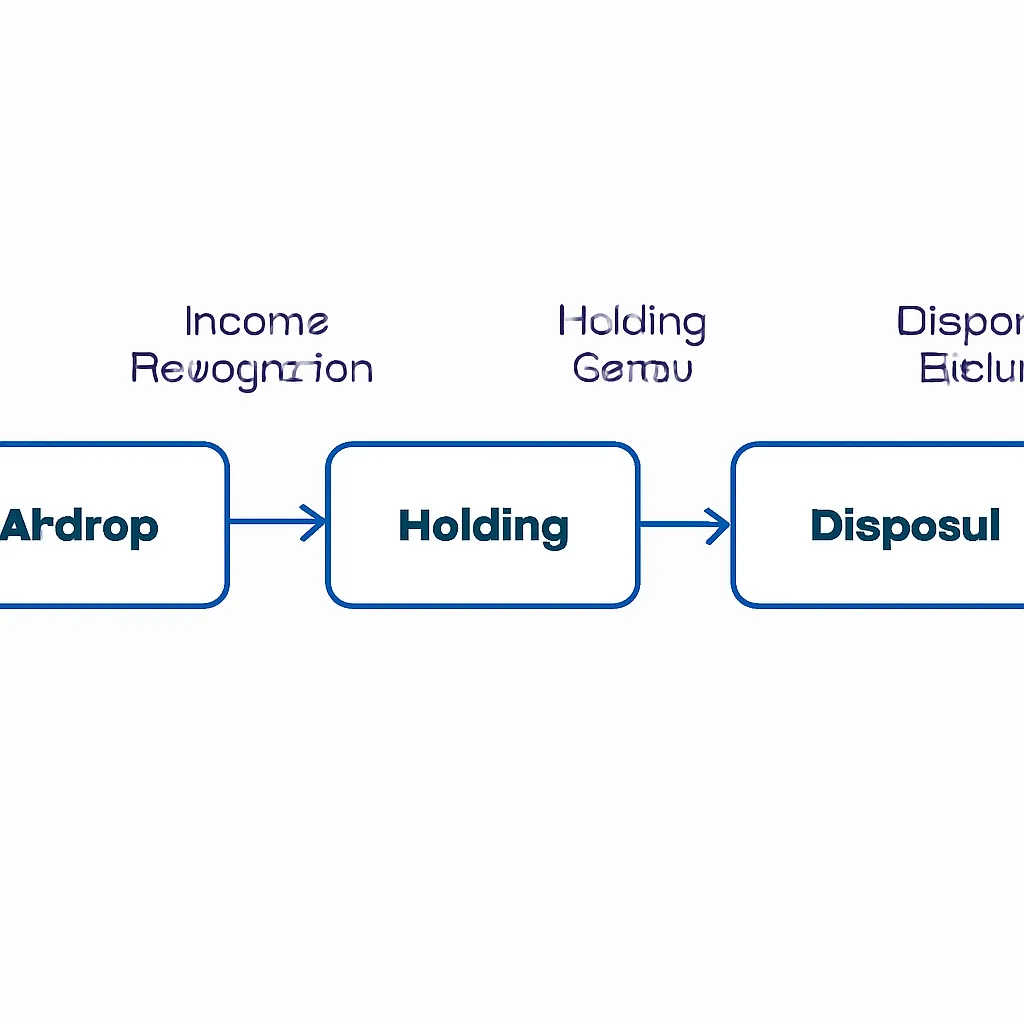
The crypto airdrop tax question in Germany comes down to one key factor: did you do anything to receive the tokens? The BMF guidance distinguishes between airdrops where you performed a service or action, and those where tokens simply arrived in your wallet with no effort on your part. If you had to retweet, hold a specific token, join a community, or complete any task to qualify, the airdrop is likely treated as income from other services under § 22 No. 3 EStG. At the moment you receive the tokens, you recognise income equal to their fair market value in euros on that date. That value also becomes your cost basis for any future sale.
Unsolicited Airdrops Tax Treatment
Completely unsolicited airdrops, where no action was required and you had no relationship with the project, sit in a greyer area. The BMF guidance suggests these may not trigger immediate income tax on receipt, but you need to be careful. If you later sell tokens that arrived for free, you may still owe crypto trading tax on the full disposal proceeds if the holding period has not been met. Regardless of how the airdrop arrived, you should record the date of receipt and the euro value on that date. Poor record-keeping is one of the most common reasons German crypto holders face unexpected bills at assessment time.
Mining Income: Hobby or Business?
Mining sits at the intersection of two very different tax regimes. If you mine casually on a home machine, the Finanzamt may treat your rewards as other income under § 22 No. 3 EStG, taxed at your personal rate. But if you mine at scale, run multiple rigs, or operate in a way that looks systematic and profit-oriented, the activity could be classified as a commercial trade. That triggers Gewerbesteuer (trade tax) on top of income tax, and you may need to register a business.
Tax Treatment of Mining Rewards
The fair market value of mined coins on the day they are received counts as income, and that same value becomes the cost basis for future disposals. If you later sell mined coins and the one-year holding period has passed, the disposal is tax-free regardless of how much the price has risen, which can be a meaningful advantage for long-term holders. Electricity costs and hardware depreciation may be deductible against mining income if the activity is classified as commercial, but the rules on deductions for private miners are more restrictive.
Crypto Staking Tax and the 10-Year Rule
Is staking taxable in Germany? Yes, staking rewards are generally taxable as other income at the moment you receive them, at fair market value. The amount you declare at receipt also sets the cost basis for when you eventually sell those reward tokens. What complicates crypto staking tax is the effect on the original staked principal. The BMF's 2022 guidance raised the possibility that staking could extend the tax-free holding period on the underlying tokens from one year to ten years, on the basis that lending or staking tokens constitutes a form of capital use. This would be a significant downside for stakers who expected to sell their principal after one year tax-free.
The Ten-Year Rule for Staking
The practical consensus among German tax practitioners is that the ten-year rule is most likely to apply to lending arrangements and certain DeFi protocols rather than straightforward proof-of-stake validation, but this area remains contested. If you are staking meaningful amounts, you should take a conservative position and seek advice before assuming a clean one-year exit. CryptaTax automatically tracks your staking reward receipts, applies fair market values at the time of receipt, and flags potential holding period implications so you are not caught out at filing time.
Staking Tax Scenarios Table
| Scenario | Taxable on Receipt? | Holding Period on Rewards | Holding Period on Principal |
|---|---|---|---|
| Proof-of-stake rewards | Yes, at fair market value | 1 year from receipt | Potentially 10 years (contested) |
| Liquidity pool rewards | Yes, at fair market value | 1 year from receipt | Potentially 10 years |
| Unsolicited airdrop | Unclear, may not be taxable | 1 year from receipt | Not applicable |
| Task-based airdrop | Yes, at fair market value | 1 year from receipt | Not applicable |
| Mining rewards | Yes, at fair market value | 1 year from receipt | Not applicable |
How Are DeFi Rewards Taxed in Germany?
DeFi tax in Germany is one of the least settled areas, largely because the protocols themselves vary so much. How are DeFi rewards taxed? The answer depends on the mechanism. Yield farming rewards, liquidity mining distributions, and protocol governance tokens distributed as incentives are generally treated as other income when received, taxable at fair market value on the date of receipt. Providing liquidity by depositing tokens into a pool may also trigger a disposal of the deposited assets if legal ownership transfers to the protocol, which could generate a crypto trading tax liability if those deposited tokens were held for less than a year.
Wrapping Tokens Tax Issues
Wrapped tokens present a similar puzzle. Wrapping ETH into WETH, for example, could in theory be a disposal if the exchange is treated as a sale of one asset and acquisition of another. The BMF guidance has not yet provided a definitive answer on all wrapping scenarios, so the cautious approach is to record every interaction and its euro value at the time. DeFi users who trade frequently across multiple protocols often accumulate thousands of taxable events without realising it. Automated tracking tools are not optional for active DeFi participants; they are a practical necessity if you want an accurate tax return.
NFT Tax in Germany
NFT tax in Germany follows broadly the same private disposal framework as fungible tokens. If you buy an NFT and sell it within one year at a profit, that gain is taxable at your personal income tax rate. Hold for more than one year and the gain is tax-free. Creating and selling NFTs as an artist or creator is a different matter entirely: that income is likely treated as commercial or freelance income, taxable in the year of receipt and potentially subject to VAT if your turnover exceeds the relevant threshold.
Active NFT Trading Risks
Trading NFTs actively, flipping multiple pieces within short timeframes, risks reclassification as a commercial activity rather than private asset management. The same principle applies to crypto trading tax more broadly: if the Finanzamt concludes your activity looks like a business, you lose the one-year exemption and may face additional trade tax. NFT royalties received on secondary sales are also a taxable receipt, and the euro value at the time each royalty lands in your wallet needs to be recorded.
Illustrative Scenario
This scenario is illustrative. It does not describe a real person or client, and the figures are examples only.
To illustrate how this applies in practice, consider the following scenario:
Lena is a software developer in Munich who has been active in crypto since 2021. During the year, she received a governance token airdrop from a DeFi protocol she had used regularly, earned staking rewards on her ETH, and sold two NFTs she had bought six months earlier at a profit. She also swapped several tokens through a DeFi aggregator, generating dozens of small disposals she had not tracked.
When Lena sat down to file her Einkommensteuererklärung, she realised she had no record of the euro values at the time of each event. The airdrop she received in exchange for being an active protocol user was clearly a taxable receipt, but she could not determine the fair market value at distribution. Her staking rewards needed to be declared as other income, and her NFT sales within one year were taxable gains. The DeFi swaps had generated a series of small disposal events she had never considered.
After connecting her wallets and exchange accounts to CryptaTax, Lena was able to reconstruct every transaction, assign correct euro values at the time of each event, and generate a tax report ready for her Steuerberater to review. The process took a fraction of the time she had expected, and she filed with confidence rather than guesswork.
Frequently Asked Questions
Is crypto airdrop tax always due in Germany?
Not always. Whether crypto airdrop tax applies depends on whether you performed any action to receive the tokens. Task-based airdrops, where you completed a step to qualify, are generally taxable as other income at fair market value on receipt. Completely unsolicited airdrops with no action required sit in a greyer area, though you should still record the receipt date and value as a precaution.
How is crypto trading tax calculated in Germany?
Crypto trading tax in Germany applies to disposals of assets held for less than one year. The taxable gain is the difference between the sale proceeds and the acquisition cost, converted to euros. Gains above the annual exemption threshold for private disposal income are taxed at your personal income tax rate. Assets held for more than one year are completely exempt from tax on disposal.
Is staking taxable in Germany?
Yes, staking rewards are generally taxable as other income at fair market value when you receive them. Is staking taxable on the original staked principal too? Potentially. The BMF guidance raised the possibility of a ten-year holding period applying to staked tokens instead of the usual one year, though this remains disputed among practitioners. If you plan to sell staked assets, seek advice on your specific situation.
How are DeFi rewards taxed in Germany?
How are DeFi rewards taxed depends on the protocol. Most yield farming and liquidity mining rewards are treated as other income on receipt, taxable at fair market value. Providing liquidity may also trigger a disposal of the deposited tokens if legal ownership transfers to the protocol. Every DeFi interaction should be recorded with its euro value at the time of the transaction.
What is the one-year rule for crypto in Germany?
Under § 23 EStG, gains from selling crypto assets held for more than one year are fully exempt from income tax for private individuals. If you sell within one year of acquisition, any profit above the annual threshold is taxed at your personal rate. The holding period starts from the date of acquisition, or from the date of receipt for earned tokens such as mining rewards and staking income.
Do I pay NFT tax in Germany if I hold for over a year?
If you buy an NFT and sell it after holding for more than one year, any gain is tax-free under the private disposal rules, the same as for fungible crypto assets. NFT tax in Germany becomes due if you sell within one year at a profit, or if your NFT activity is classified as commercial trading rather than private asset management, which removes the one-year exemption entirely.
Can I deduct losses from crypto trades in Germany?
Yes. Losses from crypto disposals under § 23 EStG can be offset against gains in the same category within the same tax year. If losses exceed gains, they can be carried forward to offset future years. Losses cannot be offset against other types of income such as employment income. Accurate records of every acquisition cost and disposal price are essential to claim these offsets correctly.
What records do I need to keep for crypto tax in Germany?
You should keep records of every transaction including the date, the euro value at the time, the acquisition cost, the type of event, and the wallet or exchange involved. This applies to trades, airdrops, staking receipts, DeFi interactions, NFT purchases and sales, and mining rewards. The Finanzamt can request records going back several years, and gaps in your records can result in estimated assessments that may not be in your favour.
Does Germany tax crypto-to-crypto swaps?
Yes. Exchanging one cryptocurrency for another is treated as a disposal of the first asset and an acquisition of the second. If you held the first asset for less than one year, any gain on that swap is subject to crypto trading tax at your personal income tax rate. This applies equally to swaps on centralised exchanges, decentralised exchanges, and DeFi aggregators.
Source: CryptaTax