
DeFi Tax in Japan: Staking, NFTs, Airdrops and More Explained
DeFi tax in Japan is not a niche concern. If you have earned rewards from a liquidity pool, received an airdrop, sold an NFT, or simply swapped one token for another on a decentralised exchange, you have a taxable event under Japanese law. Japan treats most crypto gains as miscellaneous income (zatsu shotoku), which sits at the top of the personal income tax stack and can be taxed at a combined national and local rate that reaches up to 55%. That is a significant number. Many DeFi users discover this reality only when they sit down to file, by which point the records are fragmented, the yen values are hard to reconstruct, and the deadline is close. This guide explains how each major DeFi activity is treated, what records you need to keep, and where the most common mistakes happen.
How Japan Classifies Crypto Income
The National Tax Agency (NTA) in Japan has issued guidance confirming that cryptocurrency gains generally fall under miscellaneous income for individuals who do not trade as a registered business. This matters because miscellaneous income is taxed at your marginal rate, combined with the inhabitant tax levied at the prefectural and municipal level. The total effective rate rises progressively. Someone earning a modest salary plus significant DeFi income can find themselves in a much higher bracket than expected, because miscellaneous income stacks on top of employment income.
No Capital Gains Exemption
There is no annual capital gains exemption for crypto in Japan, unlike the system in the UK or Germany. Every disposal, swap, or income event must be recorded in yen at the prevailing exchange rate on the date the event occurred. The NTA permits two cost-basis methods for calculating gains: the moving average method and the total average method. Once you choose a method for a given asset, you must apply it consistently. Switching mid-year without notifying the tax office is not permitted.
The table below summarises how the main income categories interact with the tax framework.
Income Categories Summary Table
| Income Type | Japanese Tax Category | Taxed When |
|---|---|---|
| Token swap on a DEX | Miscellaneous income | At the point of disposal |
| Staking rewards | Miscellaneous income | When rewards are received |
| Liquidity pool rewards | Miscellaneous income | When rewards are received |
| Airdrop tokens | Miscellaneous income | When received, at fair market value |
| NFT sale | Miscellaneous income | At the point of sale |
DeFi Tax on Liquidity Pools and Yield Farming
Providing liquidity to a decentralised protocol is one of the most common DeFi activities, and it generates multiple taxable moments. When you deposit tokens into a liquidity pool, the NTA's position is that you have disposed of those tokens in exchange for LP tokens. That disposal is a taxable event. You calculate the gain or loss by comparing the yen value of the LP tokens received against the adjusted cost basis of the tokens you deposited. This can feel counterintuitive because you have not actually received cash, but under Japanese tax rules the exchange itself triggers the liability.
Withdrawal and Reward Taxation
When you later withdraw from the pool, you dispose of the LP tokens and reacquire the underlying assets, which is again a taxable disposal. If the pool has generated trading fees or reward tokens, those are treated as miscellaneous income at the point they are credited to your address or become claimable. Yield farming adds another layer: reward tokens distributed by a protocol are income at receipt, and any subsequent sale of those reward tokens is a further disposal event that realises a gain or loss.
This is why record-keeping for liquidity pool activity is so demanding. A single position can generate dozens of taxable events across a year, each requiring a yen valuation at the precise time it occurred.
Crypto Staking Tax: Is Staking Taxable in Japan?
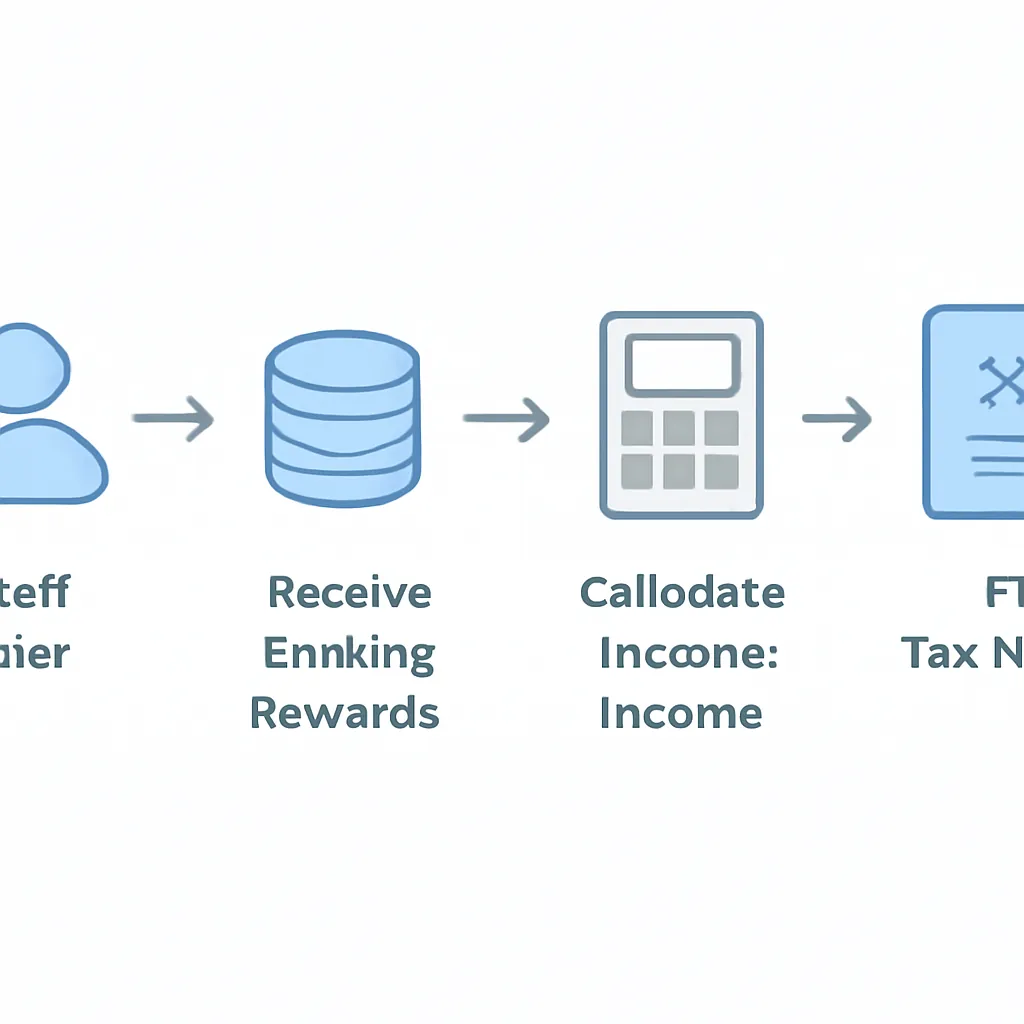
Yes, staking is taxable in Japan. The question of whether staking rewards constitute income at receipt or only when sold has been debated in several jurisdictions, but Japan's NTA treats staking rewards as miscellaneous income at the moment they are received. You must record the yen value of each reward distribution on the date it arrives in your wallet. That value becomes your cost basis for those tokens. If you later sell the staked tokens at a higher price, the gain above that cost basis is taxed again as a further disposal.
Double Taxation Risk
This means staking can result in two layers of tax: income tax on receipt of the reward, and a gain on disposal when you eventually sell. If the token price falls significantly between the date you receive the reward and the date you sell, you could end up having paid income tax on a value that no longer exists in your portfolio. This is a structural challenge of the Japanese approach and one that catches many stakers off guard.
Whether you are staking ETH through a liquid staking protocol or participating in proof-of-stake validation directly, the treatment is the same. The frequency of reward distribution matters for record-keeping: protocols that distribute rewards daily or continuously require a daily log of yen valuations, which is practically impossible to reconstruct manually after the fact.
Staking Activities Tax Table
| Staking Activity | Taxable Event | Basis for Calculation |
|---|---|---|
| Receiving staking rewards | Yes, miscellaneous income | Yen value at date of receipt |
| Selling staked tokens | Yes, capital disposal | Sale price minus cost basis |
| Locking tokens (no reward yet) | No event at lock-up | Original cost basis carries forward |
How Are DeFi Rewards Taxed Alongside NFTs and Airdrops
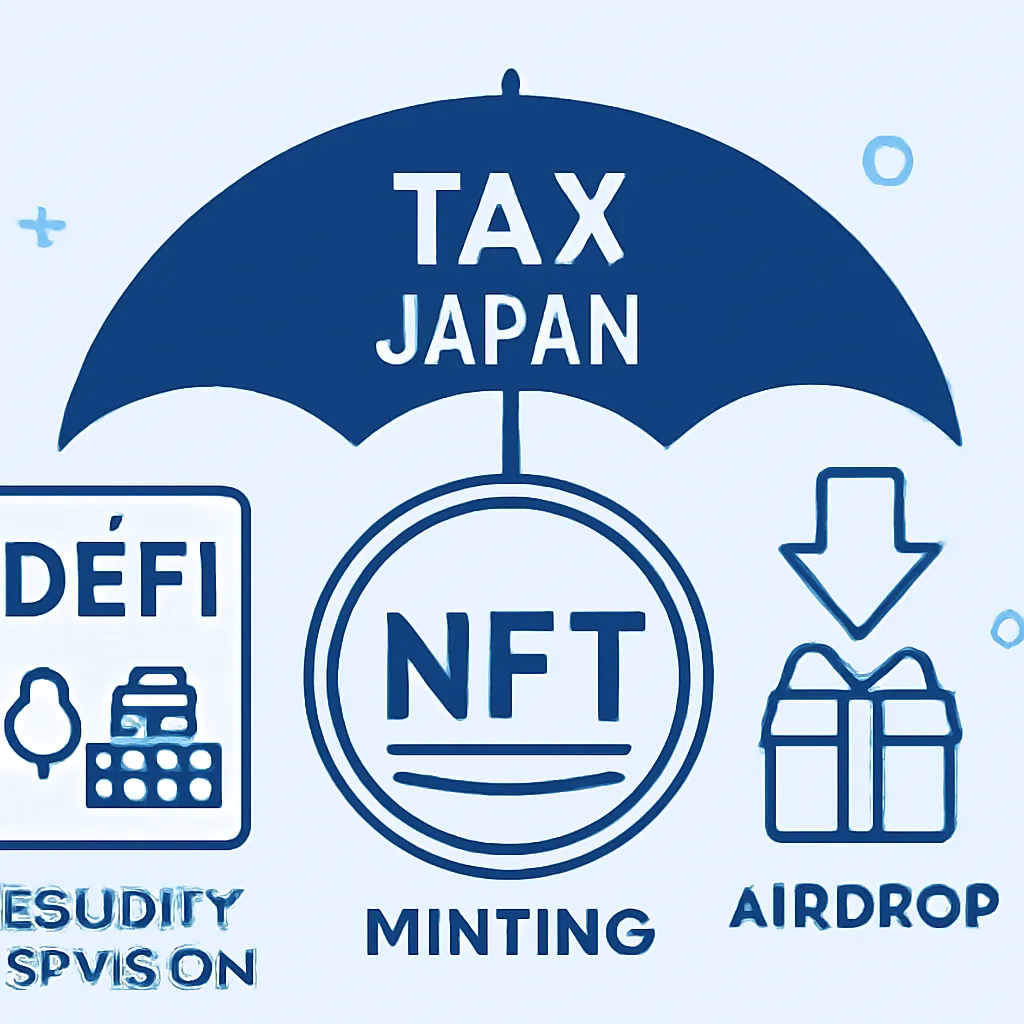
How are DeFi rewards taxed when they arrive as NFTs or airdropped tokens rather than straightforward staking yields? The answer in Japan is consistent: any asset received for free or as a reward is miscellaneous income at its fair market value on the date of receipt. For airdrops, if the token is listed on an exchange at the time of receipt, the NTA expects you to use the observable market price. If no price exists yet because the token has not been listed, there is genuine ambiguity, but a prudent approach is to record the event and apply a nil value, then report any gain when you eventually sell based on the actual proceeds.
NFT Tax Treatment
NFT tax in Japan follows the same miscellaneous income framework. If you sell an NFT for more than you paid to create or acquire it, the profit is miscellaneous income. If you are an artist minting and selling NFTs regularly, the NTA may reclassify your activity as business income, which carries different deduction rules. Gas fees paid during minting or purchase can generally be added to the cost basis of the NFT, which reduces the eventual taxable gain.
Crypto Trading Tax Events
Crypto trading tax applies whenever you swap one cryptocurrency for another, sell crypto for yen, or use crypto to purchase goods or services. Every swap on a DEX is treated as two events: a disposal of the token you gave up, and an acquisition of the token you received. Both must be recorded at yen values on the transaction date.
Record-Keeping Requirements and Common Mistakes
Japan's tax year runs from 1 January to 31 December. The filing deadline for individual income tax is 15 March of the following year. You are required to self-assess your DeFi and crypto income within that window. The NTA does not receive automatic reports from DeFi protocols in the way that traditional brokers report to regulators, but this does not mean DeFi activity is invisible. Blockchain data is public and the NTA has demonstrated awareness of crypto activity through its guidance updates over recent years.
Common DeFi Tax Mistakes
The most common mistakes made by DeFi users in Japan include: failing to record every swap as a disposal, using incorrect or inconsistent yen conversion rates, applying the wrong cost-basis method, omitting LP reward income, and not accounting for gas fees. Gas fees paid on Ethereum or other networks can sometimes be deducted as an expense against your miscellaneous income, but only if they are directly related to income-producing activity. Personal transaction fees are not always deductible.
Keeping a transaction log that records the date, type of event, token amounts, yen value at the time, and the resulting gain or loss for every single on-chain interaction is the minimum standard you should aim for. Manual spreadsheets work for small volumes. For anyone active across multiple protocols, wallets, and chains, automated tools become necessary rather than optional.
Illustrative Scenario
This scenario is illustrative. It does not describe a real person or client, and the figures are examples only.
To illustrate how this applies in practice, consider the following scenario:
Kenji is a software engineer in Tokyo. He has been earning staking rewards on a proof-of-stake network throughout the year and also provided liquidity to a popular DEX, collecting reward tokens over several months. In January he begins trying to reconstruct his tax position manually. He has records of his ETH wallet but his DeFi interactions span three chains and two hardware wallets. He cannot find yen valuations for every reward distribution date, and he is unsure whether his LP deposits counted as taxable disposals at the time he made them.
After connecting all his wallet addresses to CryptaTax, Kenji's full transaction history is imported automatically. The platform applies the moving average cost-basis method consistently, converts every event to yen using historical rates, and flags each staking reward as miscellaneous income at receipt. His LP entry and exit points are identified as disposal events with the correct valuations applied. By the time he reaches the filing deadline on 15 March, he has a complete income summary and a reconciled cost-basis report that he can hand directly to his accountant. What he thought would take weeks took an afternoon.
Frequently Asked Questions
Is DeFi income taxable in Japan?
Yes. The NTA treats DeFi income, including rewards from staking, liquidity pools, yield farming, and airdrops, as miscellaneous income. It is taxed at your marginal rate combined with inhabitant tax, with a potential combined rate of up to 55%. You must report it in your annual self-assessment filing.
Is staking taxable in Japan?
Yes, staking is taxable in Japan. Staking rewards are treated as miscellaneous income at the point they are received. You must record the yen value of each reward on the date it arrives. When you later sell those staked tokens, any gain above the recorded cost basis is taxed again as a separate disposal event.
How are DeFi rewards taxed when I receive them as tokens?
Any token received as a reward, whether from staking, yield farming, or a liquidity pool, is miscellaneous income at its yen fair market value on the date of receipt. That value also becomes your cost basis for those tokens. A subsequent sale triggers a second taxable event based on the difference between the sale price and that cost basis.
What is the crypto trading tax rate in Japan?
Crypto trading gains are classified as miscellaneous income and taxed at your marginal national income tax rate plus a 10% inhabitant tax. The combined effective rate can reach up to 55% for high earners. There is no flat capital gains rate or annual exemption for crypto in Japan.
Does swapping tokens on a DEX trigger tax in Japan?
Yes. Every token swap on a decentralised exchange is treated as a disposal of the token you gave up and an acquisition of the token you received. The NTA requires you to record both sides of the trade at their yen values on the transaction date and calculate any gain or loss on the disposed token.
What is the NFT tax treatment in Japan?
NFT tax in Japan falls under the miscellaneous income framework. If you sell an NFT for more than its acquisition or creation cost, the profit is taxable as miscellaneous income. Gas fees paid during minting or purchase can generally be added to your cost basis, reducing the eventual taxable gain. Regular NFT sellers may be reclassified as business income earners.
Is a crypto airdrop taxable in Japan?
Yes. Crypto airdrop tax applies at the point of receipt. If the airdropped token has an observable market price, that yen value is your income. If no listed price exists yet, the event should still be recorded. Any gain realised when you later sell the airdropped tokens is a separate taxable disposal.
What are the deadlines for filing crypto tax in Japan?
The Japanese tax year runs from 1 January to 31 December. The self-assessment filing deadline for individual income tax, including crypto and DeFi income, is 15 March of the following year. Late filing can attract penalties and interest, so starting your reconciliation well before the deadline is advisable.
Can I deduct gas fees from my DeFi tax liability in Japan?
Gas fees directly related to income-producing DeFi activity can generally be treated as an expense against your miscellaneous income, which reduces your taxable amount. Fees for purely personal transactions are less clearly deductible. Keeping a record of every gas fee paid and the transaction it relates to is essential to support any deduction claim.
What records do I need for DeFi tax reporting in Japan?
You need a complete log of every on-chain event: date, transaction type, token amounts in and out, yen value at the time, and the resulting gain or loss. You must also record which cost-basis method you are using and apply it consistently. For active DeFi users, automated software is the only practical way to maintain these records accurately across multiple wallets and chains.
Source: CryptaTax