
NFT Tax in the US: What You Actually Owe
NFT tax is one of the most searched and least understood topics for US crypto holders right now. If you bought, sold, minted, or received an NFT at any point during a tax year, the IRS expects you to account for it. The rules are not as exotic as many people assume. The IRS treats NFTs as property, the same broad category that covers Bitcoin and Ethereum. What changes is how you acquired the NFT, how long you held it, and what you did with it. Each of those facts determines whether you face a capital gain, ordinary income, or potentially both. This guide walks through every common scenario a US individual filer is likely to encounter, including how crypto trading tax principles carry over to NFTs, how DeFi tax interacts with NFT platforms, and whether staking rewards tied to NFT ownership count as taxable income.
How the IRS Classifies NFTs for Tax Purposes
The IRS issued guidance in 2023 clarifying that certain NFTs may qualify as collectibles under Section 408(m) of the Internal Revenue Code. That distinction matters because collectibles held for more than one year are taxed at a maximum long-term capital gains rate of 28 percent rather than the lower rates that apply to standard capital assets. The IRS applies a look-through analysis: if the underlying asset an NFT represents, such as a piece of physical art or a gem, would itself be a collectible, then the NFT inherits that classification. If the underlying asset would not be a collectible, the NFT is taxed like any other capital asset. For most profile-picture projects, gaming items, and utility tokens structured as NFTs, the standard capital gains rates apply. The practical takeaway is that you cannot assume all NFTs are identical for tax purposes. You need to consider what the NFT actually represents before applying a rate.
Collectibles Classification and Tax Rates
| NFT Type | Likely IRS Classification | Max Long-Term Rate |
|---|---|---|
| Art NFT (underlying art is a collectible) | Collectible | 28% |
| Gaming item / utility NFT | Standard capital asset | 20% |
| NFT backed by non-collectible asset | Standard capital asset | 20% |
Buying and Selling NFTs: NFT Tax on Capital Gains
When you sell an NFT, you trigger a taxable event. The gain or loss is calculated as the difference between your sale proceeds and your cost basis. Your cost basis is what you paid to acquire the NFT, including any gas fees you paid at the time of purchase, because those fees are a necessary cost of acquisition. If you held the NFT for twelve months or less before selling, any gain is short-term and taxed at your ordinary income rate, which can be as high as 37 percent depending on your total income. Hold for more than twelve months and the gain becomes long-term, attracting the lower rates described above.
Dual Taxable Events When Using Crypto
Paying for an NFT using ETH or another cryptocurrency creates a second taxable event on the crypto itself. When you spend ETH to buy an NFT, you are disposing of that ETH at its current fair market value. If your ETH has appreciated since you acquired it, you realise a capital gain on the ETH at that point. This is the same principle that governs all crypto trading tax in the US: spending crypto is treated as a sale. Many buyers overlook this and then face a surprise gain calculation when they file. Keeping a clear record of the ETH price at the exact moment of each NFT purchase is therefore essential.
Minting NFTs and the Tax Implications
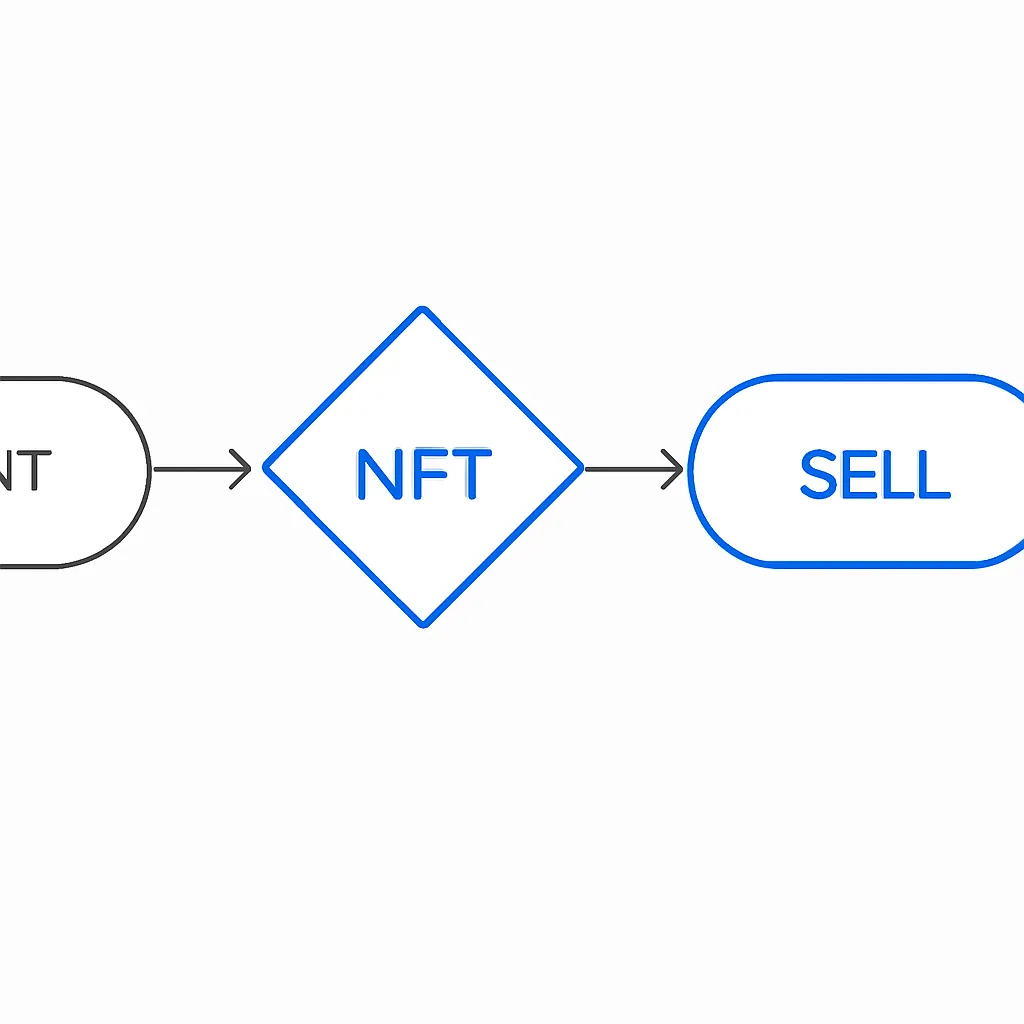
Minting an NFT is not automatically a taxable event. Creating an NFT and placing it in your wallet does not produce income by itself, because you have not received anything of value from a third party. The tax clock starts running from the date you mint, which becomes your acquisition date for holding period purposes. Gas fees paid during minting can be added to your cost basis, reducing the gain when you eventually sell.
Tax Treatment for NFT Creators
The picture changes if you are a creator who mints NFTs and sells them as part of a trade or business. In that situation, proceeds from primary sales are likely ordinary income rather than capital gain. The IRS looks at the frequency of activity, the intent to profit, and whether the activity resembles a business. An artist who mints and sells dozens of NFTs per year is more likely to be treated as self-employed than a hobbyist who mints one piece for personal reasons. Self-employment tax at 15.3 percent on net earnings applies on top of ordinary income tax for those classified as running a business, which significantly changes the total tax picture.
Royalties, Secondary Sales, and Ongoing Income
Many NFT smart contracts pay the original creator a royalty each time the NFT changes hands on the secondary market. These royalty payments are taxable as ordinary income in the year you receive them. They are not capital gains because you are not selling a capital asset at that point. You are receiving compensation for an ongoing contractual right built into the token. If you receive royalties regularly, you may need to make quarterly estimated tax payments to avoid an underpayment penalty at year end.
Taxation of Royalty Payments
The recipient of a royalty payment denominated in cryptocurrency must convert it to USD at the fair market value on the date received. That converted figure becomes your income, and it also becomes the cost basis of the crypto you now hold. If you later sell that crypto, you calculate a further gain or loss from that basis. Tracking the receipt date and the USD value of each royalty payment is the minimum record-keeping required to file accurately.
| NFT Activity | Tax Treatment | Rate Category |
|---|---|---|
| Selling an NFT held under 12 months | Short-term capital gain | Ordinary income rates (up to 37%) |
| Selling an NFT held over 12 months | Long-term capital gain | 0%, 15%, or 20% (or 28% if collectible) |
| Minting and selling as a business | Ordinary income plus self-employment tax | Up to 37% + 15.3% SE tax |
| Creator royalties received | Ordinary income | Up to 37% |
| Spending ETH to buy an NFT | Capital gain on the ETH disposed | Short or long-term depending on hold period |
DeFi Tax, Staking, and NFT-Adjacent Income
NFT ownership increasingly intersects with broader DeFi activity. Some NFT projects give holders access to staking mechanisms where locking the NFT or associated tokens generates yield. Understanding how DeFi rewards are taxed is therefore directly relevant for many NFT holders. The IRS position, reinforced by the 2023 Jarrett case and subsequent agency guidance, leans toward treating newly created tokens from staking as income at the point of receipt. Whether you are asking is staking taxable in the context of an NFT project or a standalone proof-of-stake network, the answer under current IRS practice is generally yes: crypto staking tax applies when you receive the reward tokens, and the taxable amount is their fair market value at that moment.
DeFi Rewards and Staking Income
DeFi tax extends to liquidity provision, lending, and yield farming that some NFT platforms facilitate. If an NFT grants access to a DeFi protocol and you earn tokens through that protocol, those tokens are income when received. How DeFi rewards are taxed follows the same property-as-income logic the IRS applies everywhere else in crypto. There is no special exemption because the income arrived through an NFT-gated mechanism rather than a direct wallet interaction. The cost basis of received reward tokens is their fair market value on the day of receipt, and any subsequent disposal triggers a separate capital gain or loss calculation.
Crypto Airdrops Connected to NFT Holdings
Crypto airdrop tax is another area where NFT holders often get caught out. Projects frequently airdrop governance tokens or new assets to NFT holders as a reward for ownership. The IRS treats airdrops as ordinary income at the fair market value of the tokens on the date you gain dominion and control over them, which is typically when they land in your wallet and you have the ability to transfer or sell them. Receiving an airdrop you did not ask for does not make it tax-free. The moment it is in your wallet and accessible, you have income.
Valuation and Record-Keeping for Airdrops
The key record to keep is the date of receipt and the USD value of each airdropped token at that moment. If the token has no established market value on the day of the airdrop, the IRS guidance suggests it may be valued at zero until a market price is established, but this is a nuanced area and professional advice is worth seeking if large values are involved. When you eventually sell those airdropped tokens, your basis is the income amount you already recognised, so you will only pay capital gains tax on any additional appreciation above that point.
Record-Keeping and Filing Obligations
The record-keeping burden for NFT holders is real but manageable with the right tools. For every NFT transaction you need the date of acquisition, the cost in USD at that date including gas fees, the date of disposal, and the proceeds in USD at disposal. For income events such as royalties, staking rewards, and airdrops, you need the date received and the USD fair market value at receipt. These records need to be retained for at least three years from the filing date of the return on which the transaction is reported, and longer if you omit income or file late.
Reporting Capital Gains and Income
Form 8949 is where capital gains and losses from NFT sales are reported, and Schedule D summarises the totals. Income from royalties, staking, and airdrops flows to Schedule 1 as other income, or to Schedule C if you are operating a business. The question on Form 1040 asking whether you received, sold, or exchanged digital assets must be answered honestly. Answering no when you had active NFT transactions is a compliance risk that is not worth taking. CryptaTax automates the aggregation of transaction data from wallets and exchanges, calculates gains and income figures, and pre-populates the relevant forms, reducing both the time and the error rate involved in filing.
Illustrative Scenario
This scenario is illustrative. It does not describe a real person or client, and the figures are examples only.
To illustrate how this applies in practice, consider the following scenario: Michael is a freelance graphic designer based in Austin, Texas. During a single tax year he minted three NFTs from personal artwork, sold two of them on a secondary marketplace, received ETH royalties twice from a piece he had sold the previous year, and received an airdrop of governance tokens because he held a specific NFT in his wallet. Each of these events had a separate tax consequence. The NFT sales generated capital gains calculated from his gas-inclusive cost basis. The royalties counted as ordinary income in the amounts received, converted to USD on each receipt date. The airdrop was also ordinary income at the fair market value when it hit his wallet. Michael had also spent ETH to purchase a fourth NFT, realising a small capital gain on that ETH because it had appreciated since he bought it. Faced with four different tax event types across a single year, Michael used CryptaTax to connect his MetaMask wallet and the marketplace APIs. The software identified each transaction type, assigned the correct tax treatment, and generated a ready-to-review Form 8949 and Schedule 1 summary, cutting his preparation time significantly and giving him confidence that nothing was missed.
Frequently Asked Questions
Is selling an NFT taxable in the US?
Yes. Selling an NFT is a taxable disposal of property. You calculate the gain or loss as the difference between your sale proceeds and your cost basis. Gains are either short-term or long-term depending on how long you held the NFT before selling.
What is the NFT tax rate for long-term gains?
For NFTs classified as standard capital assets, the long-term rate is 0 percent, 15 percent, or 20 percent depending on your total income. For NFTs classified as collectibles under the IRS look-through rule, the maximum long-term rate is 28 percent. Short-term gains are taxed at ordinary income rates regardless of NFT type.
Do I owe tax when I mint an NFT?
Minting an NFT for yourself is generally not a taxable event because you are not receiving anything of value from a third party. Gas fees paid during minting can increase your cost basis, reducing the gain when you sell. If you are minting as part of a business, the rules around self-employment income may apply to your sales proceeds.
How are DeFi rewards taxed if they come through an NFT project?
DeFi rewards generated through NFT-gated staking or liquidity mechanisms are treated as ordinary income at the fair market value of the tokens on the date you receive them. The mechanism that delivered the reward does not change the tax treatment. You then hold those tokens with a cost basis equal to the income you recognised, and any later sale creates a separate capital gain or loss.
Is staking taxable when an NFT grants access to a staking pool?
Under current IRS practice, crypto staking tax applies when you receive new tokens as a reward, regardless of how you gained access to the staking pool. The taxable amount is the fair market value of the reward tokens at the time of receipt. Your holding period for those tokens starts from the date you received them.
How is a crypto airdrop taxed if I received it because I held an NFT?
Crypto airdrop tax applies when you receive tokens and have the ability to access or transfer them. The taxable amount is the fair market value of the tokens on the date you gained control. The fact that the airdrop was triggered by NFT ownership rather than a direct opt-in does not create an exemption from income tax.
Does buying an NFT with ETH create a taxable event on the ETH?
Yes. Spending cryptocurrency to purchase an NFT is treated as a disposal of that cryptocurrency at its current fair market value. If your ETH has appreciated since you acquired it, you realise a capital gain on the ETH at that moment. This applies to any crypto used as payment, not just ETH.
What forms do I use to report NFT taxes?
Capital gains and losses from NFT sales are reported on Form 8949 and summarised on Schedule D. Income from royalties, airdrops, and staking rewards is typically reported on Schedule 1 as other income, or on Schedule C if your NFT activity qualifies as a business. The digital assets question on Form 1040 must also be answered accurately.
How does crypto trading tax apply if I frequently flip NFTs?
Frequent NFT flipping follows the same crypto trading tax rules as other digital assets. Each sale is a separate taxable disposal. If you are buying and selling in high volume with a profit motive, the IRS may treat the activity as a business, converting gains to ordinary income and adding self-employment tax obligations on net earnings.
How long do I need to keep NFT transaction records?
The IRS generally requires you to retain records for at least three years from the filing date of the return that includes those transactions. If you significantly underreport income, the period extends to six years. Keeping wallet addresses, transaction hashes, dates, and USD values at the time of each event gives you the evidence needed to support your return if questioned.
Source: CryptaTax