
DeFi Tax in Singapore: What You Owe on Staking, Trading and NFTs
DeFi tax in Singapore is not as simple as "crypto is tax-free here." That claim circulates widely, and it contains a grain of truth, but it misses most of the picture. The Inland Revenue Authority of Singapore (IRAS) does not impose capital gains tax, which means a straightforward buy-and-hold trade that turns a profit is generally outside the tax net. But the moment you start earning rewards through staking, providing liquidity, receiving airdrops, flipping NFTs, or trading with enough frequency that IRAS considers you to be in the business of trading, the position changes. Income tax can apply, and the burden is on you to understand the difference. This guide walks through each major DeFi activity, explains the tax treatment IRAS is most likely to apply, and tells you what records you need to keep. Whether you are a casual yield farmer or an active on-chain trader, getting this right before you file is far easier than explaining it afterwards.

How Singapore Taxes Crypto: The Core Framework
Singapore operates a territorial tax system with no capital gains tax. For most passive investors who simply buy and sell cryptocurrency, gains fall outside income tax because they are capital in nature. IRAS has confirmed this general principle, but it has also been clear that the character of a gain depends on the facts, not the asset class. If your activity looks like a trade, IRAS will treat the profits as trading income, subject to income tax at your applicable rate.
Capital Gains vs Income Receipts
The key distinction IRAS draws is between capital gains (not taxable) and income receipts (taxable). When you receive crypto as payment for services, as a reward for activity, or as a regular return on a position, that receipt is more likely to be treated as income. The value of the crypto at the point of receipt is what matters for calculating the taxable amount, and that figure is translated into Singapore dollars using the exchange rate at that time. This framework underpins every DeFi activity discussed below.
Singapore residents are taxed on income arising in or derived from Singapore, as well as foreign income remitted to Singapore in certain circumstances. For most retail DeFi users, the practical question is whether the income is taxable at all, not where it arises. The table below summarises the general positions before diving into each activity in detail.
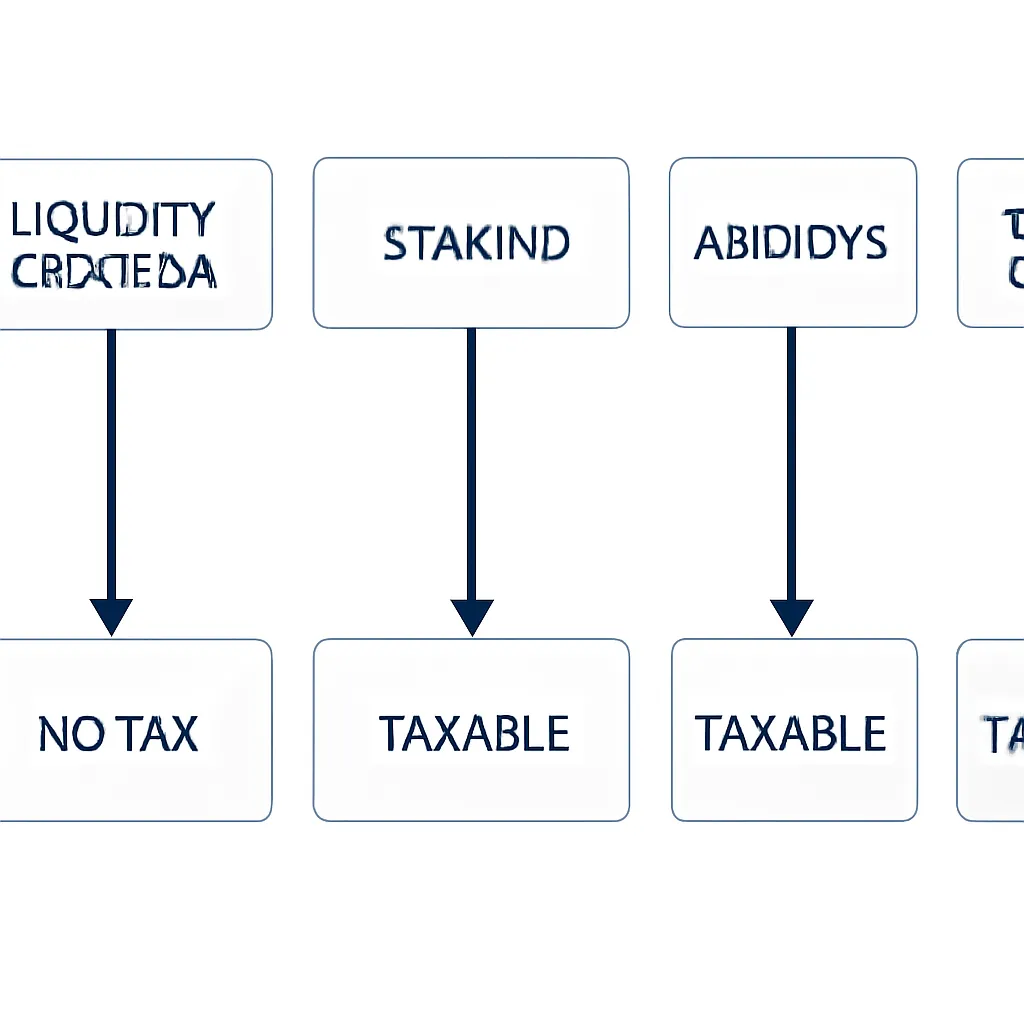
Summary Table of Tax Positions
| DeFi Activity | Likely Tax Character | Taxable in Singapore? |
|---|---|---|
| Buying and holding crypto (capital intent) | Capital gain | Generally no |
| Frequent trading (business intent) | Trading income | Yes |
| Staking rewards | Income receipt | Generally yes |
| Liquidity pool rewards / yield | Income receipt | Generally yes |
| Airdrops (unsolicited) | Potentially nil on receipt; gain on disposal | Depends on facts |
| NFT sales (investment intent) | Capital gain | Generally no |
| NFT sales (trading intent) | Trading income | Yes |
Crypto Trading Tax: When Profits Become Taxable Income
Crypto trading tax applies when IRAS determines that your activity constitutes a trade rather than a capital investment. There is no bright-line rule, but IRAS uses a set of indicators, often called the badges of trade, to make this assessment. These include the frequency of transactions, the length of time assets are held, whether the activity is financed by borrowing, whether the taxpayer has expertise in the area, and whether the activity resembles how a professional trader operates.
Badges of Trade Assessment
A Singapore resident who makes occasional purchases and holds for months or years is unlikely to be treated as a trader. Someone who executes dozens of trades each week, uses leverage, and treats the activity as a primary income source is in very different territory. The profits on each disposal would be treated as trading income and taxed accordingly.
Cost Basis and Record-Keeping
Where trading income is established, cost basis matters enormously. The gain on each trade is the disposal proceeds minus the allowable cost. Singapore does not mandate a specific cost basis method, but you need to apply your chosen method consistently and be able to demonstrate it to IRAS. Poor record-keeping is one of the most common reasons crypto traders end up in difficulty, not because the tax owed is large, but because they cannot reconstruct their position.
Crypto Staking Tax and Whether Staking Is Taxable
Crypto staking tax is one of the most commonly misunderstood areas in Singapore. Is staking taxable? In most practical scenarios, yes. When you stake tokens and receive rewards in return, those rewards represent a return on your activity and are generally treated as income in the period they are received. The taxable value is the Singapore dollar equivalent of the tokens at the time they arrive in your wallet.
Tax Point at Receipt
This matters because the tax event occurs at receipt, not at the point you eventually sell the staking rewards. If you receive 10 tokens as a staking reward when each token is worth SGD 50, you have SGD 500 of income to declare. If those tokens later rise to SGD 80 each and you sell them, the additional SGD 300 gain may be capital in nature if you are not a trader, though the original SGD 500 remains income regardless.
Liquid and Locked Staking
Liquid staking and delegated staking through third-party protocols follow the same logic. The tax point is receipt of the reward tokens. Locked staking, where rewards accumulate but are not accessible until a set date, is slightly more nuanced: IRAS has not issued specific guidance on this, so a conservative approach would treat the rewards as income when they are constructively received, meaning when you have a legal right to access them.
Staking Tax Table Summary
| Staking Type | Tax Point | Valuation Basis |
|---|---|---|
| Standard / liquid staking | Date tokens received in wallet | SGD market value at receipt |
| Locked staking (rewards inaccessible) | Date of constructive receipt (conservative) | SGD market value when accessible |
| Validator node rewards | Date tokens credited | SGD market value at credit |
How Are DeFi Rewards Taxed: Liquidity Pools and Yield
How are DeFi rewards taxed when they come from liquidity pools, lending protocols, or automated yield strategies? The answer follows the same income-receipt principle as staking. If you deposit assets into a liquidity pool and receive fee income or governance tokens in return, that income is taxable on receipt at its SGD value at the time.
Impermanent Loss Complexity
Liquidity provision also creates an additional complexity: impermanent loss. When you withdraw from a pool, the composition of your assets may differ from what you deposited. IRAS has not issued specific guidance on impermanent loss, but the general principle is that any disposal of a crypto asset could trigger a tax event if you are classified as a trader. For non-traders, the withdrawal and recomposition may be capital in nature. Keeping precise records of what you deposited, what you withdrew, and the values at each point is essential.
Auto-Compounding and Yield Aggregators
Yield aggregator protocols that automatically compound returns add another layer. Each auto-compounding event may or may not constitute a receipt depending on the protocol mechanics. If the protocol mints new tokens to represent your compounded position, that could be a taxable receipt. If it simply increases the underlying balance, the position is less clear. Given IRAS has not ruled on this directly, documenting your approach and applying it consistently is the safest path.
Crypto Airdrop Tax: Free Tokens Are Rarely Free
Crypto airdrop tax in Singapore depends on why the airdrop was received. IRAS guidance suggests that a completely unsolicited airdrop, where you receive tokens simply for holding another asset and took no action to obtain them, may not be taxable on receipt. In that case, the cost basis of the airdropped tokens could be treated as zero, and any gain on eventual disposal would be assessed on the full proceeds (though again, likely capital and outside the tax net for a passive holder).
Action Required Airdrops Taxable
The position changes when the airdrop requires action on your part. If you received tokens because you completed a task, participated in a protocol, referred users, or met a qualifying condition, IRAS is more likely to treat the receipt as income. The value of the tokens at the time of receipt becomes taxable income, and the tokens then have a cost basis equal to that amount for any future disposal calculation.
Retroactive Airdrops Grey Zone
Retroactive airdrops from protocols you used historically sit in a grey zone. The safest position is to treat the tokens as income on receipt, valued at the market price at that point, unless you have specific grounds to argue otherwise. Keeping records of the airdrop date, the number of tokens received, and the price at that time is non-negotiable.
NFT Tax in Singapore: Art, Collectibles and Trading
NFT tax follows the same capital versus income framework as other crypto assets. If you buy an NFT as a long-term investment or collectible and sell it later at a profit, IRAS is likely to treat the gain as capital, which is not taxable in Singapore. The challenge arises when the pattern of activity suggests trading rather than investing.
Trading vs Investing in NFTs
An individual who regularly buys and sells NFTs, particularly with a short holding period, for profit generation rather than collection, may be viewed as carrying on a trade in NFTs. In that case, profits are trading income and fully taxable. Creators who mint and sell NFTs as part of an ongoing business are also clearly within the income tax net: the proceeds are business income, and costs of creation are deductible expenses.
Royalties and Creator Income
Royalties received from secondary sales of NFTs you have created are income and taxable in the period received. The SGD value at the date of receipt is the relevant figure. For buyers who later receive royalty-like distributions from an NFT they hold (some projects share protocol revenue with holders), the same income receipt principle applies.
Illustrative Scenario
This scenario is illustrative. It does not describe a real person or client, and the figures are examples only.
To illustrate how this applies in practice, consider the following scenario: Priya is a software engineer based in Singapore who has been active in DeFi for two years. She holds ETH and stakes it through a liquid staking protocol, receiving staking rewards monthly. She also provided liquidity to a decentralised exchange and received fee rewards, and she received a retroactive governance token airdrop from a protocol she used in the past. She has never sold her original ETH holdings and considers herself a long-term investor, not a trader.
Priya's staking rewards and liquidity pool fees are income in the periods she received them, valued in SGD at the relevant market prices. Her airdrop, received after using the protocol, is also likely taxable income on receipt given she met a qualifying condition. Her original ETH, held without frequent trading, is more likely capital in nature. When Priya uses CryptaTax to pull together her wallet history, the platform categorises each transaction type automatically, calculates the SGD value at the date of each income receipt, and produces a summary she can take to her tax accountant or use to file her own return. Without that transaction history, reconstructing two years of on-chain activity manually would be both time-consuming and error-prone.

Frequently Asked Questions
Is DeFi taxable in Singapore?
DeFi activity can be taxable in Singapore depending on what you are doing. Singapore has no capital gains tax, so passive investors who simply buy and hold are generally outside the tax net. However, income received through staking rewards, liquidity pool fees, airdrops linked to actions, and NFT trading profits can all be subject to income tax.
Is staking taxable in Singapore?
Yes, staking rewards are generally taxable as income in Singapore. When you receive reward tokens, the taxable amount is their SGD market value at the point of receipt. You declare this as income in the tax year the rewards are received, regardless of whether you sell the tokens.
How are DeFi rewards taxed in Singapore?
DeFi rewards, whether from staking, liquidity provision, yield farming, or protocol incentives, are treated as income receipts by IRAS. The tax is calculated on the SGD value of the tokens when they arrive in your wallet. The tokens then carry a cost basis equal to that value for any future disposal.
What is the crypto trading tax position in Singapore?
If IRAS determines that your crypto buying and selling constitutes a trade rather than passive investment, your profits are treated as trading income and taxed at your income tax rate. Factors such as high transaction frequency, short holding periods, use of leverage, and a profit-focused approach all point toward a trading classification.
Is crypto airdrop tax owed in Singapore?
It depends on how you received the airdrop. Completely unsolicited airdrops may not be taxable on receipt, though any eventual gain on disposal still needs to be considered. Airdrops received because you completed a task or met a qualifying condition are more likely to be treated as taxable income at the market value on the date of receipt.
How does NFT tax work in Singapore?
NFT gains are generally treated as capital and not taxable in Singapore if you bought the NFT as a long-term investment. If you buy and sell NFTs frequently with a profit motive, IRAS may treat this as a trade, making the profits taxable income. Creators who sell NFTs as part of an ongoing activity are clearly within the income tax net.
Do I need to declare crypto income if I never converted to SGD?
Yes. The fact that you hold crypto rather than converting to Singapore dollars does not remove a tax obligation on income receipts. IRAS taxes income when it arises, at its SGD equivalent value at that time. Receiving tokens as staking rewards or fees creates a tax event even if you never sell them.
What records do I need to keep for DeFi tax in Singapore?
You should keep a complete record of every on-chain transaction, including the date, the asset received or disposed of, the quantity, and the SGD market price at that time. For income receipts like staking rewards, you need the date and value at receipt. For disposals, you need the proceeds and the original cost basis. IRAS can request records going back five years.
What happens if I made a mistake on a previous tax return?
You can file a voluntary amendment with IRAS. Approaching IRAS proactively before they identify an error is consistently treated more favourably than waiting to be audited. Penalties for honest mistakes made in good faith are lower than those for deliberate omissions. Getting your records in order and seeking advice from a tax professional is the right first step.
Can I deduct transaction fees and gas costs from my DeFi income?
Where you are treated as carrying on a trade or business, expenses that are wholly and exclusively incurred in producing that income, including gas fees, are generally deductible. For passive income receipts such as staking rewards, the deductibility of associated costs is less settled and specific advice from a Singapore tax professional is recommended.
Source: CryptaTax