
NFT Tax Treatment in France: What You Owe on Crypto Tax in France
If you have bought, sold, or traded NFTs in France, you have tax obligations that are easy to overlook. Crypto tax in France applies to a wide range of digital asset transactions, and NFTs sit in a particularly nuanced corner of that framework. The French tax authority, the Direction Générale des Finances Publiques (DGFiP), does not treat all NFT activity the same way. Whether your gains are taxed as capital gains on digital assets, as commercial income, or as something else entirely depends on the nature of the NFT, how you acquired it, and what you did with it. Getting this wrong can mean either overpaying or, worse, filing incorrectly and facing penalties later. This guide explains the rules as they currently stand, who they apply to, and what steps you need to take.
How France Classifies Crypto Assets and NFTs
France introduced a dedicated tax regime for digital assets in 2019, built around the concept of actifs numériques (digital assets). This framework was designed primarily with cryptocurrencies in mind, but its reach extends further. NFTs occupy an ambiguous position because they are not purely fungible tokens, and the DGFiP has acknowledged that their tax treatment depends on what the NFT represents.
For most NFTs bought and sold by private individuals, the French tax authority applies the same flat tax rate that governs other digital asset disposals. However, when an NFT is considered a work of art, a collectible, or a tool used in a commercial or professional activity, different rules can apply. The distinction matters enormously. A digital artwork sold by a collector and the same file sold by the artist who created it are treated very differently under French law. The collector pays tax under the digital asset regime; the creator may be taxed as a professional operating a business.
First Step: Categorize Your NFT Activity
This means your first step is not calculating your gain. Your first step is understanding which category your NFT activity falls into.
The Standard Crypto Tax France Rate for NFT Disposals
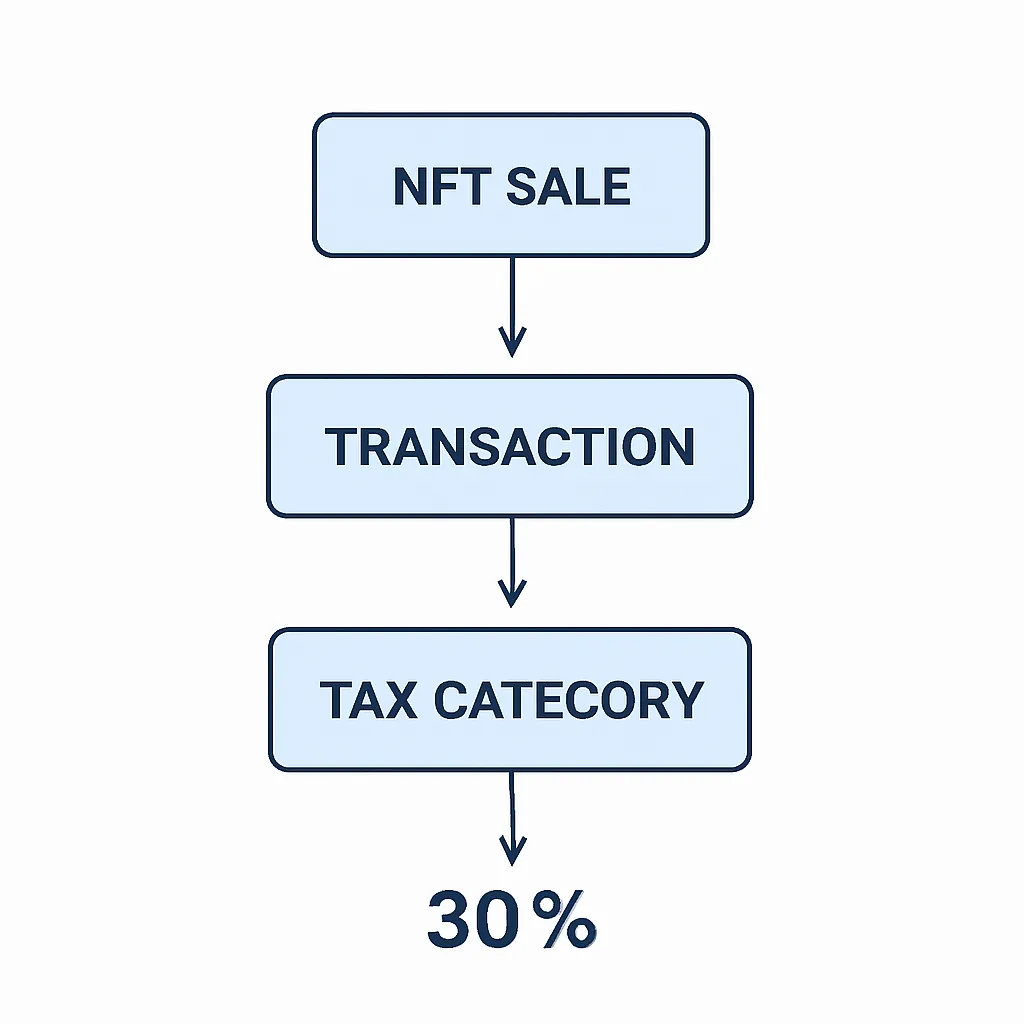
For individual investors and collectors who are not operating as professionals, gains from selling NFTs are generally taxed under the flat tax known as the Prélèvement Forfaitaire Unique (PFU), also called the flat tax. This rate sits at 30%, covering both income tax and social contributions. It applies to the net capital gain realised on the disposal of digital assets, which includes NFTs classified under the actifs numériques framework.
Calculating Net Gain on NFT Disposals
The net gain is calculated by subtracting the acquisition cost and any directly attributable fees from the sale proceeds. If you bought an NFT for a certain amount in ETH and later sold it for more ETH, both the ETH you spent and the ETH you received carry their euro values at the date of each transaction. France taxes the gain in euros regardless of whether you ever converted back to fiat currency. This is a point many NFT holders miss. Swapping one digital asset for another, including swapping ETH for an NFT or an NFT for ETH, is a taxable disposal in France.
Tax Regimes for Different NFT Activities
| Taxpayer Type | Applicable Tax Regime | Rate |
|---|---|---|
| Private individual, occasional NFT sales | PFU flat tax on digital asset gains | 30% |
| NFT artist or creator (professional) | BNC or BIC commercial income | Progressive income tax scale |
| Private individual, NFT qualifies as artwork | Special régime for artworks | 6.5% of sale price (alternative method) |
| Habitual trader (professional status) | BIC industrial and commercial profits | Progressive income tax scale |
When an NFT Might Be Taxed as Artwork in France
France has a longstanding special tax regime for the sale of works of art. Under this regime, a seller can opt to pay a flat levy of 6.5% on the total sale price rather than calculating the actual gain. This option exists because tracking the original acquisition cost of artworks can be difficult, especially for pieces acquired years earlier or inherited.
Does Your NFT Qualify as a Work of Art?
The critical question is whether a digital NFT qualifies as a work of art under French law. French law defines works of art quite specifically, and digital creations have historically sat in a grey area. The DGFiP has not issued sweeping guidance confirming that all NFTs qualify. In practice, an NFT that represents an original digital artwork by a recognised creator may have a stronger case for this classification than a generative profile picture or a gaming item.
If you are selling high-value NFTs that you genuinely believe qualify as artworks under French law, this is a conversation to have with a tax adviser before filing. The 6.5% rate on sale price can be significantly more favourable than 30% on the gain, particularly if the NFT has appreciated substantially. But claiming the wrong regime creates risk, and the DGFiP has the power to reassess.
NFT Creators and Artists: A Different Tax Obligation
If you created the NFTs you are selling rather than buying them as an investor, the analysis changes entirely. An artist or creator selling their own work is not realising a capital gain on an investment. They are generating income from a professional activity. In France, this income is taxed under either the Bénéfices Non Commerciaux (BNC) regime for non-commercial profits or the Bénéfices Industriels et Commerciaux (BIC) regime for commercial and industrial profits, depending on the nature of the creative work.
Income Tax Regimes for NFT Creators
Both regimes apply progressive income tax rates rather than the flat 30% PFU rate. Depending on your total income, this could mean a higher effective rate. It also means different filing requirements, potential VAT obligations if you exceed certain thresholds, and the possibility of deducting business expenses such as software, hardware, or platform fees against your taxable income. The benefit here is that legitimate costs reduce the taxable base. The downside is that the administrative burden is heavier than simply reporting a capital gain.
Royalties Treated as Professional Income
Royalties earned from secondary sales of NFTs, a feature built into many NFT smart contracts, are also treated as professional income for creators. These are not capital gains. They are recurring income from intellectual property, and they are taxed accordingly each time they are received.
How is Crypto Taxed in France: The Reporting Process
Understanding how is crypto taxed in France is one thing. Completing the actual filings is another. French taxpayers report digital asset gains using the standard annual income tax return, specifically the Cerfa 2086 form, which captures the details of each digital asset disposal including acquisition cost, sale proceeds, and net gain. This form feeds into the main tax return.
Reporting Every Disposal and Offsetting Losses
Every single disposal is technically reportable, not just the ones where you made a profit. If you sold an NFT at a loss, that loss can offset gains from other digital asset disposals in the same tax year, reducing your overall taxable gain. Losses cannot be carried forward to future years under the standard digital asset regime, so using them in the year they arise is important.
Declaring Foreign Accounts and Penalties
Taxpayers are also required to declare any foreign accounts or wallets held on overseas platforms, under rules that apply to comptes d'actifs numériques held outside France. Failure to declare these accounts carries significant penalties.
| Transaction Type | Taxable Event in France? | Notes |
|---|---|---|
| Selling an NFT for ETH or another crypto | Yes | Disposal of digital asset, gain calculated in euros |
| Selling an NFT for euros (fiat) | Yes | Standard digital asset disposal |
| Buying an NFT with crypto | Yes (disposal of the crypto used) | The crypto spent is disposed of at market value |
| Receiving an NFT as a gift | No (at receipt), potential gift tax rules apply | Acquisition cost for future disposal is market value at receipt |
| Creator selling their own NFT | Yes, as professional income | BNC or BIC regime, not PFU |
| Royalties from secondary NFT sales | Yes, as professional income | Taxed at progressive rates for creators |
A Brief Look at How Other Countries Compare
France is not the only jurisdiction grappling with NFT tax treatment. Knowing how neighbouring regimes work can be helpful context, particularly for traders who operate across borders or hold accounts in multiple countries.
NFT Tax Treatment in the UK
Crypto tax in the UK is handled by HMRC, which treats NFTs as capital assets subject to Capital Gains Tax. The UK annual exempt amount, tax rates, and reporting thresholds differ from the French system. UK residents pay CGT at rates that depend on their total income for the year, and they benefit from an annual allowance before gains become taxable.
Crypto Tax Rules in India
Crypto tax in India is governed by rules introduced in 2022 that impose a flat 30% tax on gains from virtual digital assets including NFTs, with no deduction for losses from other assets allowed. The India crypto tax calculator landscape has grown rapidly as Indian traders look for ways to accurately track cost basis across exchanges. How is crypto taxed in India also includes a 1% Tax Deducted at Source obligation on transactions above certain thresholds, which has no equivalent in France.
Each jurisdiction has its own mechanics, and the French system, while complex, is not the most punishing. The key in every case is accurate record-keeping from the start.
Illustrative Scenario
This scenario is illustrative. It does not describe a real person or client, and the figures are examples only.
To illustrate how this applies in practice, consider the following scenario:
Sophie is a 34-year-old graphic designer based in Lyon. She is not a professional NFT artist, but she bought three NFTs from an established generative art project during a period of high market interest, spending a total of 1.8 ETH across the purchases. Over the following months, she sold two of the three NFTs for a combined total of 2.6 ETH. At the time of each transaction, she noted the euro-denominated value of the ETH involved using her exchange's historical price data.
When tax season arrived, Sophie used a france crypto tax calculator through CryptaTax to import her wallet transactions and automatically calculate her net euro gain across both disposals. The tool applied the PFU 30% rate to her net gain and generated a pre-filled summary she could use to complete her Cerfa 2086. She also realised the third NFT, still unsold, carried no immediate tax obligation. Because she had kept records from day one, her filing took under an hour. Without those records, reconstructing the euro values would have been time-consuming and potentially inaccurate.
Frequently Asked Questions
Is crypto tax in France the same for NFTs as for Bitcoin or Ethereum?
In most cases for private investors, yes. NFTs classified as actifs numériques are subject to the same 30% PFU flat tax as gains on Bitcoin or Ethereum disposals. The key exception is NFTs that qualify as artworks or that are sold by their creator, both of which can trigger different tax regimes.
Do I pay tax when I buy an NFT with ETH in France?
Yes. Spending ETH to buy an NFT is treated as a disposal of the ETH you used. If that ETH had increased in value since you acquired it, you have realised a taxable gain at the point of purchase. The gain is calculated in euros using the market value of the ETH at the time of the transaction.
Can I offset NFT losses against other crypto gains in France?
Yes, within the same tax year. Losses from NFT disposals can be offset against gains from other digital asset disposals in the same year, reducing your overall taxable gain. Under the standard PFU regime, unused losses cannot be carried forward to future years, so it is important to claim them in the year they arise.
How is crypto taxed in France if I create and sell my own NFTs?
If you are the creator selling your own work, your income is not treated as a capital gain. It is classified as professional income under the BNC or BIC regime, depending on the nature of your activity. This means it is subject to progressive income tax rates rather than the flat 30% PFU rate, but you may be able to deduct legitimate business costs.
Do NFT royalties get taxed in France?
Yes. Royalties received by NFT creators from secondary market sales are treated as professional income, not capital gains. They are taxed each time they are received at progressive income tax rates. Collectors receiving royalties on NFTs they did not create may be assessed differently depending on the circumstances.
Do I need to declare foreign NFT platform accounts to the French tax authority?
Yes. French taxpayers are required to declare accounts holding digital assets on platforms based outside France. This obligation applies even if no transactions occurred during the year. Failure to declare foreign digital asset accounts carries penalties that can be significant.
What is the france crypto tax calculator and how does it help with NFTs?
A france crypto tax calculator is a tool that connects to your wallets and exchange accounts, imports transaction history, converts values to euros at the correct historical rates, and calculates your net gain or loss for the tax year. For NFT traders with multiple transactions across different platforms, this kind of tool substantially reduces the risk of calculation errors and missed disposals.
How does NFT tax in France compare to crypto tax in the UK?
Both countries tax NFT gains as capital assets for private individuals, but the mechanics differ. Crypto tax in the UK uses Capital Gains Tax rates that depend on the taxpayer's total income and includes an annual exempt amount before gains become taxable. France applies a flat 30% PFU rate with no equivalent annual exempt threshold for digital assets. UK taxpayers can also carry forward capital losses to future years, which French taxpayers under the PFU regime cannot.
Is there a threshold below which I do not need to report crypto gains in France?
France does not apply a simple monetary threshold below which digital asset gains are automatically exempt from reporting under the standard regime. The obligation to report disposals exists regardless of the amount, though total annual digital asset sales below a relatively low threshold may qualify for an exemption from the taxable event itself. You should verify the current threshold with the DGFiP or a qualified tax adviser before assuming your activity falls below it.
What records should I keep to support my French NFT tax filing?
You should keep records of every transaction including the date, the NFT or digital asset involved, the euro value of the consideration received and paid at the time of the transaction, any fees paid, and the platform or wallet used. The DGFiP can request supporting documentation during a review, and without clear records, accurate completion of the Cerfa 2086 form is very difficult.
Source: CryptaTax