
Crypto Airdrop Tax in France: Airdrops, Mining, Staking and DeFi
France has one of the more clearly structured crypto tax regimes in Europe, but that clarity can still catch individual holders off guard. If you have received free tokens through an airdrop, earned rewards from mining rigs humming in your living room, collected staking yields, or picked up DeFi income, the French tax authority known as the Direction Générale des Finances Publiques, or DGFiP, has a view on all of it. Crypto airdrop tax is not a single rule but part of a broader framework that distinguishes between income earned through active participation and gains realised when you eventually sell. Getting that distinction right matters, because the wrong classification can mean paying tax twice or, worse, under-reporting and triggering an audit. This guide walks through each category in plain terms so you know where you stand before you file.

How France Classifies Crypto Income: The Starting Framework
French crypto taxation is built around two main categories. The first covers occasional investors who buy, hold, and sell digital assets as part of everyday life. The second covers those whose crypto activity is habitual, professional, or commercially organised. Most individual traders and hobbyists fall into the first category, and their disposal gains are taxed under a flat levy called the Prélèvement Forfaitaire Unique, or PFU, which combines income tax and social charges into a single rate. That rate currently sits at 30%, though taxpayers can opt for the progressive income tax scale if it produces a lower overall bill.
Two-Stage Treatment of Receipts
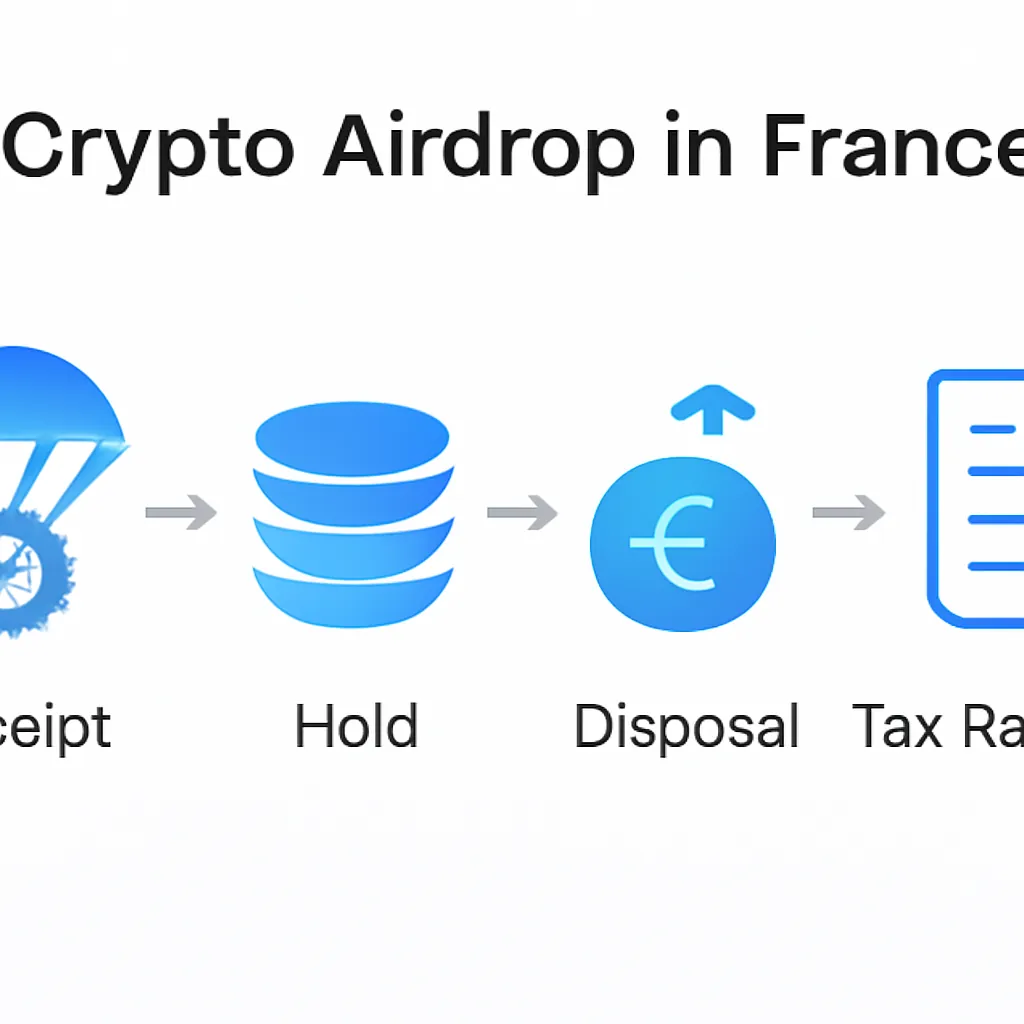
What this framework does not do is automatically treat every crypto receipt as a taxable disposal. Receiving tokens, whether from an airdrop, a mining pool, or a staking protocol, is treated as an income event separate from the capital gain that arises when you later sell those tokens. This two-stage treatment is important. You may owe tax at the moment you receive the tokens, and you may owe tax again when you sell them. Understanding which stage applies to which activity is the foundation of accurate crypto tax reporting in France.
Tax Treatment at a Glance
| Activity | Income Event on Receipt | Tax Category at Disposal |
|---|---|---|
| Occasional crypto trading | No income event on purchase | PFU flat 30% on net gains |
| Airdrop (no service required) | Generally not taxed at receipt | Capital gain taxed at 30% on sale |
| Airdrop (service or task required) | Taxable as non-commercial income (BNC) | Capital gain on subsequent sale |
| Mining income | Taxable as BNC or industrial profits (BIC) | Capital gain on subsequent sale |
| Staking rewards | Taxable as BNC in most cases | Capital gain on subsequent sale |
| DeFi yield / liquidity rewards | Taxable as BNC depending on activity | Capital gain on subsequent sale |
Crypto Airdrop Tax: Free Tokens Are Not Always Tax-Free
Airdrops divide into two broad types, and French tax treatment follows that divide closely. A pure airdrop, where a project deposits tokens into your wallet with no action required on your part, is generally not treated as taxable income at the moment of receipt. You did nothing to earn it, so there is no income to tax yet. Instead, your cost basis in those tokens is set at zero, which means the entire market value at the time you eventually sell them will be subject to capital gains tax at the 30% PFU rate. The gain is simply the sale proceeds minus zero.
Conditional Airdrop Taxation
A conditional airdrop is treated differently. If you had to complete a task such as retweeting a post, joining a community, testing a protocol, or referring another user, then the DGFiP is likely to view the tokens you received as payment for a service. In that case the fair market value of the tokens on the day you received them is taxed as Bénéfices Non Commerciaux, or BNC, which falls under the progressive income tax scale. Your cost basis for any future sale is then set at that taxed value rather than zero, which avoids double taxation on the same amount.
Timing and Reporting Requirements
Timing matters here. If you received a conditional airdrop and did not report the BNC income in the year of receipt, you cannot go back and adjust your cost basis upward when you sell. Accurate record-keeping from day one is the only way to avoid that problem.
Mining Income Tax in France: Hobby Versus Professional
Crypto mining income in France is taxed based on the scale of your operation. An individual mining on a single GPU at home, with no formal business structure and no intention of running a commercial enterprise, is likely to be treated as carrying out a non-commercial activity. The rewards received are taxable under the BNC regime in the year they are received, valued at the market price on the date of receipt. When the mined coins are later sold, any increase in value above the cost basis established at receipt is taxed as a capital gain under the PFU.
Professional Mining and BIC Regime
If your mining operation crosses into professional territory, meaning it is well-organised, generates significant recurring income, and has characteristics of a business, the DGFiP may reclassify it under the Bénéfices Industriels et Commerciaux regime, or BIC. BIC treatment brings different accounting obligations and potentially different deductible expenses. French tax law does not provide a precise revenue threshold for this crossover, so the assessment is qualitative. If you operate multiple rigs, claim depreciation on equipment, or derive a primary income from mining, you should take specialist advice on which regime applies to you.
Is Staking Taxable in France? Understanding Crypto Staking Tax
The question of whether staking is taxable in France has a straightforward answer: yes, in most cases it is. Staking rewards represent a return for locking up tokens to support a blockchain network, and the DGFiP treats that return as income in the year it is received. The applicable regime is generally BNC for individuals who stake outside any formal business structure.
Valuation and Tracking of Rewards
Crypto staking tax applies at the fair market value of each reward on the date it lands in your wallet. If you receive staking rewards weekly or even daily, as many protocols distribute them, that means tracking the euro value of each distribution separately. This is not optional. Each receipt is a distinct taxable event, and the aggregate over the tax year must be declared. When you eventually sell the staked tokens or their rewards, the cost basis is the value you already declared as BNC income, so you pay capital gains only on any appreciation above that point.
Liquid Staking Complexities
Liquid staking through DeFi protocols adds a layer of complexity. Wrapping tokens into a liquid staking derivative may itself constitute a taxable disposal in some interpretations, though the DGFiP has not issued definitive guidance on every variant. This is an area to watch as the regulator publishes further clarifications.
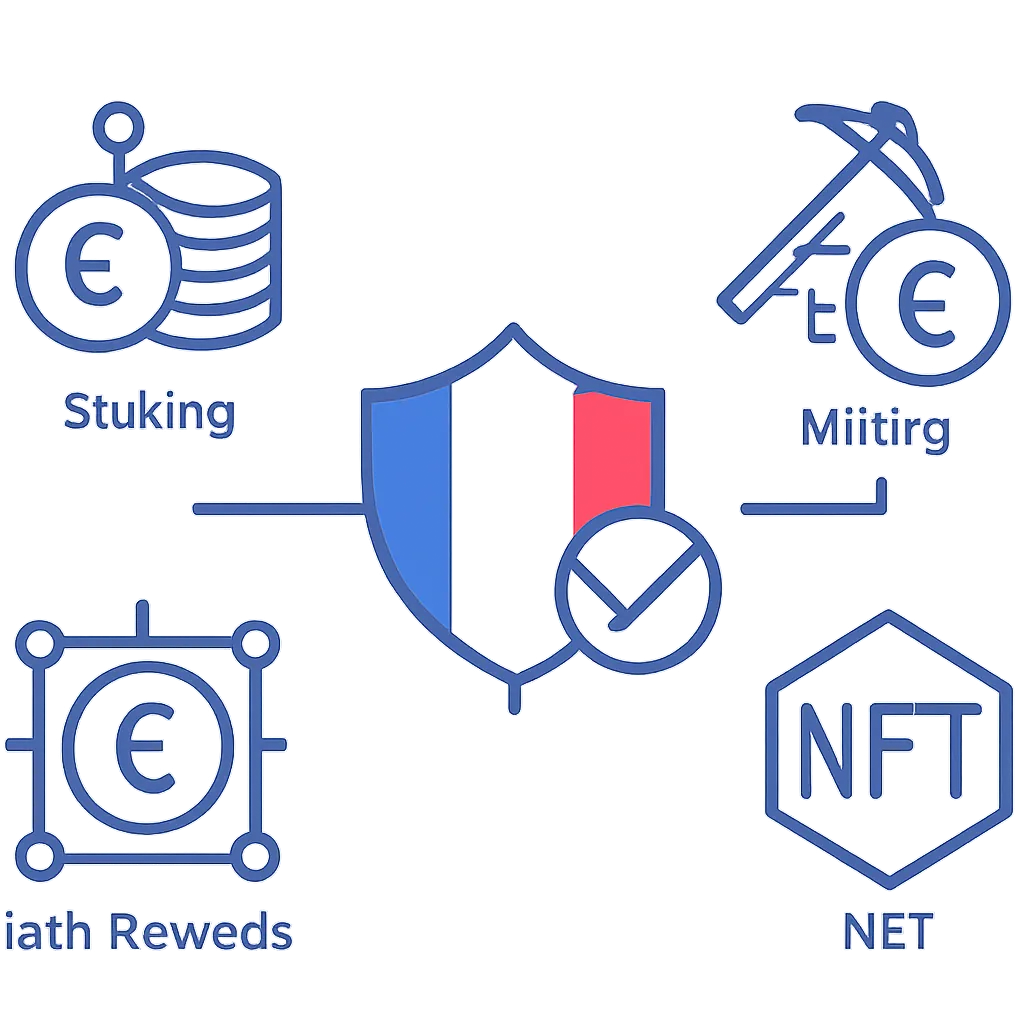
DeFi Tax and NFT Tax: The Grey Areas
How are DeFi rewards taxed in France? The honest answer is that DeFi tax sits in territory where official guidance is still developing, but the general principle is consistent with other income types. If you deposit assets into a liquidity pool and receive fees or governance tokens in return, those receipts are likely taxable as BNC income at the time they are distributed. The same logic applies to yield farming rewards, lending interest paid in crypto, and protocol incentive payments.
NFT Tax for Creators and Collectors
NFT tax in France follows the same two-stage logic as other digital assets. Creating an NFT and selling it for the first time may be treated as commercial income if you are an artist or creator, potentially falling under BIC or even the professional artists regime. For a collector who buys and resells NFTs, the gain on disposal is subject to the 30% PFU in most cases. However, if NFTs are classified as works of art under French law, different rules could theoretically apply. Specialist advice is sensible for high-value NFT portfolios.
Token-to-Token Swaps as Disposals
One consistent theme across DeFi and NFTs is that token-to-token swaps, including swapping one DeFi token for another or exchanging an NFT for crypto, are generally treated as taxable disposals in France. Unlike some jurisdictions, France does not offer a like-for-like exchange exemption for crypto assets.
| DeFi or NFT Activity | Likely Tax Treatment on Receipt | Likely Treatment on Disposal |
|---|---|---|
| Liquidity pool fees received in tokens | BNC income at fair market value | Capital gain at 30% PFU on appreciation |
| Yield farming rewards | BNC income at fair market value | Capital gain at 30% PFU on appreciation |
| NFT sale by collector | No income event on holding | Capital gain at 30% PFU |
| NFT sale by creator (first sale) | Commercial or artistic income (BIC/artists regime) | Varies by classification |
| Token-to-token swap (DeFi) | N/A | Taxable disposal, gain at 30% PFU |
Crypto Trading Tax and Calculating Your Net Gain
For individuals who trade crypto assets occasionally, crypto trading tax in France is calculated on the net gain across all disposals in a tax year. France uses a weighted average cost basis method rather than FIFO or specific identification. Every time you sell, exchange, or spend crypto, you calculate the gain by comparing the proceeds to a proportional slice of your total portfolio cost. This means you need a running record of every acquisition price, the date of acquisition, and the value in euros at that time.
Loss Offsetting and Carryforward Rules
Gains and losses can be offset against each other within the same tax year. If you sold Bitcoin at a profit and sold an altcoin at a loss in the same year, only the net position is subject to the 30% PFU. Losses cannot, however, be carried forward to future years under the standard occasional investor regime, which makes loss harvesting within a single tax year important if you have unrealised losses approaching the year end.
Foreign Account Declaration Obligations
Accounts held on foreign exchanges must be declared separately, even if you have not sold anything. Failing to declare a foreign crypto account carries its own penalties, distinct from any tax underpayment.
Illustrative Scenario
This scenario is illustrative. It does not describe a real person or client, and the figures are examples only.
To illustrate how this applies in practice, consider the following scenario:
Sophie is a freelance graphic designer based in Lyon who has been active in crypto for several years. During one tax year she received tokens through a DeFi protocol airdrop after completing a series of on-chain tasks to qualify, earned staking rewards from a proof-of-stake network she had been participating in since the previous year, and sold a portion of her Bitcoin holdings at a profit. She also swapped some ETH for a DeFi governance token through a decentralised exchange.
Sophie initially assumed the airdrop was tax-free because she had not paid for the tokens. When she reviewed her position ahead of filing, she realised the task-based nature of the airdrop meant the tokens were likely BNC income at receipt. Her staking rewards also needed to be valued in euros on each distribution date, a task she had not tracked through the year. The ETH-to-governance-token swap counted as a taxable disposal, adding an unexpected capital gain.
Using CryptaTax, Sophie imported her wallet transactions and exchange history, which allowed the platform to calculate her BNC income, identify each staking distribution date and euro value, and compute the capital gain on both the Bitcoin sale and the ETH swap. Filing accurately and on time meant she avoided the penalties that come with omitted income, and she now keeps records continuously rather than scrambling at year end.
Frequently Asked Questions
Is crypto airdrop tax always due in France when you receive free tokens?
Not always at the moment of receipt. A pure airdrop where no action was required is generally not taxed until you sell the tokens, at which point the full sale value is treated as a capital gain. A conditional airdrop requiring tasks or services is typically taxed as BNC income in the year of receipt, with your cost basis set at the taxed value.
How is mining income taxed in France for a casual home miner?
A casual home miner is generally taxed under the BNC regime, meaning the fair market value of coins received is declared as income in the year of receipt. When those coins are later sold, any gain above the cost basis established at receipt is subject to the 30% PFU capital gains rate. Larger, commercially organised operations may be reclassified under BIC.
Is staking taxable in France for individual holders?
Yes. Crypto staking tax applies to individual holders in France. Each staking reward is treated as BNC income at its euro value on the date it is received. You must track every distribution separately and declare the total for the tax year. When you eventually sell the staked tokens, only the appreciation above the declared income value is subject to capital gains tax.
How are DeFi rewards taxed in France?
DeFi rewards, including liquidity pool fees, yield farming distributions, and lending interest paid in tokens, are generally treated as BNC income at fair market value when received. The DGFiP has not issued exhaustive guidance on every DeFi structure, but the income-at-receipt principle is consistent across most interpretations. Subsequent disposal of those tokens triggers a capital gain on any appreciation.
Does France tax token-to-token swaps?
Yes. In France, exchanging one crypto asset for another is treated as a taxable disposal, not a like-for-like exchange. The gain or loss is calculated at the point of the swap, based on the euro value of the asset given up versus its cost basis. This applies to DeFi swaps as well as direct exchanges between tokens.
What is NFT tax treatment in France for a collector?
A collector who buys and resells NFTs is generally subject to the 30% PFU on any capital gain at the point of sale. NFT tax becomes more complex for creators selling their own work, where commercial income rules or artistic income regimes may apply instead. High-value NFT portfolios benefit from specialist advice given the evolving guidance in this area.
Can I offset crypto losses against gains in France?
Under the standard occasional investor regime, yes, you can offset losses against gains within the same tax year to arrive at a net position. Only the net gain is subject to the 30% PFU. Losses cannot be carried forward to offset gains in future years under this regime, which makes reviewing your unrealised losses before the year end a sensible step.
What happens if I do not declare a foreign crypto exchange account in France?
French residents are required to declare accounts held on foreign platforms, even if no disposals occurred during the year. Failing to declare a foreign crypto account carries penalties that are separate from any tax underpayment. The obligation applies regardless of whether the account generated taxable income in that year.
What cost basis method does France use for crypto capital gains?
France uses a weighted average cost basis approach. When you sell or dispose of crypto, the cost is calculated as a proportional share of the total portfolio cost rather than using FIFO or specific identification. This means accurate records of every acquisition price and date, in euros, are essential for correct reporting of crypto trading tax.
When is the deadline to file crypto taxes in France?
Crypto gains and income are reported as part of the annual income tax return. The standard filing deadline for French residents falls in the spring following the relevant tax year, with the exact date varying slightly by department and whether you file online or on paper. Online filers in later alphabetical groups typically receive a few additional weeks. Always confirm the current year deadline directly with the DGFiP.
Source: CryptaTax