
DeFi Tax in Australia: What You Actually Owe
DeFi tax in Australia is not a grey area anymore. The Australian Taxation Office has made clear that participating in decentralised finance creates real tax obligations, and ignoring them is not a safe option. Whether you are earning yield on a lending protocol, swapping tokens on a decentralised exchange, staking coins for rewards, or minting NFTs, the ATO expects you to report it. The problem is that DeFi does not produce a tidy end-of-year summary the way a salary does. Transactions are fragmented across wallets, protocols, and blockchains, and many users genuinely do not know which events are taxable until they are already in trouble. This guide walks through the most common DeFi activities Australian taxpayers encounter and explains what the ATO considers a taxable event, how income is classified, and what records you need to keep.

How the ATO Thinks About Crypto and DeFi
The ATO does not treat cryptocurrency as currency. It treats it as a capital gains tax asset under Australian tax law, which means most disposals trigger a CGT event. A disposal includes selling crypto for Australian dollars, swapping one token for another, using crypto to pay for goods or services, and sending crypto to certain DeFi contracts. This framing matters because it means you are potentially triggering a tax event every time you interact with a protocol, not just when you cash out to your bank account.
CGT Events and Ordinary Income
Beyond CGT, the ATO also taxes certain crypto receipts as ordinary income. When you receive tokens as a reward for a service you effectively provided, whether through staking, liquidity provision, or similar activity, that receipt is generally treated as income at the time you receive it. The value used is the Australian dollar value of the tokens at the moment of receipt. Those same tokens then take on a new cost basis, and any future gain or loss when you dispose of them is a separate CGT event.
The ATO has published guidance making clear it can access data from Australian exchanges and is actively matching it against tax returns. The idea that DeFi is somehow invisible to the ATO because it happens on-chain is a dangerous misconception.
Crypto Trading Tax on DEX Swaps and Token Exchanges
Swapping tokens on a decentralised exchange is one of the most common DeFi activities, and it is one that consistently surprises new users. Under Australian tax law, exchanging one cryptocurrency for another is treated as a disposal of the first asset and an acquisition of the second. That means a swap from ETH to USDC, or from any token to any other token, is a CGT event regardless of whether you ever touched Australian dollars.
CGT on Token Swaps
Your capital gain or loss is the difference between the cost base of the token you disposed of and its market value in AUD at the moment of the swap. If you held the token for more than twelve months before the swap, you may be entitled to the 50% CGT discount, which halves the taxable gain. If you held it for less than twelve months, the full gain is included in your assessable income.
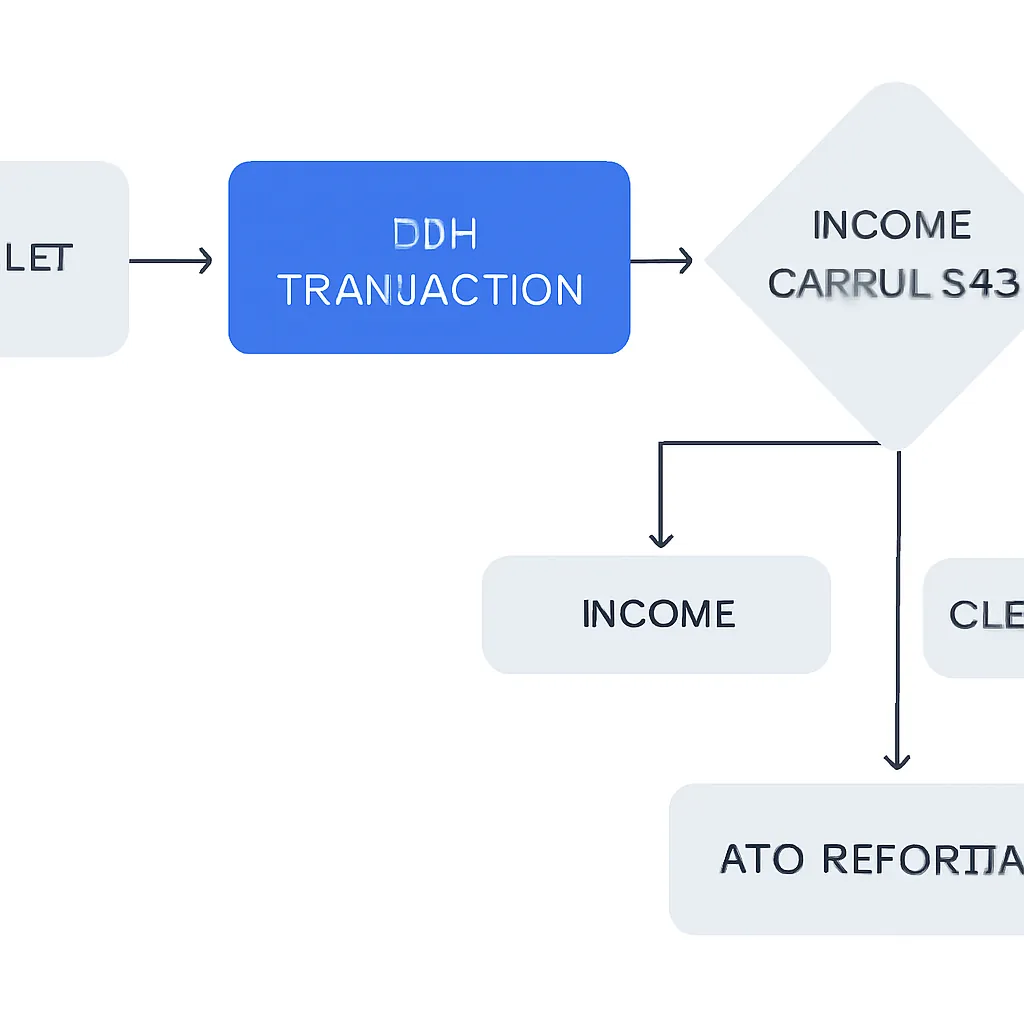
The following table outlines how common DeFi interactions are classified under ATO guidance.
DeFi Activity Classification Table
| DeFi Activity | ATO Classification | Tax Treatment | CGT Discount Eligible? |
|---|---|---|---|
| DEX token swap | Disposal of first asset | Capital gain or loss | Yes, if held 12+ months |
| Staking rewards received | Ordinary income | Taxed at marginal rate on receipt | No (on the reward itself) |
| Liquidity pool rewards | Ordinary income | Taxed at marginal rate on receipt | No (on the reward itself) |
| Airdrop received | Ordinary income (generally) | Taxed at marginal rate on receipt | No (on the airdropped token itself) |
| NFT sale | Disposal of CGT asset | Capital gain or loss | Yes, if held 12+ months |
| Wrapping tokens (e.g. ETH to WETH) | Potentially a disposal | Capital gain or loss if treated as swap | Depends on holding period |
How Are DeFi Rewards Taxed in Australia?
Understanding how DeFi rewards are taxed is essential for anyone earning yield on-chain. The ATO's general position is that if you receive tokens as a reward for participating in a protocol, and that participation resembles providing a service or deploying capital for a return, those tokens are ordinary income when you receive them. This applies to liquidity mining rewards, governance token distributions tied to activity, and most yield-farming returns.
Tax Liability on Receipt
The practical implication is that you owe tax on the AUD value of those tokens on the day you receive them, whether or not you sell them. If the tokens subsequently drop in value, that is a separate CGT loss when you eventually dispose of them. You cannot go back and reduce the income you already recognised.
Record-Keeping Requirements
Record-keeping is critical here. You need the date of each reward receipt and the AUD market value at that time. For protocols that distribute rewards continuously or in micro-amounts, this can mean hundreds or thousands of individual entries in a tax year. Manual tracking is almost impossible without purpose-built software.
Crypto Staking Tax: Is Staking Taxable in Australia?
Yes, staking is taxable in Australia. This is one of the clearest positions the ATO has taken on crypto, and it applies to both proof-of-stake validators and delegated staking through exchanges or protocols. When you receive staking rewards, the ATO treats those rewards as ordinary income, assessed at their AUD value at the time of receipt.
Staking Rewards as Income
The question of whether staking is taxable is sometimes confused by a US court case involving Jarrett v United States, in which a taxpayer argued that newly created tokens from staking should not be taxable until sold. That argument has not been adopted in Australian tax law. The ATO's guidance is that staking rewards are income on receipt, and Australian taxpayers should not rely on US legal developments to guide their filing.
Once you have recognised the income on receipt, those tokens acquire a cost base equal to the amount you included as income. Any gain or loss when you later sell or swap them is then a CGT event calculated from that cost base. So staking creates two separate tax events for the same tokens: income on arrival, and capital gain or loss on departure.
Staking Scenarios Table
| Staking Scenario | Income on Receipt? | CGT on Later Disposal? | Cost Base for CGT |
|---|---|---|---|
| Proof-of-stake validator rewards | Yes, at AUD value on receipt | Yes | AUD value recognised as income |
| Delegated staking via exchange | Yes, at AUD value on receipt | Yes | AUD value recognised as income |
| Liquid staking tokens (e.g. stETH) | Yes, on rewards component | Yes, on disposal of liquid staking token | AUD value at time of each event |
Crypto Airdrop Tax and How It Works
Crypto airdrop tax in Australia follows a similar logic to staking rewards. When you receive tokens through an airdrop, the ATO generally treats that as ordinary income if the airdrop is linked to your participation in a protocol or community. The taxable amount is the AUD value of the tokens at the time you receive them and gain the ability to use or sell them.
Unsolicited Airdrops Nuance
There is some nuance around unsolicited airdrops. If tokens are sent to your wallet without any action on your part and have negligible value at the time of receipt, the ATO may accept that no income arose at that point. However, this is not a blanket exemption, and the safer approach is to record all airdrops and document the AUD value at receipt. If the value was genuinely zero or near-zero, your income inclusion is also near-zero, so the record protects you either way.
Cost Base for Airdropped Tokens
The tokens you received in an airdrop then have a cost base equal to the income amount you recognised. Sell them later for more, and you have a capital gain. Sell them for less, and you may have a capital loss to offset against other gains.
NFT Tax in Australia
NFT tax follows the same CGT framework that applies to other crypto assets. Buying an NFT is an acquisition. Selling it is a disposal. Your capital gain is the sale proceeds minus your cost base, which includes the purchase price and any transaction fees you paid. If you held the NFT for more than twelve months, the 50% CGT discount may apply.
Minting and Business Income
Minting an NFT is slightly more complex. If you mint an NFT and immediately sell it, the ATO is likely to treat the proceeds as ordinary business or hobby income rather than a capital gain, particularly if you are regularly creating and selling NFTs. The distinction between carrying on a business and engaging in a hobby matters because business income is taxed in full while hobby income may not be assessable, though expenses also may not be deductible. If you are minting and selling frequently, seeking professional advice is worth the cost.
NFT Rewards Tax Treatment
Receiving an NFT as a reward or as part of a play-to-earn game triggers income tax on the AUD value at receipt, using the same logic as staking rewards and airdrops.
Illustrative Scenario
This scenario is illustrative. It does not describe a real person or client, and the figures are examples only.
To illustrate how this applies in practice, consider the following scenario:
Priya is a graphic designer based in Melbourne who has been active in DeFi for about two years. During the financial year, she swapped ETH for a governance token on a decentralised exchange, staked that token to earn rewards, received a small airdrop from a new protocol she had used, and sold an NFT she purchased earlier in the year for a modest profit. She assumed that because she never cashed out to her bank account, none of it was taxable.
When she finally looked into her obligations, she realised that each of those four activities was a potential tax event. The swap was a CGT disposal of ETH. The staking rewards were income in the year she received them. The airdrop was also income on receipt. The NFT sale was a capital gain, though because she had held the NFT for more than twelve months, she was entitled to the 50% discount. None of this required her to touch Australian dollars at any point. Using CryptaTax, Priya imported her wallet transactions, which automatically calculated her cost bases, matched her reward receipts to AUD values, and produced a summary ready for her accountant. What had seemed impossibly complex became a manageable filing task.
Frequently Asked Questions
What is DeFi tax and does it apply to me in Australia?
DeFi tax refers to the tax obligations that arise from participating in decentralised finance protocols. In Australia, the ATO treats most DeFi activity as either a capital gain event or ordinary income, depending on the nature of the transaction. If you have swapped tokens, earned rewards, received airdrops, or sold NFTs, DeFi tax almost certainly applies to you.
How are DeFi rewards taxed by the ATO?
DeFi rewards, including liquidity mining returns and yield farming distributions, are generally treated as ordinary income by the ATO. They are assessed at their AUD market value on the date you receive them. Those same tokens then have a cost base equal to the income amount, and any future disposal creates a separate CGT event.
Is staking taxable in Australia?
Yes, staking is taxable in Australia. The ATO treats staking rewards as ordinary income at the time of receipt, valued in AUD. This applies whether you are running a validator node yourself or delegating your tokens through an exchange or protocol. When you later sell or swap those rewards, a second tax event, a CGT calculation, also applies.
Do I pay tax on crypto swaps if I never converted to Australian dollars?
Yes. The ATO treats swapping one cryptocurrency for another as a disposal of the first asset, regardless of whether you touched AUD. Your capital gain or loss is calculated using the AUD market value of the token you disposed of at the time of the swap, minus its cost base.
How does crypto airdrop tax work in Australia?
Crypto airdrop tax in Australia generally treats airdropped tokens as ordinary income at the time you receive them and can access them. The taxable amount is their AUD value on that date. Tokens received through unsolicited airdrops with negligible value may result in minimal or no income, but you should still document the receipt and value at the time.
What is the NFT tax treatment in Australia?
NFT tax in Australia follows the capital gains tax rules that apply to other crypto assets. When you sell an NFT, your gain is the sale price minus your cost base, including purchase price and fees. If you held the NFT for more than twelve months, the 50% CGT discount may reduce your taxable gain. Frequent creators and sellers may be treated as carrying on a business, which changes the tax treatment.
Can I claim the 50% CGT discount on DeFi gains?
You can claim the 50% CGT discount on gains from disposing of crypto assets, including tokens acquired through DeFi activity, if you held them for more than twelve months before disposal. The discount does not apply to ordinary income such as staking rewards or airdrop receipts at the point of receipt. It only applies to subsequent capital gains when you later sell those tokens.
What records do I need to keep for DeFi tax in Australia?
The ATO requires you to keep records of every transaction, including the date, the amount in the original token, the AUD value at the time, and the nature of the transaction. For DeFi, this means tracking every swap, reward receipt, airdrop, and NFT transaction. Records should be kept for at least five years. Purpose-built crypto tax software can automate much of this process by connecting directly to your wallets and exchanges.
What happens if I do not report my DeFi activity to the ATO?
The ATO has data-matching programs and can access transaction data from Australian crypto exchanges. Failing to report DeFi income or capital gains can result in amended assessments, interest charges, and penalties. The ATO has indicated it is actively reviewing crypto tax compliance, so unreported DeFi activity carries real financial risk.
Do I need a crypto tax accountant to file DeFi taxes in Australia?
You do not legally need an accountant, but DeFi tax can be complex enough that professional advice adds genuine value, particularly if you have high transaction volumes, run a business involving crypto, or hold assets across multiple chains. Using crypto tax software to organise your data before meeting an accountant can significantly reduce the time and cost involved.
Source: CryptaTax