
Crypto Staking Tax in the UAE: What Every Holder Needs to Know
The UAE has a reputation as a tax-friendly destination, and for many crypto holders that reputation is largely deserved. There is no personal income tax and no capital gains tax at the federal level for individuals. But that does not mean every crypto activity is consequence-free. Crypto staking tax, DeFi rewards, NFT disposals, and trading gains all sit in a regulatory space that is still maturing. If you hold crypto in the UAE, whether as a resident, a freelancer, or someone operating through a free zone, understanding how your on-chain activity is treated is essential before you assume a zero-liability position. This guide covers the key categories: staking rewards, DeFi income, NFT transactions, airdrops, and trading, with a clear-eyed look at where the rules are settled and where they are not.

The UAE Tax Landscape for Individual Crypto Holders
The UAE introduced a federal corporate tax in June 2023, applying to businesses with taxable income above a certain threshold. For individuals, however, the position is more straightforward. Personal income from employment, investments, and most financial activities remains outside the scope of federal taxation. The UAE does not have a capital gains tax regime for natural persons, and there is no withholding tax on investment returns.
Free Zone and Business Activity Nuances
That said, the picture is not entirely uniform. Free zone entities enjoy their own tax frameworks, and certain business activities can bring individuals within the corporate tax net if they are operating in a way that resembles a business rather than personal investing. The Virtual Assets Regulatory Authority, known as VARA, oversees virtual asset activities in Dubai, while the Financial Services Regulatory Authority governs the Abu Dhabi Global Market. Neither body has published specific guidance classifying staking rewards or DeFi income as taxable personal income at the individual level.
The practical takeaway is that for most UAE-resident individuals, crypto profits are not subject to income or capital gains tax under current rules. The complexity arises when activity crosses into business territory, when corporate structures are involved, or when individuals have tax obligations in other jurisdictions through residency or citizenship.
Is Crypto Staking Tax a Real Concern in the UAE?
Crypto staking tax is the question most holders ask first, and for UAE residents the answer is nuanced. Staking involves locking up cryptocurrency to support a proof-of-stake blockchain network in exchange for rewards, typically paid in the same token. In many jurisdictions, such as the UK or Australia, those rewards are treated as income at the point of receipt, with a second taxable event arising when the tokens are eventually sold.
No Income Tax on Staking Rewards
In the UAE, there is no personal income tax to apply to staking rewards at the point of receipt. If you receive ETH staking rewards or earn rewards on any other proof-of-stake network, there is currently no mechanism under UAE federal law to tax that receipt as income for a private individual. Similarly, when you later sell those staked tokens and realise a gain, there is no capital gains tax to trigger.
Where this could change is if your staking activity is conducted through a UAE company or free zone entity, or if the scale and regularity of your operations means the authorities could characterise you as carrying on a business. The corporate tax threshold and the distinction between investment income and business income are both relevant here. Most casual or even moderately active individual stakers will fall outside that net, but it is worth being honest about the nature of your activity.
Business Activity Threshold for Staking
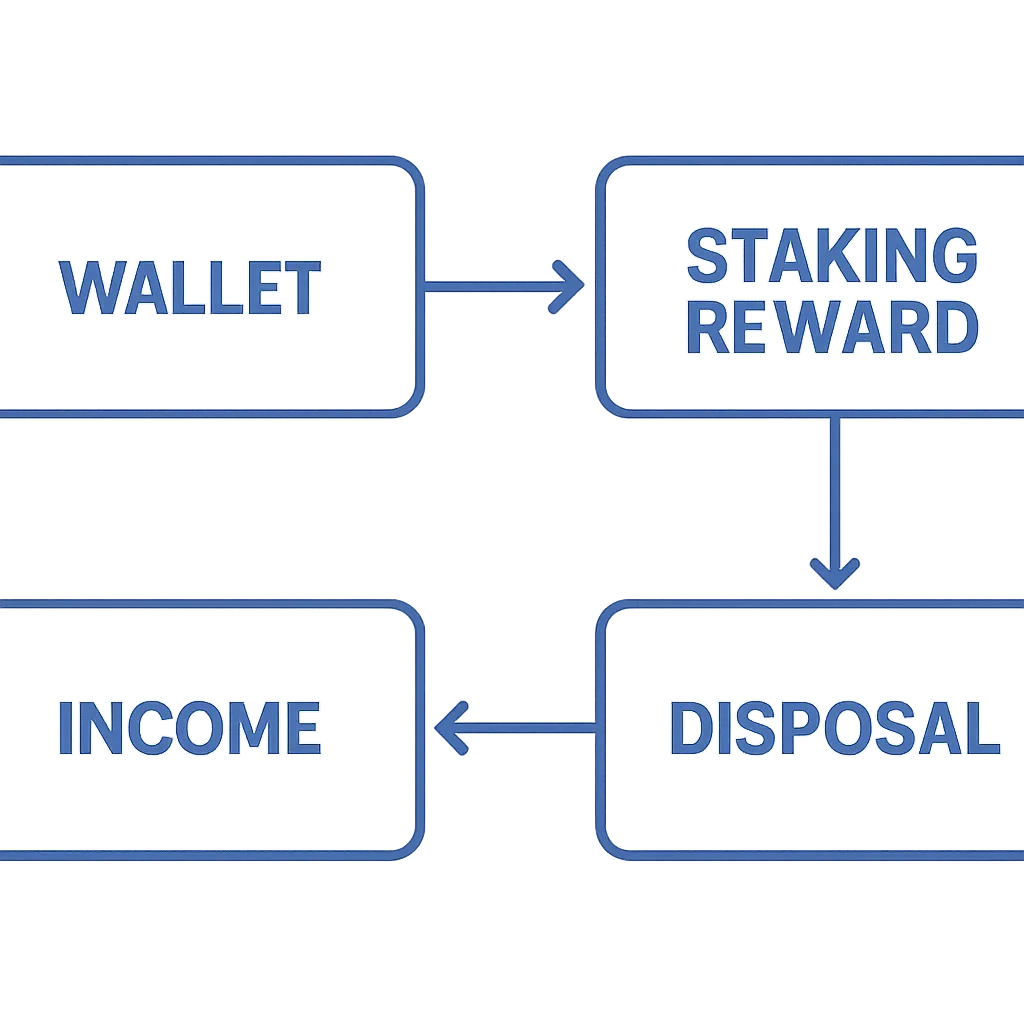
| Crypto Activity | Individual UAE Resident | UAE Corporate Entity |
|---|---|---|
| Staking rewards received | No income tax (no personal income tax regime) | Potentially within corporate tax scope if above threshold |
| Staking token disposal (gain) | No capital gains tax | Potentially taxable as business income |
| DeFi yield/liquidity mining | No personal income tax | Depends on entity structure and activity classification |
| NFT sale profit | No capital gains tax | May attract corporate tax if trading as a business |
| Crypto airdrop receipt | No income tax at receipt | Treatment depends on business characterisation |
| Crypto trading gains | No capital gains tax for individuals | Subject to corporate tax rules if above threshold |
How Are DeFi Rewards Taxed in the UAE?
How are DeFi rewards taxed? This is one of the most searched questions among crypto-native users, and it matters particularly for those active in liquidity pools, yield farming, and lending protocols. DeFi activity can generate income in multiple forms: interest-like yield, governance token rewards, liquidity provider fees, and more. Each has a slightly different economic character, but they all share the same basic question of whether they are taxable at receipt or only at disposal.
No Personal Tax on DeFi Yields
For UAE-resident individuals, the answer mirrors the staking analysis. There is no personal income tax, so there is no mechanism to tax DeFi yields as income when received. Capital gains tax does not exist at the individual level, so disposing of reward tokens at a profit is also not a taxable event under current UAE federal law.
The nuance is around activity that could be characterised as a business. Someone running a professional DeFi strategy at scale, using a company structure, or providing DeFi-related services commercially would need to consider the corporate tax framework. For individual retail participants earning yield on their own holdings, that threshold is unlikely to be crossed. The key distinction is between managing personal investments and operating a financial business.
Business Characterization Risk in DeFi
It is also worth remembering that the DeFi tax question remains unresolved in many major jurisdictions. Guidance from the OECD's Crypto-Asset Reporting Framework process is evolving, and UAE residents with connections to other tax jurisdictions, particularly US citizens abroad or UK non-doms with continuing UK ties, cannot assume the UAE position eliminates all obligations elsewhere.
NFT Tax and Crypto Airdrop Tax in the UAE
NFT tax and crypto airdrop tax follow the same structural logic in the UAE. For individuals, neither the creation and sale of NFTs nor the receipt of airdropped tokens triggers a personal income or capital gains tax liability under the current framework. An artist selling NFT artwork, a collector flipping digital assets, or a wallet receiving an airdrop of a new protocol's tokens is not facing a UAE personal tax bill on those activities.
NFT and Airdrop Tax Treatment
That said, NFT activity can become business activity. An individual who mints and sells NFTs regularly as a primary source of income may be carrying on a trade rather than investing personally. At that point, the corporate tax analysis becomes relevant, depending on how the activity is structured. The same applies to someone systematically farming airdrops as a commercial strategy through a structured entity.
For most individuals, the practical risk is not UAE taxation but documentation. Even in a low-tax or zero-tax environment, maintaining records of what you received, when, and at what value is important. Circumstances change: tax residency can shift, rules can evolve, and demonstrating a clean record of your on-chain activity protects you regardless of where you end up.
Jurisdictional Comparison Table
| Jurisdiction | Staking Rewards (Receipt) | NFT Sale Gain | Airdrop Receipt | DeFi Yield |
|---|---|---|---|---|
| UAE (Individual) | Not taxable (no personal income tax) | Not taxable (no CGT) | Not taxable | Not taxable |
| UK | Taxable as miscellaneous income | Taxable as capital gain | Taxable as income or capital depending on type | Taxable as income or capital |
| US | Taxable as ordinary income | Taxable as capital gain (short or long term) | Taxable as ordinary income | Taxable as ordinary income |
| Australia | Taxable as ordinary income | Taxable as capital gain (50% discount if held 12+ months) | Taxable as ordinary income | Taxable as income |
Crypto Trading Tax for UAE Residents
Crypto trading tax for UAE residents is an area where the zero-tax position is clearest for individuals. Buying and selling cryptocurrencies, whether on centralised exchanges or through decentralised protocols, does not give rise to a capital gains tax liability for natural persons under UAE law. There is no equivalent of the UK's capital gains tax annual exempt amount calculation, no US short-term versus long-term distinction, and no Australian CGT discount to navigate.
No Capital Gains on Crypto Trades
This applies to straightforward spot trading as well as more complex activities like crypto-to-crypto swaps, which in many jurisdictions count as a disposal and trigger a taxable event. In the UAE, an individual swapping Bitcoin for Ethereum does not face a personal tax bill on any embedded gain.
The limit of this favourable treatment, again, is the business activity boundary. High-frequency traders operating through a corporate structure, exchanges, brokers, and others providing trading services commercially are in a different position. The corporate tax framework applies to businesses, and a company earning significant income from crypto trading would need proper tax advice and accurate records. Individual traders who happen to be active are unlikely to cross that line, but the more a person's crypto activity resembles a commercial operation, the more attention it warrants.
Business Activity and Cross-Border Issues
UAE residents who are also tax residents elsewhere face an entirely different calculation. US citizens, for example, owe US tax on global income regardless of where they live. The UAE's domestic rules provide no shelter from that obligation.
Record-Keeping: Why It Matters Even in a Zero-Tax Environment
The absence of personal income and capital gains tax in the UAE does not eliminate the need for good record-keeping. There are several practical reasons to track your crypto activity carefully even if your current tax position is favourable.
Changing Tax Residency and Cost Basis
First, tax residency can change. If you leave the UAE and establish residency in a jurisdiction with crypto taxes, your historical cost basis matters. Knowing what you paid for assets, when you received staking rewards, and what airdrops you collected will determine your tax position in the new jurisdiction from day one. Without those records, you are guessing, and guessing is expensive when you eventually need to file.
Second, regulatory requirements are evolving. The UAE is a signatory to international information-sharing frameworks, and the OECD's Crypto-Asset Reporting Framework is expanding the flow of financial data between tax authorities. What is private today may be shared data tomorrow.
Regulatory Evolution and Source of Funds
Third, proving the source of funds matters for banking, property purchases, and business relationships. A clear, verifiable record of where your crypto came from and how it was accumulated is an asset in itself. Good records protect you against mischaracterisation and make any future compliance requirement far easier to meet.

Illustrative Scenario
This scenario is illustrative. It does not describe a real person or client, and the figures are examples only.
To illustrate how this applies in practice, consider the following scenario:
Ahmed is a software engineer based in Dubai. He has been staking ETH for roughly two years and participates in two DeFi liquidity pools, earning yield in various tokens. He also received an airdrop from a new protocol and has sold several NFTs he created as a hobby. Over the past year he made a number of crypto-to-crypto trades, swapping between major assets. He had assumed all of this was completely outside any tax framework given his UAE residency.
When Ahmed looks into his position more carefully, he confirms that as a UAE-resident individual with no other tax residency, none of his activities currently trigger a personal income tax or capital gains tax liability under UAE federal law. However, he realises he has no records of his cost basis, reward receipts, or disposal dates. He signs up for CryptaTax, connects his wallets and exchange accounts, and generates a full transaction history. This gives him a clean cost-basis record for all assets, documentation of every staking reward and airdrop, and a clear audit trail in case his circumstances change or the regulatory landscape shifts. Ahmed does not owe tax today, but he is now prepared for any scenario that might change that.
Frequently Asked Questions
Is crypto staking tax applicable for individuals in the UAE?
Under current UAE federal law, individual residents are not subject to personal income tax or capital gains tax. Staking rewards received by a natural person are therefore not taxed at the point of receipt, and selling staked tokens at a profit does not trigger a capital gains liability. The position differs for corporate entities.
Is staking taxable if I operate through a UAE company?
Yes, potentially. UAE corporate tax applies to businesses above a certain income threshold. If you conduct staking through a company or free zone entity, the rewards may fall within the corporate tax scope depending on how the activity is classified. Personal investing by an individual is treated differently from a commercial operation.
How are DeFi rewards taxed in the UAE for private individuals?
How DeFi rewards are taxed in the UAE for individuals comes down to the same principle: there is no personal income tax framework to apply them to. Yield from liquidity pools, lending protocols, and governance token rewards is not taxable income for a natural person under current UAE law. That position can change if the activity is structured through a corporate entity or resembles a business operation.
What is the NFT tax position for UAE residents?
NFT tax for UAE-resident individuals is currently zero at the personal level. Profits from selling NFTs are not subject to capital gains tax, and income from minting and selling NFTs as an individual is not subject to personal income tax. If NFT creation is your primary business and is conducted through a company, corporate tax considerations apply.
Is crypto airdrop tax something I need to worry about in the UAE?
For individual UAE residents, crypto airdrop tax is not a current concern under federal law. There is no income tax mechanism to tax airdropped tokens at receipt. That said, you should still record airdrops including the date, quantity, and approximate value at receipt, because your situation may change and records will protect you.
Does crypto trading tax apply to UAE residents who trade actively?
Crypto trading tax does not apply to individual UAE residents under the current framework. There is no capital gains tax, so profits from buying and selling crypto assets, including crypto-to-crypto swaps, are not taxable personal income. The exception is if trading is conducted through a corporate entity or constitutes a commercial operation subject to corporate tax.
Do I need to file any crypto tax return in the UAE as an individual?
There is no personal income tax return requirement in the UAE for individuals. You do not need to file a self-assessment or report crypto gains to a federal tax authority as a private individual under current rules. However, if you operate a business or corporate entity, corporate tax registration and filing obligations may apply.
What happens to my UAE tax position if I move to another country?
When you change tax residency, the tax rules of your new jurisdiction apply to your ongoing and sometimes historical crypto activity. Your cost basis for all assets, the dates and values of staking rewards received, and records of any airdrops or DeFi income will all become relevant. Keeping accurate records now, even though there is no UAE personal tax to pay, protects you from a much harder calculation later.
Are there any reporting obligations for crypto under UAE anti-money laundering rules?
UAE anti-money laundering and counter-terrorism financing rules apply to virtual asset service providers operating in the country, not to individual holders managing their own wallets. However, large transfers and unusual activity can attract scrutiny from banks and financial institutions. Clear records of the source and nature of your crypto holdings help demonstrate legitimate activity when requested.
Will the OECD Crypto-Asset Reporting Framework affect UAE crypto holders?
The OECD's Crypto-Asset Reporting Framework is a global standard for automatic exchange of crypto financial information between tax authorities. As this framework is implemented by participating jurisdictions, UAE-based exchanges and service providers may be required to report account data internationally. This is most relevant for UAE residents who also have tax obligations in another country.
Source: CryptaTax