
NFT Tax: What You Owe, When You Owe It, and How to Avoid Costly Mistakes
NFT tax is one of the most misunderstood areas in personal crypto taxation. Many people assume that because NFTs are a newer asset class, the rules are either unclear or simply do not apply yet. In most jurisdictions that assumption is wrong, and it can be expensive. Whether you bought a digital artwork, minted a collection, or received tokens as part of a play-to-earn game, tax authorities in major markets treat those events as taxable transactions. The question is not usually whether tax applies. The question is how much, when you need to report it, and what records you need to keep. This guide walks through the core scenarios that affect individual traders and collectors, including related income from DeFi rewards, staking, and airdrops.
How NFT Tax Works: The Core Principle
In most countries, NFTs are treated as capital assets or property for tax purposes. That means the same logic that applies to crypto trading tax applies here: you have a cost basis when you acquire an NFT, and when you dispose of it, the difference between what you paid and what you received is either a gain or a loss. Disposal is a broader concept than many people realise. It includes selling an NFT for fiat currency, swapping one NFT for another, and in some jurisdictions even gifting one to another person.
Capital Gains Treatment for NFTs
The tax rate you pay on a gain depends on how long you held the asset and your country's specific rules. Some jurisdictions apply a flat rate to all capital gains from crypto and digital assets. Others apply your marginal income tax rate, particularly if the activity looks more like a trade than an investment. If you regularly buy and sell NFTs for profit, tax authorities may classify you as a trader rather than an investor, which changes the rate and the reporting requirements significantly.
The table below summarises how several major jurisdictions broadly classify NFT disposals for individual taxpayers.
| Jurisdiction | Primary Tax Treatment | Key Rate Consideration |
|---|---|---|
| United Kingdom | Capital Gains Tax (CGT) | Annual CGT exemption applies; rates depend on income band |
| United States | Capital gains (short or long term) | Held over 12 months qualifies for lower long-term rates |
| Germany | Capital gains or income tax | Assets held over 12 months may be tax-free for individuals |
| Australia | Capital Gains Tax | 50% CGT discount available for assets held over 12 months |
| Japan | Miscellaneous income | Gains taxed as miscellaneous income, not capital gains |
Buying an NFT: Is There an Immediate NFT Tax Event?
Buying an NFT with fiat currency does not usually trigger a tax event in itself. You are simply acquiring an asset. Your cost basis is established at the price you paid, including any gas fees or marketplace transaction fees that are directly attributable to the purchase. Keeping a clear record of this amount matters a great deal later, because your gain or loss on disposal is calculated from it.
Buying NFT With Crypto Triggers Tax
The situation becomes more complicated if you buy an NFT using cryptocurrency rather than fiat. In that case you are disposing of the crypto to acquire the NFT. Most tax authorities treat that crypto disposal as a taxable event in its own right. You need to calculate the gain or loss on the crypto at the moment of the swap, based on its cost basis versus its market value at the time of the transaction. This catches many people out. They focus entirely on the NFT and forget they have just triggered a crypto trading tax event on the ETH or other token they used to pay for it.
Selling and Swapping NFTs: When the Tax Bill Arrives
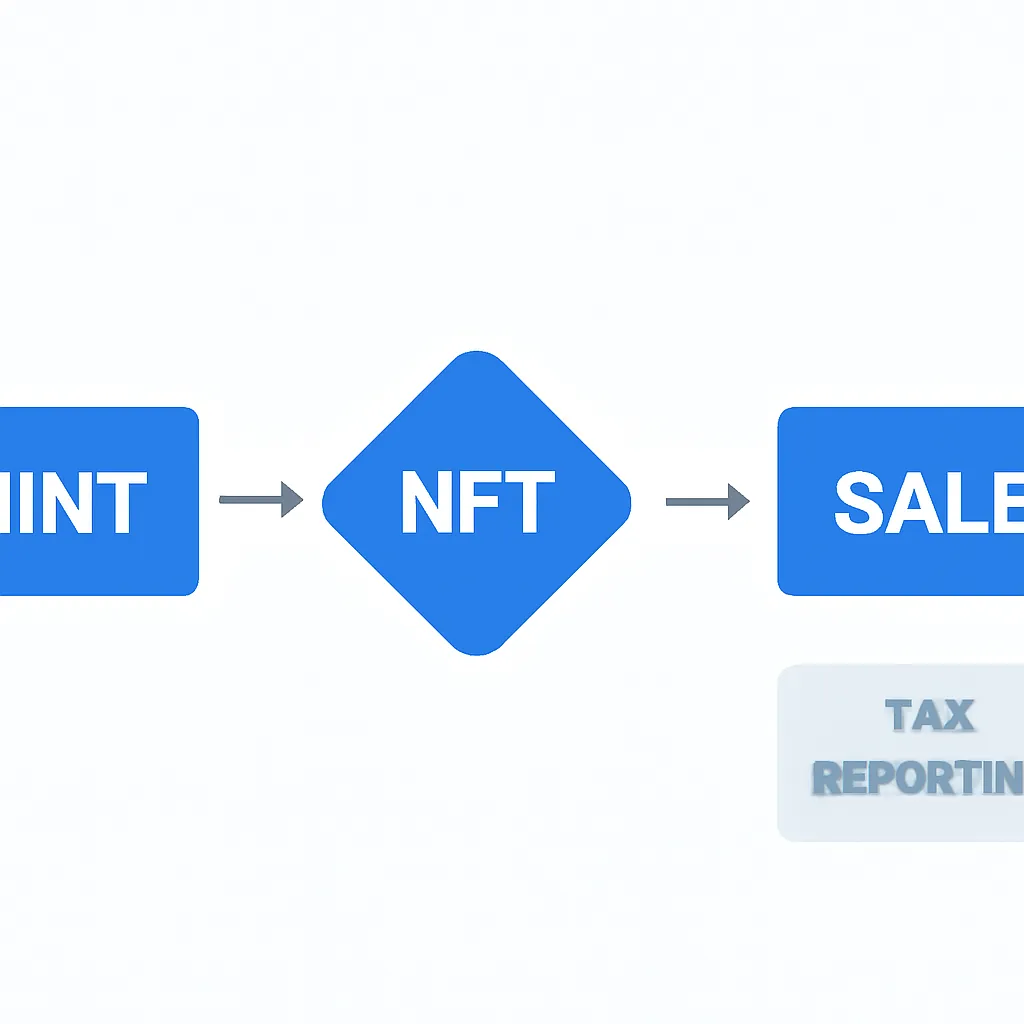
Selling an NFT is the most obvious taxable disposal. The gain is the sale proceeds minus your cost basis, and that figure flows into your tax return. If you sell for less than you paid, you have a capital loss, which in many jurisdictions can be offset against other capital gains in the same tax year or carried forward to future years.
Swapping NFTs Creates Two Disposals
Swapping one NFT for another is treated as two simultaneous disposals in most jurisdictions. You are deemed to have sold the first NFT at its fair market value at the time of the swap, and then purchased the second NFT at that same value. This means a swap can generate a taxable gain even if no cash changes hands, which surprises a large number of NFT traders when they come to file.
The table below outlines the key taxable events most individual NFT holders need to account for.
| Transaction Type | Taxable Event? | What to Record |
|---|---|---|
| Buy NFT with fiat | No (establishes cost basis) | Purchase price, date, fees |
| Buy NFT with crypto | Yes (crypto disposal) | Crypto cost basis, market value at time of swap, date |
| Sell NFT for fiat | Yes | Sale proceeds, cost basis, date |
| Swap NFT for NFT | Yes (deemed disposal) | Fair market value of NFT disposed, date |
| Gift an NFT | Varies by jurisdiction | Market value at time of gift, recipient details |
| Mint an NFT | Possibly (gas fees, income) | Minting cost, any income received on mint |
Minting NFTs and Creator Royalties
If you create and mint your own NFTs, the tax treatment shifts from capital gains territory toward income tax in many jurisdictions. When you sell a self-created NFT, tax authorities often treat the proceeds as trading income or self-employment income rather than a capital gain, because you have not purchased an asset and sold it at a profit. You have created something and sold it. The distinction matters because income tax rates are typically higher than capital gains rates, and different deductions may apply.
Creator Royalties Treated as Income
Royalty income from NFT secondary sales sits in the same category. Each time your NFT resells and you receive a royalty payment, that is generally treated as income in the year you receive it. You will need to track each payment individually, including the date, the amount in your local currency at the time of receipt, and the platform it came through. Some creators receive royalties automatically via smart contracts, which makes the tracking easier in one sense but does not reduce the tax obligation.
Gas fees incurred during minting can often be added to the cost basis of the NFT or treated as a deductible expense, depending on whether you are operating as a trader or creator. The specific treatment varies by country and sometimes by the nature of your overall crypto activity.
DeFi Tax, Staking, and Airdrops Connected to NFT Activity
NFT ecosystems increasingly overlap with DeFi and staking mechanics. Understanding how DeFi tax works in this context is important for anyone active in NFT-linked protocols. When an NFT project offers staking, where you lock an NFT or associated token and receive yield in return, the rewards you earn are typically treated as income when you receive them. This is broadly how crypto staking tax operates: the reward is valued at market price on the date of receipt and taxed as income. Whether you later sell those reward tokens and realise a gain is a separate question that generates a second taxable event.
Staking Rewards Taxed as Income
The question of how are DeFi rewards taxed has a similar answer in most jurisdictions: income tax applies at the point of receipt, based on fair market value. Whether it is liquidity pool income, yield farming rewards, or NFT-linked staking distributions, the principle holds. The follow-on disposal of those tokens is then subject to capital gains treatment.
Crypto airdrop tax follows a similar pattern. If you receive NFTs or tokens via an airdrop, the general position in the UK, US, and Australia is that you have received income equal to the market value of what you received. You need to record that value on the date of receipt. When you eventually sell or swap those airdropped assets, you calculate a gain or loss from that original income value as your cost basis.
The question of whether is staking taxable attracts a definitive yes in most English-speaking tax jurisdictions. The more nuanced question is whether each individual reward payment triggers a reporting obligation, or whether only the aggregate matters. In practice, keeping a record of each reward receipt is the safest approach.
Record-Keeping: The Part Most People Get Wrong
The single biggest practical problem for NFT taxpayers is records. NFT transactions often span multiple wallets, multiple blockchains, multiple marketplaces, and sometimes years of activity. Reconstructing cost basis information later is difficult and sometimes impossible if you have not tracked it in real time.
Essential Records for NFT Transactions
At a minimum, you need to record the date of every transaction, the type of transaction, the amount paid or received in your local currency at the time, the platform or marketplace involved, and any fees paid. For crypto-to-NFT swaps, you also need the historical price of the cryptocurrency used. On-chain data helps, but exchange rates at the precise time of each transaction require a reliable source, and those sources do not always agree.
Tools like CryptaTax are built to pull transaction data from wallets and exchanges, apply exchange rates at the correct historical timestamp, and calculate gains and losses across multiple asset types, including NFTs, staking rewards, and DeFi activity. Getting your data into a structured format before the tax filing deadline removes a significant amount of stress and reduces the risk of errors that could attract scrutiny from tax authorities.
Illustrative Scenario
This scenario is illustrative. It does not describe a real person or client, and the figures are examples only.
To illustrate how this applies in practice, consider the following scenario:
Priya is a graphic designer based in the UK who began selling digital artwork as NFTs. Over the course of a tax year she minted a small collection, sold several pieces on a secondary marketplace, and also bought two NFTs from other creators using ETH she had held for several months. She also staked tokens earned from an NFT project and received yield rewards throughout the year.
When it came to filing her Self Assessment return, Priya realised she had four separate categories of taxable activity: income from her own NFT sales as a creator, capital gains from the ETH disposal each time she bought another creator's NFT, capital gains from selling NFTs she had purchased earlier in the year, and income from her staking rewards valued at market price on the date each reward was received. None of these were especially large individually, but together they added up to a meaningful tax liability she had not planned for. Using CryptaTax, Priya imported her wallet transactions, matched them to exchange rate data, and generated a report broken down by category. She filed on time and avoided the penalties that come with a late or incomplete return.
Frequently Asked Questions
Do I pay tax when I buy an NFT?
Buying an NFT with fiat currency does not usually create an immediate tax liability. It establishes your cost basis. However, if you buy an NFT using cryptocurrency, that crypto disposal is a taxable event and you need to calculate any gain or loss on the crypto at the time of the transaction.
How is NFT tax calculated when I sell?
Your taxable gain is the sale proceeds minus your original cost basis, including any fees you paid when acquiring the NFT. If the result is positive, that gain is subject to capital gains tax or income tax depending on your jurisdiction and how frequently you trade. A negative result is a capital loss.
Is swapping one NFT for another a taxable event?
In most jurisdictions, yes. Swapping is treated as a disposal of the first NFT at its fair market value at the time of the swap. That value is also the cost basis for the NFT you receive. You may owe tax on the gain even though no cash changed hands.
How are DeFi rewards taxed if they come from an NFT project?
DeFi tax rules generally treat rewards as income at the point of receipt, valued at market price on the date you receive them. This applies whether the rewards come from a DeFi protocol or an NFT-linked staking scheme. When you later sell or swap those reward tokens, a separate capital gains calculation applies.
Is staking taxable if the staking involves an NFT?
Yes, crypto staking tax applies regardless of whether the underlying mechanism involves an NFT or a standard token. The rewards you receive are treated as income in most jurisdictions. You need to record the value of each reward at the time of receipt and report it accordingly.
How is crypto airdrop tax handled for NFT airdrops?
Crypto airdrop tax works the same way for NFTs as for fungible tokens in most countries. You are treated as having received income equal to the market value of the airdropped NFT on the date you received it. That value also becomes your cost basis when you eventually sell or swap the asset.
What records do I need to keep for NFT transactions?
You need the date of every transaction, the type of event, the amount in your local currency at the time, the platform used, and any fees paid. For purchases made with cryptocurrency, you also need the historical price of that crypto at the transaction timestamp. Keeping these records in real time is far easier than reconstructing them later.
Does crypto trading tax apply differently to NFTs than to regular crypto?
The underlying principle is the same: disposal triggers a gain or loss calculation. The difference is that NFTs are unique assets, so you cannot pool them the way some jurisdictions allow for fungible tokens. Each NFT needs to be tracked individually with its own cost basis and disposal record.
What happens if I made a loss on my NFTs?
A loss on an NFT disposal can generally be offset against capital gains from other assets in the same tax year, reducing your overall tax bill. In many jurisdictions, unused losses can be carried forward to offset gains in future years. You still need to report the loss to claim the relief.
What is the deadline for reporting NFT tax in the UK?
For UK residents, NFT gains and income need to be reported via Self Assessment. The online filing deadline for a given tax year is 31 January of the following year, with the tax payment due on the same date. Missing this deadline results in automatic penalties and interest charges.
Source: CryptaTax