
Crypto Tax UAE: A Practical Guide for Individuals
The UAE has a reputation as a crypto-friendly destination, and for good reason. There is no personal income tax in the UAE, which means most individuals holding or trading crypto will not face a tax bill on their gains in the way a UK or US resident would. But that does not mean crypto is entirely outside the tax net. Understanding crypto tax in the UAE requires looking beyond income tax and examining how VAT, the newer corporate tax regime, and regulatory obligations interact with your activity. Get this wrong and you could face unexpected liabilities or compliance gaps that are difficult to unwind.

The UAE Tax Landscape for Crypto Holders
The UAE does not levy personal income tax on individuals. That applies to salaries, investment returns, capital gains, and, by extension, profits from buying and selling cryptocurrency. For a retail trader or long-term crypto holder who is not operating through a company, this is genuinely good news. Profits from selling Bitcoin or Ethereum, for example, are not subject to a personal tax charge in the same way they would be in the UK, Germany, or the United States.
Personal Income Tax Exemption
However, the UAE introduced a federal corporate tax in June 2023, set at a standard rate of 9% on taxable income above AED 375,000. This changes the picture for individuals who operate through a business structure, including freelancers and sole traders who have established a company or free zone entity. If your crypto activity sits inside a corporate wrapper, the corporate tax rules will likely apply to it. The personal tax exemption does not automatically flow through to your company.
The distinction between personal and business crypto activity is therefore one of the most consequential questions any UAE-based crypto participant needs to answer before assuming they owe nothing.
How Is Crypto Taxed in the UAE: Breaking Down the Categories
Understanding how is crypto taxed in the UAE means separating activity into distinct categories, because the treatment differs depending on what you are doing and how you are structured.
No Tax for Personal Holdings
For individuals with no corporate entity, holding crypto and realising gains sits outside the income tax net. There is no capital gains tax regime for natural persons in the UAE. Receiving crypto as a gift, inheriting it, or simply holding it long-term creates no tax event at the personal level under current rules.
Trading as an individual, including frequent buying and selling on exchanges, also falls outside personal income tax. This is one of the clearest contrasts with jurisdictions like the UK, where HMRC treats frequent trading as potentially giving rise to income tax rather than the more favourable capital gains tax rate.
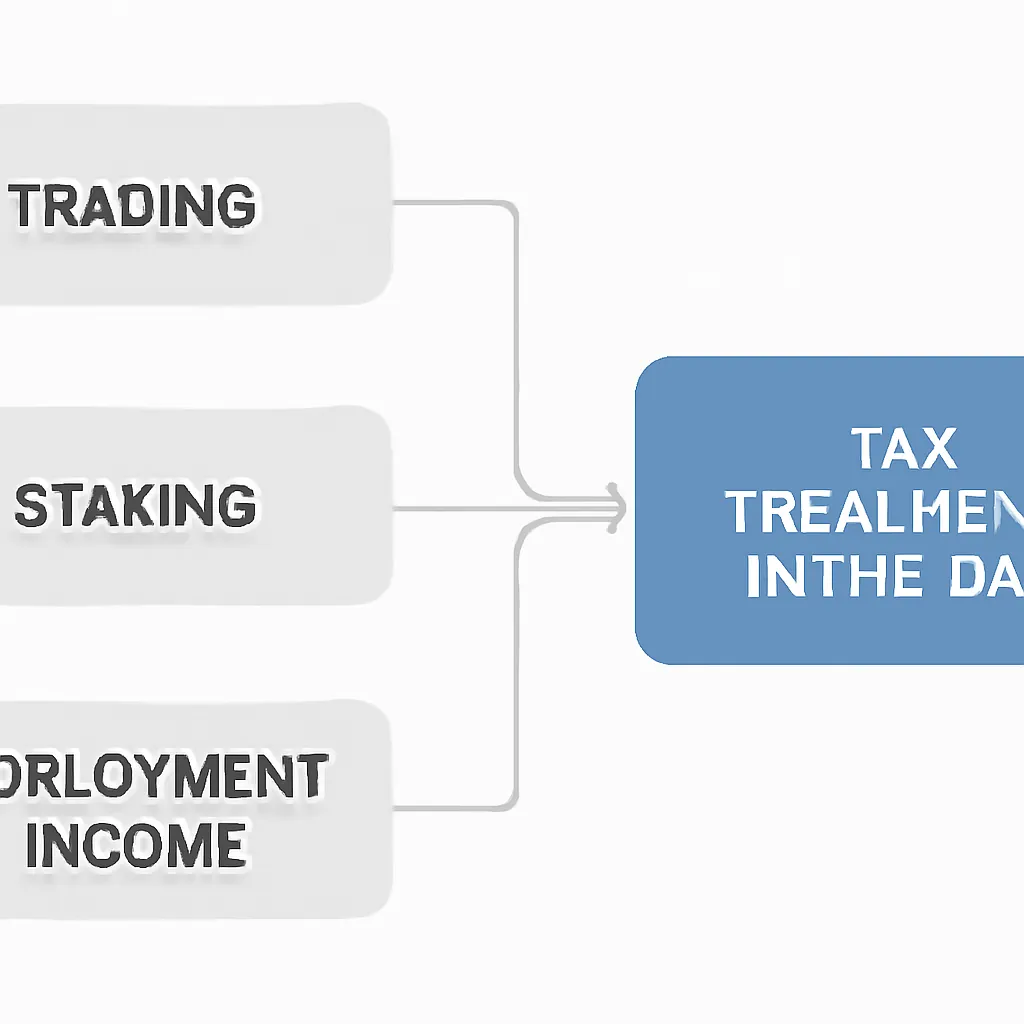
Employment and Business Income
Things become more complex when crypto forms part of employment or business income. Receiving crypto as a salary or consulting fee does not change the personal income tax position for residents, since salary income is also untaxed. But if those payments flow into a business entity, the corporate tax calculation will need to account for them.
| Activity Type | Personal Tax Position | Potential Corporate Tax Exposure |
|---|---|---|
| Buying and holding crypto | No personal tax | No, if held personally |
| Selling crypto for a gain | No personal capital gains tax | Potentially yes, if through a company |
| Receiving crypto as salary | No personal income tax | Company payroll obligations may apply |
| Mining or staking rewards | No personal income tax | Potentially yes, if commercial scale |
| DeFi yield or lending returns | No personal income tax | Review required if through entity |
| Crypto used in business transactions | VAT may apply depending on nature | Included in corporate taxable income |
VAT and Crypto Transactions in the UAE
Value Added Tax was introduced in the UAE in January 2018 at a standard rate of 5%. The Federal Tax Authority has issued guidance indicating that the VAT treatment of crypto assets depends on whether the transaction constitutes a supply of goods or services. Crypto used as a means of payment for goods or services may be treated similarly to fiat currency in some contexts, but the position is nuanced and not uniformly settled across all asset types.
VAT on Crypto Payments
Businesses that accept cryptocurrency as payment for taxable supplies are still required to account for VAT on the underlying transaction. The crypto is treated as consideration, and the VAT obligation does not disappear simply because the payment was made in a digital asset rather than dirhams. Businesses need to determine the dirham value of the crypto received at the time of supply to calculate VAT correctly.
For individuals who are not VAT-registered and are not running a business, routine crypto trading and investing generally falls outside the VAT framework. The concern arises when activity crosses into something resembling a business, at which point VAT registration thresholds and obligations become relevant.
VAT Implications Table
| Scenario | VAT Implication |
|---|---|
| Individual buying crypto on an exchange | Generally outside VAT scope for personal use |
| Business accepting crypto as payment | VAT applies on the underlying supply at standard rate |
| Crypto exchange or brokerage service | May constitute a taxable financial service; review required |
| NFT sales by an individual artist or creator | Potentially taxable supply if conducted as a business |
Free Zone Entities and Crypto Business Activity
The UAE's free zones have historically offered attractive tax conditions, including full corporate tax exemptions for qualifying activities. The introduction of federal corporate tax has refined this picture. Free zone entities can still benefit from a 0% rate on qualifying income, but they must meet specific conditions around substance, the nature of their income, and compliance with the Qualifying Free Zone Person rules.
Qualifying Income for 0% Rate
For individuals who have set up a free zone company specifically to hold or trade crypto, this is an area requiring careful review. Not all crypto activity will automatically qualify for the 0% rate. Income from transactions with mainland UAE entities, or activity that falls outside the qualifying income definition, may be taxed at 9%. The specific free zone, the nature of the crypto activity, and the structure of any relevant contracts all matter.
Taking advice from a qualified UAE tax adviser before structuring any significant crypto activity through a free zone entity is strongly recommended. The potential savings are real, but so are the compliance traps for those who assume blanket exemption still applies.
Record-Keeping Obligations for Crypto in the UAE
Even where no personal tax liability arises, maintaining clear records of crypto activity is not optional. The UAE's Federal Tax Authority requires businesses and corporate entities to retain financial records, and those obligations extend to crypto-related transactions. For companies holding corporate tax obligations, records need to demonstrate how crypto income was calculated, what values were used for dirham conversion, and how positions were reported.
Record-Keeping for Individuals
For individuals, while there is no direct record-keeping requirement driven by personal income tax, good practice still matters. If your situation changes, if you move jurisdiction, if you set up a company, or if you become subject to a regulatory inquiry, having a clean transaction history will protect you. Exchanges may not retain records indefinitely, and reconstructing historical cost basis or transaction volumes retroactively is difficult.
A practical approach is to export transaction data from every exchange and wallet regularly, record the dirham or USD value at the time of each transaction, and store records in an organised format that could be shared with a tax adviser or auditor if needed.
Essential Records Table
| Record Type | Why It Matters |
|---|---|
| Transaction history by exchange | Establishes cost basis and disposal proceeds |
| Dirham or USD value at time of transaction | Required for corporate tax and VAT calculations |
| Wallet addresses and on-chain records | Supports traceability for regulatory purposes |
| Staking or reward receipts | Needed to determine income recognition timing |
| Entity structure documents | Determines whether corporate tax applies to activity |
The VARA Framework and Regulatory Compliance
The Virtual Assets Regulatory Authority, known as VARA, oversees the regulation of virtual assets in Dubai. While VARA is primarily focused on businesses and service providers rather than individual investors, its existence signals the direction of travel for crypto oversight in the UAE. Individuals engaging in activity that could be classified as a virtual asset service, including operating a trading desk, providing wallet custody, or running an exchange, may need to consider VARA licensing requirements.
Retail Investors and VARA
For most retail investors simply holding and trading on regulated exchanges, VARA does not create a direct compliance burden. But the boundary between retail investor and service provider is worth keeping in mind, particularly as activity scales up or becomes more structured. Staying within the personal investor category preserves the simpler tax and regulatory position that makes the UAE attractive in the first place.
Illustrative Scenario
This scenario is illustrative. It does not describe a real person or client, and the figures are examples only.
To illustrate how this applies in practice, consider the following scenario:
Ahmed is a freelance software developer based in Dubai who has been accumulating Bitcoin and Ethereum as personal savings for three years. He also receives occasional staking rewards from a proof-of-stake protocol. Ahmed operates through a free zone company he set up to invoice international clients for his development work.
His personal crypto holdings create no personal income tax liability, since the UAE has no personal income tax. His staking rewards, received into a personal wallet rather than through the company, are also not subject to personal tax. However, when Ahmed reviews his corporate tax position, he realises that his free zone company must confirm it meets the Qualifying Free Zone Person conditions. His accountant flags that if any crypto transactions were processed through the company rather than personally, they would need to be reviewed for inclusion in corporate taxable income.
Ahmed uses CryptaTax to generate a clean transaction history for his personal holdings, separating personal and company activity clearly. This gives him a defensible record and makes his annual review with his UAE tax adviser straightforward. It also ensures that if he ever moves jurisdiction, he has a complete cost basis history ready to hand.
Frequently Asked Questions
Is crypto taxed in the UAE for individuals?
The UAE does not levy personal income tax, which means individuals are not taxed on crypto gains or trading profits at the personal level. There is no capital gains tax on personal crypto holdings. However, individuals operating through a company may be subject to corporate tax introduced in 2023, and VAT can apply in business contexts.
Do I need to pay tax on Bitcoin profits in the UAE?
If you hold Bitcoin personally and sell it for a profit, that gain is not subject to personal income tax in the UAE. The country has no personal capital gains tax regime. If you operate through a UAE company, the corporate tax rules may apply to profits generated within that entity depending on its structure and qualifying status.
How is crypto taxed in the UAE for businesses?
Businesses in the UAE became subject to federal corporate tax from June 2023, at a 9% rate on taxable income above AED 375,000. Crypto income earned through a corporate entity, including trading profits, staking rewards, and crypto payments received for services, would generally be included in the corporate tax calculation. Free zone entities may qualify for a 0% rate if they meet specific conditions.
Does the UAE charge VAT on cryptocurrency transactions?
VAT at 5% applies in the UAE to taxable supplies of goods and services. When a business accepts crypto as payment for a taxable supply, VAT obligations still apply based on the value of the underlying transaction. Routine personal crypto trading by non-registered individuals is generally outside the VAT scope, but business activity may trigger registration requirements.
Do I need to report crypto if I live in the UAE?
There is no personal income tax return requirement in the UAE for individuals, so there is no annual filing in which you would report personal crypto gains. Businesses subject to corporate tax must file returns and include crypto-related income. Even without a filing obligation, keeping detailed records is strongly advisable in case your status changes or regulatory inquiries arise.
Are staking rewards taxable in the UAE?
Staking rewards received personally by an individual in the UAE are not subject to personal income tax under current rules. If staking activity is conducted through a company or at a commercial scale that constitutes a business, the corporate tax position needs to be reviewed. The timing of income recognition for staking rewards within a company context is a technical question worth confirming with a UAE tax adviser.
Is the UAE a crypto tax haven?
The UAE offers one of the most favourable personal tax environments for crypto holders globally, primarily because it has no personal income tax or capital gains tax. This makes it genuinely attractive compared to jurisdictions like the UK, US, or Germany. However, calling it a complete tax haven is an oversimplification given the corporate tax framework, VAT rules, and regulatory obligations that apply to business activity.
What records should I keep for crypto in the UAE?
Even without a personal filing obligation, keeping detailed records protects you if your circumstances change. You should retain transaction histories from every exchange and wallet, note the dirham or USD value at the time of each transaction, and keep records of staking rewards and any crypto received as payment. If you use a company, records become a legal requirement under corporate tax rules.
Does the UAE share crypto data with other countries?
The UAE is a signatory to international frameworks aimed at improving tax transparency, including the Common Reporting Standard. The OECD's Crypto-Asset Reporting Framework is also being adopted progressively across jurisdictions and will expand automatic information exchange to include crypto assets. UAE-based exchanges may begin reporting account data to foreign tax authorities for individuals who are tax resident elsewhere.
Can I move to the UAE to avoid paying crypto tax in my home country?
Moving to the UAE can legitimately reduce or eliminate personal tax on future crypto gains if you establish genuine tax residency there and sever ties with your previous jurisdiction. However, most countries have exit tax rules, departure procedures, and residency tests that must be carefully managed. Gains accrued before becoming a UAE resident may still be taxable in your previous country. Taking specialist advice before any move is essential.
Source: CryptaTax