
Crypto Capital Gains Tax in the UAE: What Every Trader Needs to Know
The UAE has built a reputation as one of the most crypto-friendly jurisdictions on the planet, but that does not mean traders can ignore their tax position entirely. Whether you are a resident in Dubai, Abu Dhabi, or anywhere across the Emirates, understanding how crypto capital gains tax works in the UAE is essential before you file anything. Using a reliable crypto tax calculator is one of the most practical ways to get a clear picture of what you owe, or whether you owe anything at all. This guide walks through the current UAE tax framework for crypto assets, what triggers a taxable event, how the recently introduced corporate tax landscape fits in, and how individual traders can stay on the right side of their obligations without unnecessary stress.

The UAE Tax Environment for Crypto Traders
The UAE has historically had no personal income tax. That baseline remains true today for individual residents. There is no capital gains tax applied to individuals on profits made from buying and selling cryptocurrency in the UAE. For the vast majority of retail traders and crypto-native individuals living in the Emirates, this means personal crypto gains are not subject to any direct levy at the federal level.
Nuances of Corporate Tax
That said, the situation is not entirely without nuance. The UAE introduced a federal corporate tax in 2023, which applies to businesses and some freelancers operating under a trade licence. If your crypto activity crosses the threshold of a business operation rather than personal investing, the picture changes. Knowing which side of that line you fall on is one of the most important questions you can ask before deciding how to calculate crypto taxes for your own situation.
Free Zone Considerations
Free zone entities also operate under a separate regime with specific conditions. Entities in financial free zones such as the DIFC or ADGM may be subject to different rules from those in mainland UAE or other free zones. The regulatory landscape is layered, and the details matter.
What Counts as a Taxable Event in the UAE
Even in a low-tax environment, certain activities can create reportable or taxable positions, particularly as the UAE aligns itself with international standards such as the OECD's Crypto-Asset Reporting Framework (CARF). Understanding what triggers a taxable event is foundational before you attempt to calculate crypto taxes or produce a crypto tax report.
Activities with Tax Implications
For individuals, the core principle is that personal capital gains from crypto trading are not taxed. However, the following activities may have implications depending on your residency status, business classification, and the nature of your trading activity:
Taxable Events Table
| Activity | Individual (Personal) | Business / Corporate |
|---|---|---|
| Buying and selling crypto | No personal capital gains tax | Potentially subject to corporate tax |
| Crypto received as income or salary | No personal income tax | Treated as revenue for corporate tax purposes |
| Staking and yield rewards | Not taxed personally | May be treated as business income |
| NFT sales | Not taxed personally | Depends on business classification |
| Mining income | Not taxed personally | Likely corporate income if structured as a business |
The key dividing line is always whether the activity constitutes a business. Frequent, high-volume trading with a profit motive and a commercial structure is more likely to be viewed as a business activity than occasional personal investing.
How a Crypto Tax Calculator Helps UAE Residents
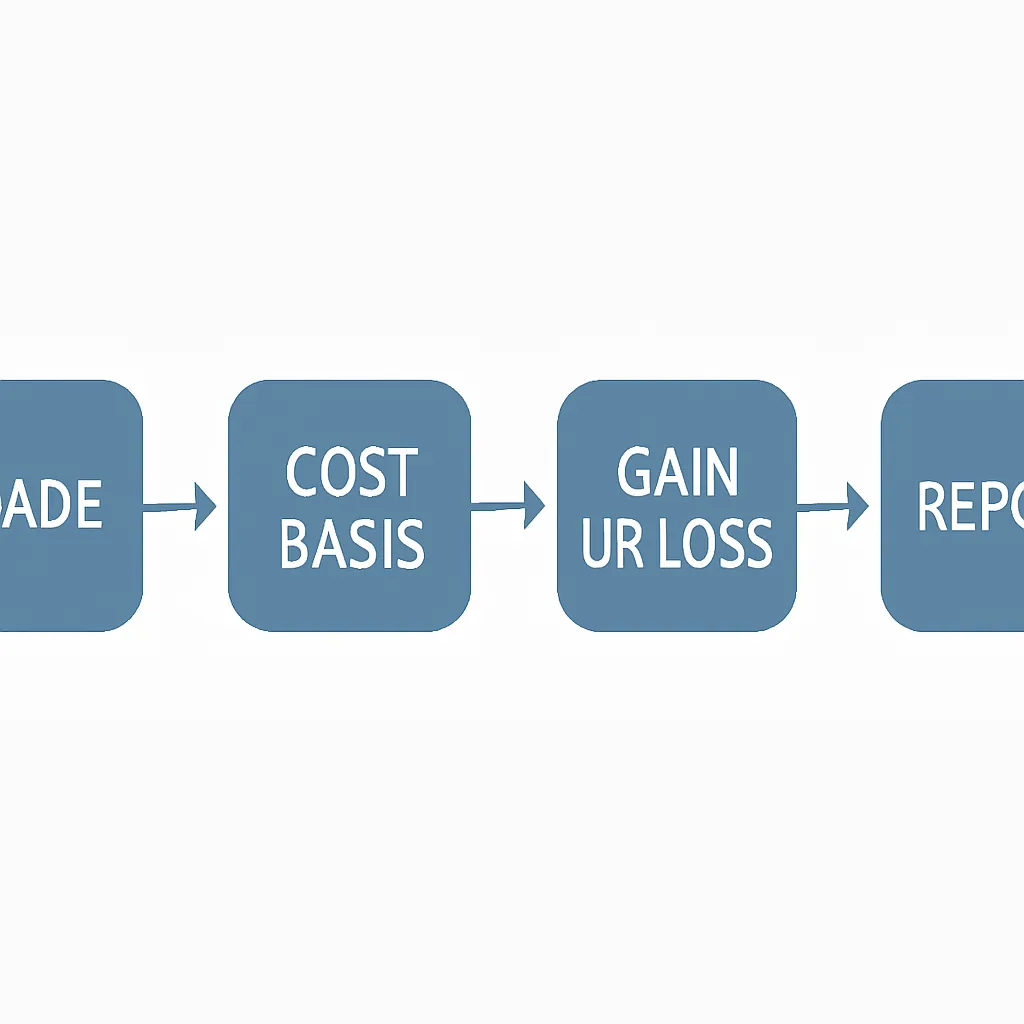
Even when personal taxes are minimal, keeping accurate records of your crypto transactions is still valuable. A good crypto tax calculator does far more than produce a number for HMRC or the IRS. It gives you a full picture of your portfolio, your cost basis on every position, your realised and unrealised gains, and a clean transaction history you can present to any authority or institution that asks.
Multi-Jurisdiction Support
UAE residents who also hold tax residency in another country, or who previously lived in the UK, US, Germany, or Australia, may still have obligations to those jurisdictions. Many crypto traders underestimate how long their home-country tax obligations follow them after relocation. A crypto tax calculator that supports multiple jurisdictions lets you model your liability across all relevant regimes at once, which removes guesswork and prevents expensive surprises.
Benefits Beyond Compliance
Beyond compliance, detailed records support legitimate financial planning. If you are applying for a mortgage, seeking institutional investment, or onboarding with a regulated exchange, having a clean, exportable crypto tax report demonstrates the kind of financial discipline that opens doors.
Cost Basis Methods and Why They Matter
Even in a jurisdiction where personal gains are not taxed, understanding cost basis remains critical for anyone who retains obligations to another country or who operates through a UAE-registered entity. The method used to calculate your cost basis directly affects the size of any reported gain or loss, and different jurisdictions permit different methods.
Cost Basis Methods Table
| Cost Basis Method | How It Works | Common Jurisdiction |
|---|---|---|
| FIFO (First In, First Out) | The oldest coins are treated as sold first | UK, US (default), Australia |
| LIFO (Last In, First Out) | The most recently acquired coins are sold first | US (permitted in some contexts) |
| HIFO (Highest In, First Out) | The highest-cost coins are sold first, minimising gains | US (permitted) |
| Average Cost Basis | Total cost divided by total units held | UK (for same-day and 30-day rules), Canada |
| Specific Identification | Trader selects which exact coins were sold | US (with adequate records) |
Toggling Between Methods
A well-built crypto capital gains calculator will let you toggle between these methods so you can see how each one affects your reported position. That flexibility is especially useful for traders who are transitioning between tax jurisdictions, as the cost basis you establish in one country can carry forward into another.
CARF and the UAE's Commitment to International Reporting
The UAE has signalled its commitment to the OECD's Crypto-Asset Reporting Framework, which is the global standard designed to make crypto transactions visible to tax authorities across borders. CARF works by requiring crypto service providers, including exchanges and wallet operators, to collect user information and report it automatically to the relevant tax authority, which then shares that data with other participating jurisdictions.
Implications for UAE Traders
What this means for UAE-based traders is straightforward: if you use a regulated exchange operating in the UAE or in any other CARF-participating country, your transaction data will eventually flow to the tax authority of your country of tax residency. For someone with continuing UK, US, or EU obligations, that is a direct line between your trading history and a tax authority that may be looking at it.
Proactive Reporting Benefits
Producing a complete crypto tax report before those automatic exchanges happen is always better than waiting to receive a query you were not prepared for. Filing proactively, even when no tax is owed, demonstrates transparency and avoids penalties that are typically triggered not by the tax itself but by late or absent reporting.
How to File Crypto Taxes if You Have Multi-Jurisdiction Obligations
Understanding how to file crypto taxes when you straddle two or more jurisdictions requires a systematic approach. The UAE does not require individuals to file a personal tax return, so there is no domestic filing obligation for most residents. The obligation is likely to originate from a former country of residence or a country where you hold citizenship that taxes on a worldwide basis.
Practical Steps for Filing
The practical steps are consistent regardless of which foreign jurisdiction applies:
First, gather every transaction record from every exchange, wallet, and DeFi protocol you have used during the relevant tax year. Incomplete records are the single most common cause of errors in crypto tax reports. Second, run those records through a crypto tax calculator that supports the cost basis method required by your target jurisdiction. Third, generate a formatted crypto tax report that matches the output format expected by that jurisdiction's tax authority. Fourth, review the output for anomalies before submitting, particularly around transfers between your own wallets, which should not be treated as disposals.
Using Crypto Tax Software
A reliable piece of crypto tax software will handle all of these steps automatically once you connect your exchanges and wallets via API or upload your transaction history in CSV format.
Illustrative Scenario
This scenario is illustrative. It does not describe a real person or client, and the figures are examples only.
To illustrate how this applies in practice, consider the following scenario:
Ahmed is a software engineer based in Dubai who relocated from the UK three years ago. He has been trading Bitcoin and Ethereum on a regulated exchange since before his move. Ahmed is no longer a UK tax resident, but he traded actively during his final UK tax year and has never filed a self-assessment return declaring those gains. Now, with CARF reporting expanding, his UK-registered exchange is preparing to share data with HMRC.
Ahmed decides to get ahead of the situation. He uploads his full transaction history, going back to his first trade, into CryptaTax. The software automatically applies HMRC's share pooling rules to his UK-period trades and generates a capital gains summary broken down by tax year. It identifies a reportable gain from his final UK year that falls above the annual exempt amount. Ahmed uses the crypto tax report to file an amended self-assessment for that year, paying the tax owed along with a small interest charge. Because he filed voluntarily before HMRC contacted him, no penalty applies. The entire process takes an afternoon.
Frequently Asked Questions
Do UAE residents pay crypto capital gains tax?
Individual UAE residents do not pay personal capital gains tax on cryptocurrency profits under the current federal framework. There is no personal income tax in the UAE, which extends to gains made from buying and selling crypto assets. However, if your activity is classified as a business operation, the UAE corporate tax introduced in 2023 may apply.
What is a crypto tax calculator and how does it work?
A crypto tax calculator is software that imports your transaction history from exchanges and wallets, applies the correct cost basis method for your jurisdiction, and calculates your realised gains and losses. It then produces a formatted crypto tax report you can use to file with your relevant tax authority. Most tools support API connections and CSV uploads to automate the data gathering process.
Can I use a crypto capital gains calculator for multiple countries?
Yes. Good crypto tax software lets you apply different cost basis methods and tax rules for different jurisdictions within the same transaction history. This is particularly useful for traders who have relocated and may carry obligations to both their current country and a former country of residence.
How do I calculate crypto taxes if I have thousands of transactions?
Manual calculation is impractical at scale. A crypto tax calculator automates the process by ingesting your full transaction history and computing gains, losses, and income events automatically. The key is making sure every exchange account and wallet is connected or uploaded so no transactions are missed, as gaps in the data are the most common source of errors.
What triggers a taxable crypto event in a country I used to live in?
In most jurisdictions, a taxable event occurs when you dispose of a crypto asset. Disposal includes selling for fiat, swapping one crypto for another, spending crypto on goods or services, and gifting crypto to someone other than a spouse. Simply holding crypto or transferring it between your own wallets is generally not a disposal, though you need complete records to prove the transfer was internal.
What is CARF and should UAE-based traders be concerned?
CARF stands for the Crypto-Asset Reporting Framework, an OECD standard that requires regulated crypto service providers to report user transaction data to tax authorities, who then share it with other participating jurisdictions. UAE-based traders who have continuing tax obligations in other CARF-participating countries should be aware that their transaction data may be visible to those authorities.
How do I file crypto taxes in the UK if I have moved to the UAE?
If you were UK tax resident during a year when you made crypto gains above the annual exempt amount, you are required to file a self-assessment return for that year even if you have since left the UK. You will need a complete transaction history for that period, and a crypto tax report produced using HMRC's share pooling rules. CryptaTax supports this calculation directly.
Does crypto tax software work for DeFi and staking income?
Most modern crypto tax software handles DeFi transactions including liquidity provision, yield farming, and staking rewards. The tax treatment of these activities varies by jurisdiction, with some treating staking rewards as income at the point of receipt and others deferring taxation until disposal. A reliable crypto tax calculator will apply the correct treatment based on the jurisdiction you select.
Is it worth producing a crypto tax report even if I owe nothing?
Yes, for several reasons. A clean crypto tax report demonstrates financial transparency to banks, exchanges, and regulators. It also establishes your cost basis for future disposals, which can significantly reduce your tax liability in later years. If you ever face a query from a tax authority, having pre-prepared records is far better than reconstructing your history under pressure.
What happens if I have not kept records of my crypto trades?
Incomplete records are a serious problem but not necessarily fatal. Many exchanges allow you to export historical transaction data going back several years. Blockchain explorers can also help reconstruct on-chain activity. Once you have gathered as complete a history as possible, a crypto tax calculator can process it and flag any gaps you still need to address before filing.
Source: CryptaTax