
Crypto Airdrop Tax in Canada: Airdrops, Mining, Staking and More
Canada Revenue Agency treats most crypto receipts as taxable income, and that includes far more than just selling coins on an exchange. Crypto airdrop tax is one of the most misunderstood areas: many Canadians assume that because they did not buy anything, they owe nothing. The CRA disagrees. Whether tokens land in your wallet unsolicited, whether you earned them by validating transactions, or whether a DeFi protocol deposited rewards overnight, a tax obligation can arise the moment you receive them. This guide covers how Canadian tax law applies to airdrops, mining income, staking rewards, DeFi yields, NFT transactions, and general crypto trading. The rules are not always straightforward, but understanding the framework early saves you from painful corrections at filing time.

How the CRA Classifies Crypto Income
The Canada Revenue Agency does not treat cryptocurrency as currency. It treats it as a commodity, which means gains and receipts are subject to either income tax or capital gains tax depending on the nature of the activity. This distinction matters enormously because income is taxed at your full marginal rate, while only half of a capital gain is included in your taxable income.
Income vs Capital Gains Distinction
The CRA uses a facts-and-circumstances test to decide which category applies. If you receive crypto through an activity that looks commercial or business-like, such as regular mining or running a validator node as a going concern, the receipts are likely business income. If you receive tokens passively or speculatively, capital gains treatment is more likely. There is no bright line, and the CRA has made clear it will look at frequency, intention, and the level of organisation behind your activity. Getting this classification wrong is one of the most common mistakes Canadian crypto filers make.
The table below summarises the general CRA position on common crypto activities:
| Activity | Likely Tax Treatment | Taxable Event |
|---|---|---|
| Buying and holding crypto | Capital gains on disposal | Sale, exchange, or gift |
| Receiving an airdrop | Income at receipt (generally) | Receipt of tokens |
| Mining (hobby) | Income at receipt | Receipt of mined tokens |
| Mining (business) | Business income at receipt | Receipt of mined tokens |
| Staking rewards | Income at receipt | Receipt of staking tokens |
| DeFi yield/interest | Income at receipt | Receipt of reward tokens |
| NFT sale | Capital gains or business income | Sale or exchange |
Crypto Airdrop Tax: What the CRA Expects
An airdrop is a distribution of tokens sent directly to wallet addresses, usually as a promotional exercise, a governance reward, or a fork-related distribution. For crypto airdrop tax purposes, the CRA's general position is that when you receive tokens with value, that value forms part of your income in the year of receipt. The fair market value of the tokens at the time they arrive in your wallet is what you report.
Valuation and Documentation Challenges
This creates a practical problem. Token prices on the day of an airdrop can be highly volatile, and many airdropped tokens are illiquid or not yet listed on major exchanges. You are still expected to make a reasonable valuation. Using the price on a reputable exchange at the time of receipt, or the closest available market price, is the standard approach. Document everything: the date, the number of tokens, the source of your price data.
There is one scenario where the CRA's position is less settled. If you receive tokens completely unsolicited with no action on your part and no expectation of receiving them, some tax practitioners argue the receipt may not trigger an immediate income event. The CRA has not issued explicit guidance on this scenario, so a conservative approach is to report the income unless the tokens have no determinable fair market value at all.
Your cost basis in the airdropped tokens is the value you reported as income at receipt. When you later sell or exchange them, you calculate a capital gain or loss relative to that cost basis.
Mining Income and How It Is Reported
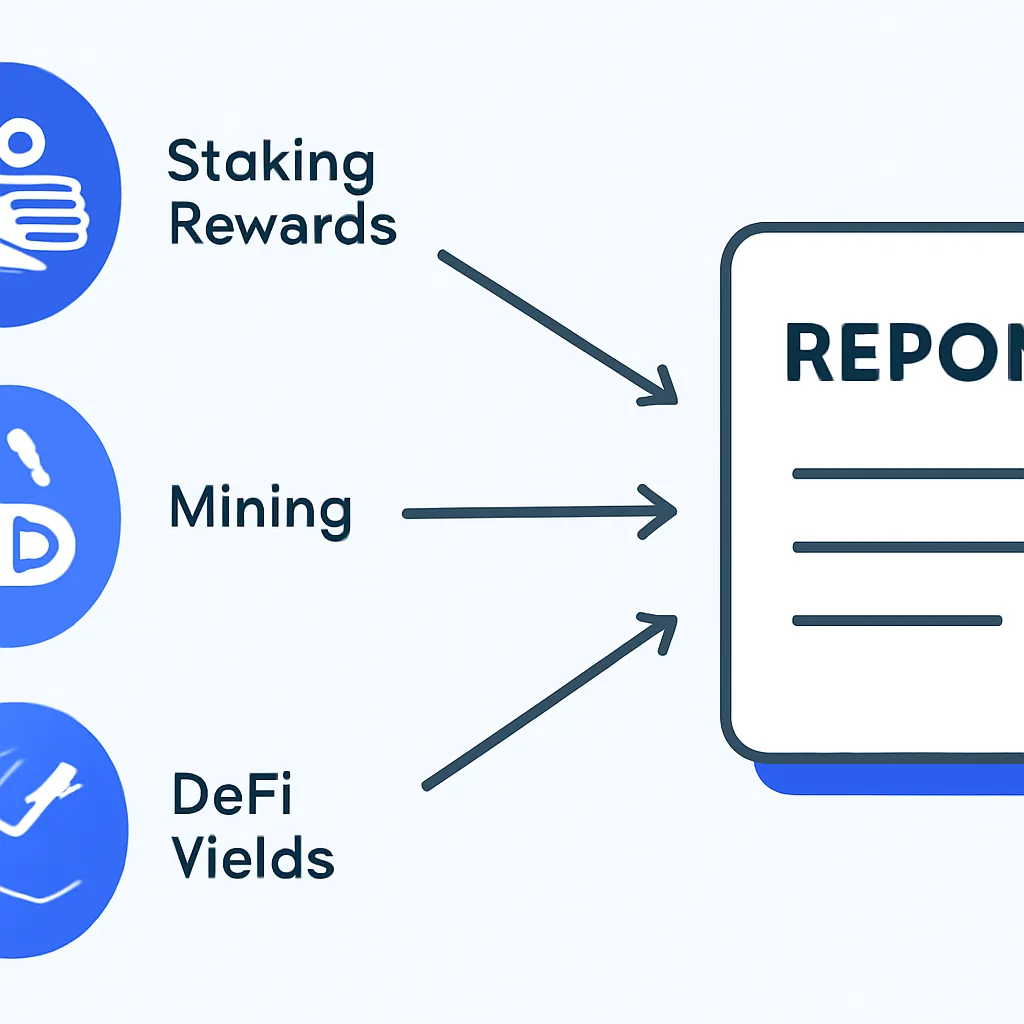
Crypto mining involves using computing power to validate blockchain transactions and earn newly issued tokens as a reward. For Canadian tax purposes, mining income is treated as income at the point the tokens are received, valued at fair market value on that date.
Hobby vs Business Mining
The key question is whether your mining activity is a business or a hobby. Hobby miners report income but cannot deduct related expenses against other income sources. Business miners can deduct electricity costs, hardware depreciation, internet costs, and other directly related expenses, which can significantly reduce the net taxable amount. The CRA looks at factors like scale, regularity, and whether you operate in a businesslike manner when making this call.
When a miner eventually sells the tokens they have mined, a second tax event occurs. The proceeds minus the cost basis (the value reported at receipt) produces a capital gain or loss. Business miners may instead treat this as business income depending on their overall treatment of the activity. Keeping meticulous records of every mined batch, including dates, quantities, and prices, is essential.
Crypto Staking Tax: Is Staking Taxable in Canada?
Is staking taxable in Canada? Yes, in the CRA's view it is. Crypto staking tax follows a similar logic to mining: when your staking activity generates reward tokens, you receive an economic benefit, and that benefit is taxable income at the time of receipt. The value of the tokens at that moment forms your income inclusion and becomes your cost basis for any future disposal.
Staking vs Mining Tax Treatment
Staking differs from mining mainly in mechanism, not in tax outcome. You lock up existing tokens to support network consensus rather than expending computing power, but the CRA treats both as producing taxable income on receipt. The question of whether it is business income or another income type again depends on the scale and commercial nature of your operation.
Liquid staking protocols, where you receive a derivative token in exchange for staking, add another layer of complexity. The CRA has not issued explicit guidance on liquid staking tokens, but receiving a new token in exchange for depositing an existing one could constitute a taxable exchange at the point of deposit. Practitioners generally advise treating it as a disposal of the original token at fair market value and recognising income on any rewards received.
How Are DeFi Rewards Taxed in Canada?
How are DeFi rewards taxed? The answer depends on what the protocol is actually doing with your assets. Broadly, the CRA treats any receipt of tokens with economic value as a taxable event. Providing liquidity to a protocol and receiving fee income or governance tokens as a reward follows the same income-at-receipt principle seen with staking and airdrops.
Lending and Yield Farming Tax
Lending your crypto through a DeFi protocol and receiving interest is treated as interest income, taxable in full at your marginal rate. If the interest is paid in tokens rather than fiat, you still value it at the fair market price of those tokens when received. Yield farming, where you move assets between protocols to maximise returns, generates multiple taxable events: each time you withdraw rewards, and potentially each time you move assets between pools if that constitutes a disposal.
DeFi tax is genuinely complex because the volume of transactions can be enormous and price data for obscure tokens can be hard to source. Automated tools that pull transaction history from your wallets and assign fair market values are not a luxury for active DeFi users; they are close to a necessity.
NFT Tax in Canada
NFT tax in Canada follows the same commodity framework. Creating and selling an NFT as part of a business, for example as a digital artist, produces business income. Buying an NFT as an investment and later selling it for a gain produces a capital gain. The CRA will look at your intent and the frequency of your transactions.
NFT Purchases and Disposals
When you buy an NFT using cryptocurrency, two events occur simultaneously. You dispose of the crypto used to pay, triggering a capital gain or loss on that crypto relative to your cost basis. You also acquire the NFT at its purchase price. If you later sell or trade the NFT, you calculate a gain or loss on that disposal too. Trading NFTs frequently using crypto creates a cascade of taxable events that can be surprisingly difficult to reconstruct without good records.
Royalties received by NFT creators each time their work is resold on secondary markets are also taxable income. The treatment, whether business income or property income, will depend on the creator's overall situation.
Crypto Trading Tax and Cost Base Calculations
Crypto trading tax in Canada is governed by the adjusted cost base method. Every time you acquire crypto, you add the cost to your ACB pool for that token. When you dispose of some or all of that token, you calculate your average cost per unit and use that to determine the gain or loss on the disposal. Disposals include sales for fiat, exchanges between cryptocurrencies, using crypto to pay for goods or services, and gifts.
Superficial Loss Rule Application
The superficial loss rule is also relevant. If you sell crypto at a loss and reacquire the same or an identical asset within 30 days before or after the sale, the CRA may deny the loss. This rule, designed to prevent artificial loss harvesting, catches many traders who do not realise it applies to crypto.
| Disposal Type | Tax Consequence | Notes |
|---|---|---|
| Sell crypto for CAD | Capital gain or loss | Proceeds minus ACB |
| Swap one crypto for another | Capital gain or loss | Deemed disposal at fair market value |
| Use crypto to buy goods | Capital gain or loss | Fair market value of goods = proceeds |
| Gift crypto to another person | Deemed disposal at fair market value | Recipient acquires at same value |
| Transfer between own wallets | No taxable event | ACB carries over |
Illustrative Scenario
This scenario is illustrative. It does not describe a real person or client, and the figures are examples only.
To illustrate how this applies in practice, consider the following scenario:
Priya is a freelance graphic designer based in Toronto who started exploring crypto in her spare time. Over the course of a tax year she received a token airdrop from a protocol she had previously used, earned staking rewards on a proof-of-stake network, swapped one token for another on a decentralised exchange, and sold an NFT she had purchased earlier in the year. She assumed none of this would be taxable because she never converted anything to Canadian dollars.
When Priya sits down with her records ahead of the CRA filing deadline, she realises she has at least four separate taxable events across different asset types. The airdrop is income at receipt. The staking rewards are income at receipt. The token swap is a deemed disposal triggering a capital gain. The NFT sale is a capital gain on top of the capital gain from spending the crypto to pay for it originally.
Using CryptaTax, Priya connects her wallets and exchange accounts, and the platform automatically pulls her transaction history, assigns fair market values, and calculates her ACB across each asset. What looked like a confusing tangle of on-chain activity becomes a clean summary she can hand to her accountant or file directly. The time saved is considerable, and more importantly, she files with confidence rather than guesswork.
Frequently Asked Questions
Do I have to pay crypto airdrop tax in Canada even if I did not ask for the tokens?
Generally yes. The CRA's position is that receiving tokens with a determinable fair market value creates a taxable income inclusion, regardless of whether you requested them. The only exception sometimes argued by practitioners is where tokens have no market value at all at the time of receipt. Document the receipt date and any available pricing information either way.
Is staking taxable in Canada?
Yes. Crypto staking tax in Canada means you report staking rewards as income at the fair market value of the tokens when you receive them. That value also becomes your cost basis for calculating any future capital gain or loss when you sell or exchange those tokens.
How are DeFi rewards taxed in Canada?
How are DeFi rewards taxed depends on the type of reward. Fee income, governance tokens, and yield farming rewards are generally treated as income at receipt. Interest paid by lending protocols is treated as interest income. All are valued at fair market value in Canadian dollars when received, and your cost basis in the received tokens is set at that value.
Does swapping one cryptocurrency for another trigger a tax event?
Yes. The CRA treats each crypto-to-crypto swap as a disposal of the outgoing token at its fair market value on the date of the transaction. Any gain above your adjusted cost base is a capital gain. This applies even on decentralised exchanges where no fiat ever changes hands.
How is NFT tax calculated in Canada?
NFT tax depends on your intent. Investment purchases sold at a profit are typically capital gains. Artists and frequent traders may be assessed as business income. You also need to account for the crypto used to purchase the NFT, since spending crypto is itself a disposal that can trigger a separate capital gain or loss.
Can I deduct crypto mining expenses in Canada?
If the CRA classifies your mining as a business activity, you can deduct directly related expenses such as electricity, hardware depreciation, and internet costs. Hobby miners report the income but cannot offset it with expenses. The distinction hinges on whether your operation is conducted in a commercial, organised, and profit-seeking manner.
What records do I need to keep for crypto tax in Canada?
You should keep records of every transaction including the date, the type of crypto involved, the quantity, and the fair market value in Canadian dollars at the time of the transaction. For airdrops and staking rewards, record the source of your price data. The CRA recommends keeping records for at least six years.
What happens if I forget to report crypto income in a previous year?
You can file an amended return or use the CRA's Voluntary Disclosures Program to correct past omissions before the CRA contacts you. Coming forward voluntarily can reduce or eliminate penalties and interest. Deliberately failing to report is considered tax evasion, which carries serious consequences including fines and potential prosecution.
Are transfers between my own wallets taxable in Canada?
No. Moving crypto between wallets you own is not a disposal and does not create a tax event. Your adjusted cost base carries over unchanged. You should still keep records of these transfers so you can demonstrate they were not sales if the CRA ever queries your transaction history.
What is the deadline for reporting crypto tax in Canada?
For most individuals, the CRA filing deadline is April 30 of the following year. Self-employed individuals and their spouses have until June 15, but any tax owed is still due by April 30 to avoid interest. Crypto income and capital gains are reported on your T1 General return using Schedule 3 for capital gains and the relevant income lines for business or other income.
Source: CryptaTax