
NFT Tax in Singapore: What Every Crypto Holder Needs to Know
Singapore has no capital gains tax, and that fact leads many NFT holders to assume they owe nothing when they sell a digital collectible for a profit. The reality is more nuanced. NFT tax obligations in Singapore depend on whether the Inland Revenue Authority of Singapore (IRAS) classifies your activity as a capital transaction or a trade. Get that distinction wrong and you could be sitting on an undisclosed income liability. This guide walks through how NFTs, DeFi rewards, staking income, and airdrops are treated under Singapore tax rules, so you can file with confidence rather than guesswork.
How Singapore Taxes Crypto and NFTs
Singapore does not levy tax on capital gains. This applies to crypto assets and NFTs just as it does to shares or property. If you buy an NFT as a long-term investment and later sell it at a profit, IRAS would generally treat that gain as capital in nature and it would fall outside the scope of income tax. The problem arises when the activity looks more like a business or trade. IRAS applies a facts-and-circumstances test, looking at factors such as how frequently you transact, whether you have a profit motive, how short your holding periods are, and whether you have relevant expertise or a business infrastructure behind what you do.
Capital Gains vs. Trading Income
For most casual collectors who buy and hold NFTs occasionally, the capital treatment is defensible. For someone flipping NFTs daily, minting and reselling in volume, or running a project as a commercial venture, IRAS is far more likely to treat proceeds as trading income, which is subject to income tax at the individual's marginal rate. There is no bright-line rule and that ambiguity makes record-keeping essential. You cannot retroactively reconstruct the facts that justify a capital position if you have not kept them from the start.
The following table summarises how IRAS broadly approaches different types of crypto and NFT activity.
IRAS Approach by Activity Type
| Activity | Likely Tax Treatment | Key Determining Factor |
|---|---|---|
| Occasional NFT purchase and sale | Capital, not taxable | Investment intent, infrequent trading |
| High-volume NFT flipping | Trading income, taxable | Frequency, profit motive, short holding periods |
| NFT minting and resale as a business | Business income, taxable | Commercial scale, systematic activity |
| Crypto trading (tokens) | Capital or trading income depending on facts | Same facts-and-circumstances test |
| DeFi rewards and staking | Likely income when received | Whether rewards represent a return for services or capital deployment |
| Airdrops | Depends on nature, possibly income | Whether received in exchange for something |
NFT Tax When You Sell or Swap
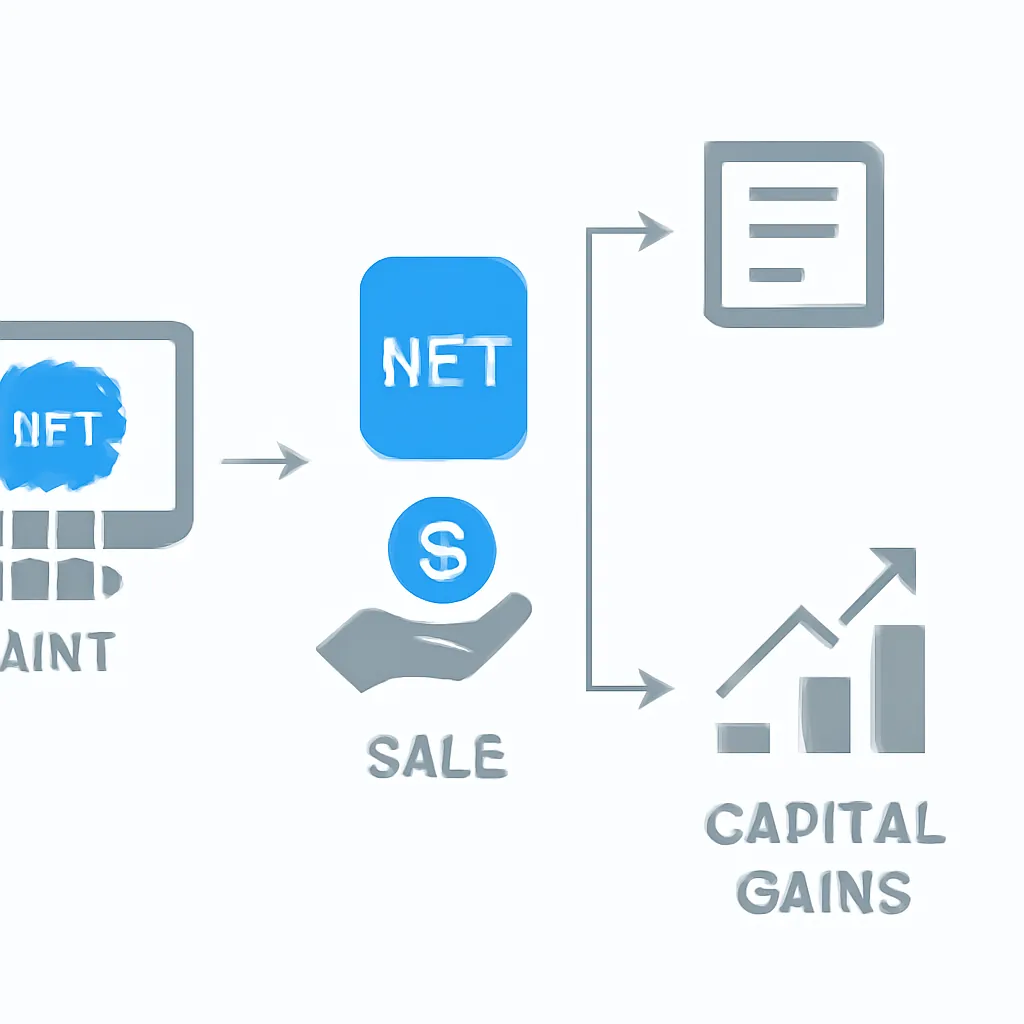
When you sell an NFT and receive Singapore dollars, another cryptocurrency, or a stablecoin in return, a taxable event may have occurred. If IRAS classifies your NFT activity as trading, the profit on that sale is income. You calculate it as the sale proceeds minus the cost of acquiring the NFT, including any gas fees or platform fees you paid at the time of purchase. Swapping one NFT for another NFT is also a disposal for tax purposes, and the same logic applies.
Taxable Events for Sales and Swaps
Crypto trading tax works on a similar basis. Selling a token for fiat, exchanging one token for another, or using crypto to buy goods or services are all treated as disposals. The gain or loss on each transaction is computed separately. Singapore does not allow you to aggregate all your crypto trades for the year into a single net figure unless you can demonstrate a consistent accounting basis that IRAS accepts. This makes transaction-level records not just helpful but necessary.
Royalty Income from NFT Creation
One point many traders overlook is royalty income from NFTs. If you are the original creator of an NFT and you receive a percentage of every secondary sale as a royalty, that income is generally taxable as business or professional income, regardless of whether the broader NFT activity is treated as capital.
DeFi Tax and How DeFi Rewards Are Taxed
DeFi tax is one of the least settled areas of Singapore crypto taxation. Decentralised finance covers a wide range of activities, from providing liquidity on automated market makers to lending assets, yield farming, and earning governance tokens as rewards. IRAS has not issued comprehensive guidance specifically for DeFi, which means you apply general income tax principles to each activity individually.
Rewards Taxed at Point of Receipt
When you receive tokens as a reward for providing liquidity or for lending assets through a DeFi protocol, IRAS would likely treat those rewards as income at the point of receipt. The value you report is the fair market value of the tokens at the time you receive them, converted to Singapore dollars. If you later sell those tokens, the difference between the sale price and the value you originally brought to account as income is a further gain or loss, and the same capital-versus-trading analysis applies again.
Governance Tokens and Valuation
How are DeFi rewards taxed when protocols distribute governance tokens rather than stablecoins? The same principle holds. The token has a market value when it arrives in your wallet, and that value is your cost base for any future disposal. If the token has no liquid market and no determinable value at the point of receipt, you record the value when a reliable price first becomes available. Keeping timestamped records of every reward and its value at receipt is the only way to produce a defensible DeFi tax position.
Crypto Staking Tax: Is Staking Taxable in Singapore?
Is staking taxable in Singapore? The short answer is yes, in most cases. When you stake cryptocurrency and receive staking rewards, those rewards are tokens with real economic value. IRAS treats receipts of value as income unless there is a clear reason to classify them otherwise. Staking rewards are broadly analogous to interest income on the basis that you are earning a return for locking up your capital, and income tax applies at the point of receipt.
Calculating Tax on Staking Rewards
The crypto staking tax calculation works the same way as DeFi rewards. You record the fair market value of each reward when you receive it. That figure becomes your cost base for those tokens. When you eventually sell the staked tokens or the rewards, you apply the capital-versus-trading test to any further gain. Someone who stakes a small amount of ETH and holds the rewards for years is in a very different position from someone running multiple validator nodes at commercial scale and selling rewards immediately.
Liquid Staking Disposal Events
Liquid staking adds a further layer of complexity. When you deposit a token and receive a liquid staking token in return, that exchange may itself constitute a disposal of the original token, triggering a taxable event before you have received any rewards at all. This is an area where the mechanics of the protocol matter enormously, and tracking what you sent, what you received, and when is critical.
| Staking Type | Potential Tax Event | When It Arises |
|---|---|---|
| Standard staking rewards | Income tax on receipt | When rewards arrive in wallet |
| Liquid staking deposit | Possible disposal of original token | At point of exchange for liquid staking token |
| Sale of staking rewards | Capital or trading gain/loss | At point of sale |
| Validator node operation | Business income | Ongoing, at receipt of each reward |
Crypto Airdrop Tax in Singapore
Crypto airdrop tax depends heavily on why you received the airdrop. IRAS distinguishes between a windfall you receive without doing anything, and a payment you receive in return for a service or action. If a protocol airdrops tokens to all wallets that held a particular asset on a snapshot date and you did nothing to earn them beyond holding, IRAS may treat that as a capital receipt, meaning no immediate income tax arises. Your cost base for those tokens is zero and any future gain on disposal is assessed under the usual trading-versus-capital framework.
Airdrops as Payment for Services
If you received the airdrop because you completed tasks, promoted a project, participated in a testnet, or otherwise performed work, the tokens are closer to payment for services. IRAS would be more likely to treat them as income at receipt. The same applies to tokens distributed as part of a compensation or loyalty programme. The line between a genuine windfall and a reward-for-action can be blurry, and you should document the circumstances at the time rather than rely on memory when filing later.
Record-Keeping: The Foundation of Every Tax Position
Every tax position described above relies on accurate, contemporaneous records. Singapore tax returns are self-assessed, meaning IRAS relies on you to report correctly. If your return is ever reviewed, you will need to show transaction dates, amounts, counterparty addresses, fair market values at the time of each event, and the basis on which you classified each transaction as capital or income. Reconstructing this from memory or from exchange dashboards months after the fact is unreliable.
Retaining Records for Five Years
You should retain records for at least five years from the date of filing. For NFTs, this means keeping purchase confirmations, gas fee receipts, sale records, and the wallet addresses involved. For DeFi and staking, you need logs of every reward, the block timestamp, and the token price at that moment. For airdrops, you need evidence of the circumstances under which the tokens arrived.
Using CryptaTax for Compliance
CryptaTax imports transaction data directly from wallets and exchanges, calculates fair market values at the point of each event, and produces a transaction-by-transaction summary that maps to your Singapore income tax filing. It removes the manual work that makes crypto tax so time-consuming and reduces the risk of errors that could draw unwanted attention from IRAS.
Illustrative Scenario
This scenario is illustrative. It does not describe a real person or client, and the figures are examples only.
To illustrate how this applies in practice, consider the following scenario:
Priya is a freelance graphic designer based in Singapore who began minting and selling NFTs of her digital artwork in late 2023. By the end of the tax year she had sold twelve NFTs through two different platforms, earned staking rewards on ETH she held in a DeFi protocol, and received a governance token airdrop from a protocol she had used regularly. She had kept no records of transaction dates, gas fees, or token prices at receipt.
When preparing her income tax return, Priya faced several questions. Were her NFT sales capital or trading income? How should she value the staking rewards she received at different points through the year? Did the airdrop need to be reported? Without records, she could not answer any of them confidently. Using CryptaTax, she connected her wallets and the platforms pulled in her full transaction history, timestamped each event, and assigned fair market values automatically. She could see immediately that her NFT volume and short holding periods pointed toward trading income, that her staking rewards had a calculable value at receipt, and that her airdrop had arrived without any associated action, supporting a capital classification. She filed with a clear audit trail behind every figure.
Frequently Asked Questions
Does Singapore have NFT tax?
Singapore does not have a capital gains tax, so NFT profits are not automatically taxable. However, if IRAS determines that your NFT activity constitutes trading or a business, the profits are treated as income and subject to income tax. The classification depends on factors such as frequency, holding period, and profit motive.
How is crypto trading tax calculated in Singapore?
If your crypto trading is classified as a trade by IRAS, you calculate taxable profit as sale proceeds minus acquisition cost, including transaction fees. Each disposal is assessed separately. You report the total trading profit on your annual income tax return and it is taxed at your marginal rate.
Is staking taxable in Singapore?
Yes, staking rewards are generally taxable as income in Singapore at the point of receipt. The taxable amount is the fair market value of the tokens when they arrive in your wallet. When you later sell the rewards, any further gain may also be taxable depending on whether IRAS treats the sale as capital or trading.
How are DeFi rewards taxed in Singapore?
DeFi rewards are generally treated as income when received, valued at fair market price at that moment. This applies to liquidity provision rewards, lending income, and yield farming returns. The tokens received become your cost base, and any gain on a subsequent sale is assessed under the capital-versus-trading framework.
Is a crypto airdrop taxable in Singapore?
It depends on the circumstances. Airdrops received passively, without any action on your part, may be treated as capital receipts with no immediate income tax. Airdrops received as payment for tasks, promotion, or participation in a project are closer to income and more likely to be taxable at receipt.
What records do I need to keep for crypto tax in Singapore?
You should keep transaction dates, amounts, wallet addresses, the fair market value of tokens at each event, and the basis for any tax classification you applied. Records should be retained for at least five years from the date of filing. This applies to NFT sales, staking rewards, DeFi activity, and airdrops alike.
Do I need to report NFT royalties in Singapore?
Yes. If you created an NFT and receive royalties from secondary sales, those payments are taxable as business or professional income. This applies regardless of how your broader NFT activity is classified. Royalty income should be reported on your annual income tax return.
What happens if I swap one NFT for another?
Swapping one NFT for another is a disposal of the first NFT and an acquisition of the second. If your NFT activity is classified as trading, any gain on the first NFT at the point of the swap is taxable income. The value of the NFT you receive becomes your cost base for the next disposal.
Does IRAS have specific DeFi tax guidance?
IRAS has not published comprehensive guidance specifically addressing DeFi. You apply general income tax principles to each DeFi activity individually. Because the rules are not codified for these products, detailed record-keeping and a consistent accounting approach are especially important.
Can I use software to prepare my Singapore crypto tax return?
Yes. Crypto tax software such as CryptaTax can import your transaction history from wallets and exchanges, assign fair market values at each event, and generate a summary that supports your Singapore income tax filing. Using software reduces errors and ensures you have a defensible audit trail if IRAS ever asks questions.
Source: CryptaTax