
NFT Tax Explained: What Every Individual Needs to Know
NFT tax is one of the most searched and least understood corners of crypto taxation. Whether you bought a digital artwork, flipped a gaming item, or received tokens through a play-to-earn platform, the tax authority in your country very likely has an opinion on what you owe. The core principle is consistent across most major jurisdictions: an NFT is treated as a capital asset, and disposing of it triggers a taxable event. That disposal could be a straightforward sale for cash, an exchange for another NFT, or even using an NFT to pay for something. Understanding where the liability arises, and how to calculate it accurately, is what separates a clean tax return from an expensive correction later. This guide covers the full picture, from the moment you mint or buy an NFT through to selling, trading, and receiving rewards from DeFi and staking activity.
How NFT Tax Works: The Basics of Capital Gains
Most tax authorities classify NFTs as a form of property or intangible asset rather than currency. That classification matters enormously. When you sell a property asset at a profit, the gain is taxable. When you sell at a loss, the loss may offset other gains. The same logic applies to NFTs. Your taxable gain is the difference between what you received on disposal and your cost basis, which is what you originally paid for the NFT plus any directly attributable acquisition costs such as gas fees.
Short-Term vs Long-Term Rates
Short-term and long-term holding periods affect the rate in several jurisdictions. In the United States, for example, assets held for more than one year qualify for lower long-term capital gains rates. In the United Kingdom, individuals benefit from an annual capital gains allowance before any tax is due, although that allowance has been significantly reduced in recent years. Germany has historically allowed tax-free disposal of certain crypto assets held for more than one year, though NFTs sit in a more contested category there. The key takeaway is that the holding period clock starts from the date of acquisition, so accurate record-keeping from day one is essential.
The following table summarises how several major jurisdictions broadly approach NFT tax for individuals.
Global Tax Treatment Table
| Jurisdiction | General Classification | Short-Term Treatment | Long-Term Treatment |
|---|---|---|---|
| United States | Property (capital asset) | Ordinary income rates apply | Reduced long-term CGT rates after 12 months |
| United Kingdom | Intangible property / CGT asset | Capital gains tax at 18% or 24% | Same rate, annual allowance applies |
| Australia | Capital gains tax asset | Full gain taxed as income | 50% discount after 12 months |
| Germany | Private asset under EStG | Full gain taxed as income | Contested; long-term exemption uncertain for NFTs |
| Canada | Property | 50% of gain included in income | Same inclusion rate applies |
NFT Tax Events: Every Transaction That Triggers a Liability
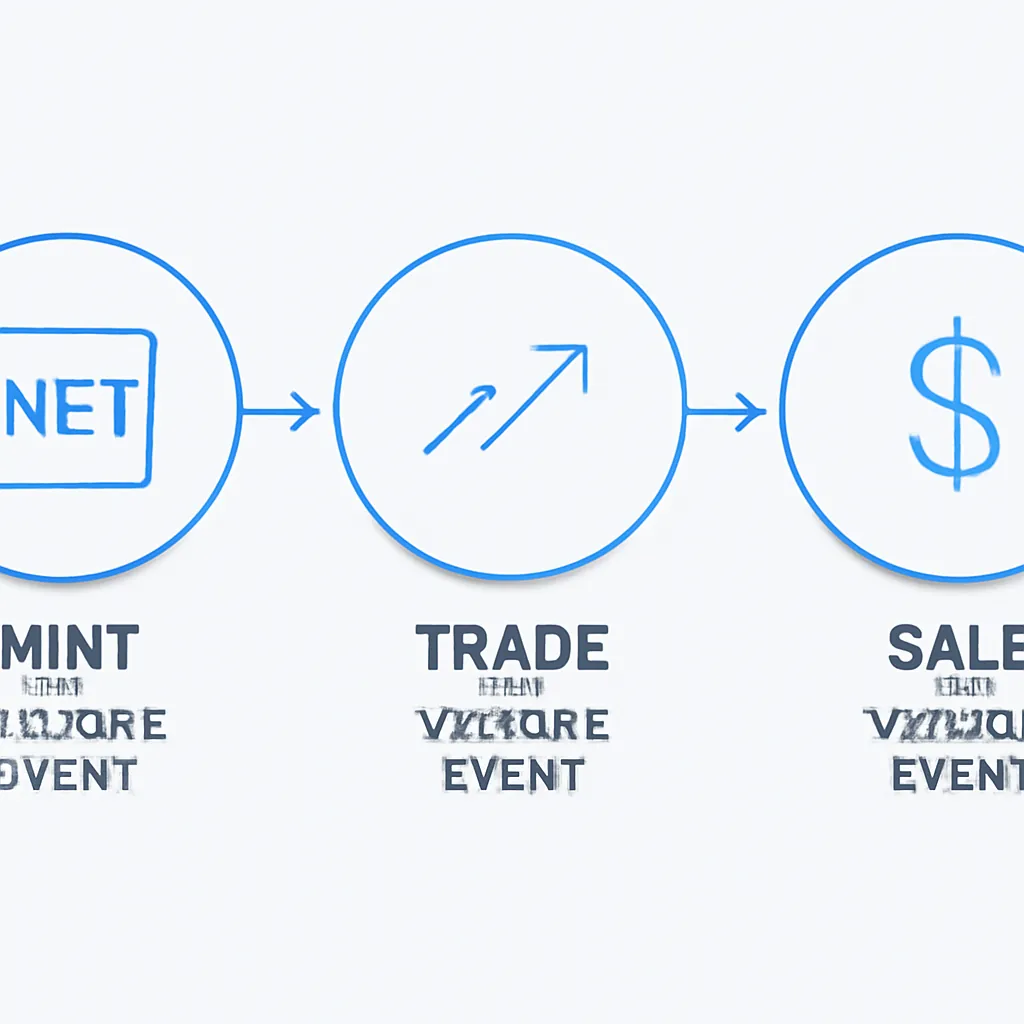
A common misconception is that only selling an NFT for fiat currency creates a tax event. In reality, tax authorities consider several types of transaction as taxable disposals, and ignoring them is one of the most frequent mistakes individual filers make.
Selling and Trading NFTs
Selling an NFT for cryptocurrency is a disposal. You are not simply swapping tokens; you are disposing of one asset and acquiring another, and the gain or loss on the NFT you sold must be reported. Trading one NFT for another NFT works the same way. The fair market value of what you received is treated as the proceeds of sale, and the difference between that value and your original cost base determines your gain or loss.
Minting an NFT is generally not a taxable event in most jurisdictions, though the gas fees paid during minting may form part of your cost basis. However, if you mint an NFT and immediately sell it, the entire proceeds less your minting cost may be treated as income rather than a capital gain in some jurisdictions, particularly if you are seen to be carrying on a trade.
Gifting, Prizes, and Airdrops
Gifting an NFT can also trigger a disposal at market value in jurisdictions such as the UK and US, even though no cash changes hands. The recipient typically inherits a cost basis equal to the market value at the date of the gift. Receiving an NFT as a prize, reward, or airdrop is often treated as income at the point of receipt, with the market value at that moment forming the cost basis for any future disposal.
DeFi Tax and NFTs: When Protocols Add Complexity
DeFi tax questions arise frequently for NFT holders who go beyond simple trading. Many NFT platforms and DeFi protocols allow holders to stake NFTs, provide liquidity using NFT positions, or earn token rewards simply by holding a particular collection. Each of these activities carries its own tax treatment, and the rules are not always straightforward.
Taxation of DeFi Rewards
How are DeFi rewards taxed when they come from an NFT-linked protocol? In most jurisdictions the answer is that rewards are treated as ordinary income at the fair market value on the date of receipt. This is the same general principle that applies to interest income or employment income. You recognise the income when you receive the tokens, and your cost basis in those tokens is the value at which you recognised that income. A subsequent disposal of those reward tokens then creates a separate capital gain or loss event.
Liquidity Provision Complexity
Liquidity provision involving NFTs, particularly on automated market makers that use NFT positions to represent liquidity ranges, adds another layer. Some tax practitioners argue that depositing assets into a liquidity pool constitutes a disposal of those assets. Others argue it represents a lending or pooling arrangement that defers any gain. Guidance from tax authorities on this specific point remains limited in most countries, so the prudent approach is to record every entry and exit with full valuations and seek professional advice if the amounts are material.
Crypto Staking Tax and NFT Staking: Is Staking Taxable?
Is staking taxable? The short answer in most jurisdictions is yes, at least at the point of reward receipt. Crypto staking tax treatment has evolved rapidly as regulators have sought to apply existing income frameworks to a new activity. When you stake tokens or NFTs and receive rewards, the dominant view among tax authorities is that those rewards represent income earned, not a creation of new property with a zero cost basis.
Global Staking Tax Positions
In the United States, the IRS has maintained that staking rewards are gross income at fair market value when received. The UK's HMRC takes a similar position, treating staking income as either miscellaneous income or trading income depending on the scale and organisation of the activity. Australia's ATO also treats staking rewards as ordinary income on receipt.
NFT Staking Reward Rules
For NFT staking specifically, the same logic applies. If you stake an NFT and receive cryptocurrency tokens as a reward, you recognise that income at the value of the tokens on the day they arrive in your wallet. Whether the NFT itself is considered disposed of during the staking period is a separate question and depends on whether you retain legal ownership and control throughout the staking arrangement. Where a smart contract temporarily holds your NFT, some advisers argue this constitutes a disposal and reacquisition, generating a potential gain or loss even without a third-party sale.
Crypto Airdrop Tax and NFT Drops: Free Tokens Are Not Always Free
Crypto airdrop tax catches many individuals off guard. Receiving tokens or NFTs for free sounds like a windfall with no strings attached. In most jurisdictions, however, the fair market value of an airdrop at the time of receipt is treated as taxable income, not a gift. This applies whether you actively claimed the airdrop or it arrived unsolicited in your wallet.
Tax on NFT Drops
NFT drops work on the same principle. If a project distributes NFTs to existing holders of a collection, the recipients generally owe income tax on the market value of those NFTs at the point of receipt. If the NFTs have no established market value at that point, the income recognised may be minimal or arguable. However, when you later sell those NFTs, the disposal proceeds will almost entirely represent a gain unless you have a defensible cost basis.
The following table outlines how airdrop and NFT drop income is commonly treated across key jurisdictions.
Jurisdiction Airdrop Table
| Jurisdiction | Airdrop Treatment at Receipt | Cost Basis for Future Disposal |
|---|---|---|
| United States | Ordinary income at FMV | FMV at date of receipt |
| United Kingdom | Miscellaneous income if in exchange for a service; otherwise no immediate income charge in some cases | FMV at date of receipt or nil if no income charged |
| Australia | Ordinary income at FMV | FMV at date of receipt |
| Canada | Business income or capital, depending on context | FMV at date of receipt |
Crypto Trading Tax and NFT Flipping: When Hobby Becomes a Trade
Crypto trading tax principles become especially relevant for active NFT flippers. Tax authorities in many countries draw a distinction between investing in assets and carrying on a trading business. An investor pays capital gains tax on profits. A trader pays income tax, which is typically a higher rate and applies to the full profit rather than just the gain above a threshold.
Investor vs Trader Factors
The factors that push someone from investor to trader vary by jurisdiction but commonly include the frequency of transactions, the intention at the point of purchase, the holding period, the use of leverage, and whether the activity is organised in a businesslike manner. Someone who buys and sells dozens of NFT collections each month, tracks floor prices daily, and reinvests proceeds systematically is more likely to be classified as a trader than someone who holds a few pieces for appreciation over years.
Trading Classification Impact
If you are classified as trading, your NFT profits are treated as business income. You may be able to deduct business expenses such as gas fees, platform fees, and software costs, but you lose the benefit of lower capital gains rates and annual exemptions. Getting this classification right from the outset is important because reclassification by a tax authority after the fact can result in significant additional tax plus interest and penalties.
Record-Keeping: The Foundation of Every Clean NFT Tax Return
No matter how well you understand the rules, poor records will undermine your tax position. Every NFT transaction needs a clear paper trail: the date of acquisition, the asset description, the cost in your local currency at the time of purchase, the transaction fees, the date of disposal, and the proceeds received in local currency at the time of disposal. Where you receive NFTs or tokens as income, you also need to record the fair market value on the date of receipt.
Risk of Omitting Transactions
Blockchain records are permanent and publicly accessible, which means tax authorities can, in principle, reconstruct your transaction history. The risk of omitting transactions is real. Exchanges and platforms are increasingly required to report user activity to tax authorities under frameworks such as DAC8 in the European Union and the OECD's Crypto-Asset Reporting Framework. Proactively maintaining accurate records is not just good practice; it is the only reliable defence if your return is queried.
CryptaTax Automation Benefits
CryptaTax automates the import of wallet and exchange transactions, calculates cost basis using accepted methods, and produces a ready-to-file tax report for individuals with NFT activity across multiple chains and platforms. Connecting your wallets takes a few minutes, and the platform handles the complexity of matching acquisitions to disposals even across DeFi protocols.
Illustrative Scenario
This scenario is illustrative. It does not describe a real person or client, and the figures are examples only.
To illustrate how this applies in practice, consider the following scenario: Sarah is a UK-based graphic designer who started collecting NFTs in 2022. Over the past two years she has purchased several pieces, sold three at a profit, received two NFT airdrops from a collection she held, and staked tokens earned from a DeFi protocol linked to one of her NFTs. When the tax year ends, Sarah realises she has no organised record of any of these transactions. She remembers roughly what she paid but cannot recall the exact dates or the sterling values at the time of each trade.
Sarah connects her Ethereum wallet to CryptaTax, which automatically pulls in every transaction and converts each one to sterling using historical exchange rate data. The platform identifies her taxable disposals, calculates the gain on each, flags the airdrop receipts as potential miscellaneous income, and separates the DeFi staking rewards into a separate income schedule. Sarah's total tax position is calculated within minutes. She can see exactly what she owes, verify each transaction, and export a report her accountant can use to file her self-assessment return. Without that automated process, she would have faced hours of manual work and a genuine risk of under-reporting.
Frequently Asked Questions
Do I have to pay NFT tax if I did not cash out to my bank account?
Yes, in most jurisdictions. A taxable disposal occurs when you sell, trade, or gift an NFT, regardless of whether you convert the proceeds to fiat currency. If you sell an NFT for ETH and leave the ETH in your wallet, you have still disposed of the NFT and may owe NFT tax on any gain.
How is NFT tax calculated if I bought using cryptocurrency?
Your cost basis is the fair market value of the cryptocurrency you spent at the time of the purchase, converted to your local currency. When you later sell the NFT, the gain is the disposal proceeds in local currency minus that cost basis. You may also have a separate gain or loss on the cryptocurrency you used to buy the NFT.
Is staking taxable if I stake an NFT rather than tokens?
Yes, in most jurisdictions, the rewards you receive from NFT staking are treated as taxable income at their fair market value on the date of receipt. This is the same principle that applies to crypto staking tax generally. Whether the NFT staking arrangement itself triggers a disposal depends on who controls the asset during the staking period.
How are DeFi rewards taxed when they come from NFT-linked protocols?
DeFi tax treatment generally requires you to recognise ordinary income at the fair market value of the reward tokens when they are received. The cost basis of those tokens is then set at the value you declared as income. A subsequent sale of those tokens creates a separate capital gain or loss.
What is the crypto airdrop tax position if I never sold the NFTs received?
In many jurisdictions, particularly the US and Australia, you may owe income tax on the value of the airdropped NFTs at the time of receipt, even if you have not sold them. The cost basis for future disposals is typically set at the value on which you paid income tax, which reduces the gain when you eventually sell.
Can I offset NFT losses against other capital gains?
In most jurisdictions, yes. Capital losses from NFT disposals can generally be offset against capital gains from other assets in the same tax year, and in many countries surplus losses can be carried forward to future years. The precise rules vary, so it is worth confirming the position in your country of residence.
Does crypto trading tax apply if I flip NFTs frequently?
It might. Tax authorities in many countries can reclassify frequent NFT trading as a trading business rather than investment activity. If that happens, your profits are taxed as income rather than capital gains, which is often less favourable. Frequency of trades, holding periods, and evidence of a systematic approach are all factors that influence this determination.
Are gas fees deductible from my NFT tax calculation?
Generally yes. Gas fees paid to acquire an NFT typically form part of your cost basis, which reduces the taxable gain on disposal. Gas fees paid on disposal can often be deducted from the proceeds. Fees paid during other activities, such as transferring between wallets, may have more limited deductibility depending on your jurisdiction.
Do I need to report NFTs worth very little or with no buyers?
Technically, any disposal should be reported, even if the asset is effectively worthless. In practice, if an NFT has become genuinely valueless and there is no active market, some jurisdictions allow you to claim a negligible value, which crystallises a loss you can use against other gains. Document the market conditions carefully if you take this approach.
Which countries have the clearest NFT tax guidance?
The United States, United Kingdom, and Australia have issued the most detailed guidance applying existing capital gains and income frameworks to crypto assets including NFTs. Many other countries apply general property or capital gains rules without specific NFT guidance, which creates uncertainty. If you are based in a jurisdiction with limited guidance, the safest position is to follow the treatment applied to other crypto assets until specific rules are published.
Source: CryptaTax