
DeFi Tax in the Netherlands: Staking, Trading, NFTs and Airdrops Explained
If you hold crypto or use DeFi protocols in the Netherlands, the tax question is never far away. The Dutch tax authority, the Belastingdienst, does not treat digital assets as a novelty. Crypto holdings, staking rewards, liquidity pool positions, NFTs and airdrops all fall somewhere inside the existing Dutch tax framework. Understanding where each activity lands is the difference between filing confidently and filing incorrectly. This guide covers how defi tax works in the Netherlands across the most common activities, what the Dutch box system means for your crypto, and how to avoid the mistakes that trip people up every year. The rules here reflect the current Dutch approach to crypto taxation and apply to residents filing a Dutch income tax return.
How the Dutch Tax System Treats Crypto
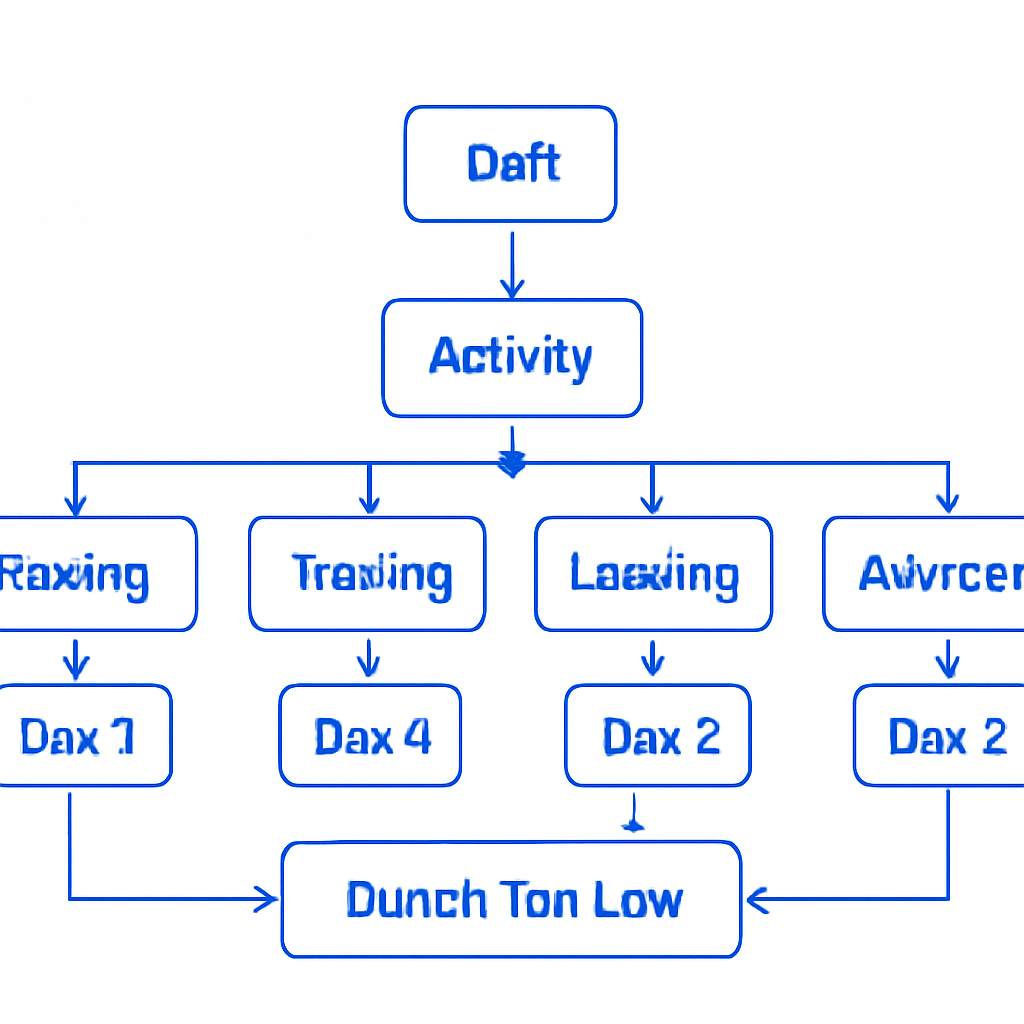
The Netherlands uses a schedular income tax system built around three boxes. Box 1 covers income from work and home ownership, taxed at progressive rates. Box 2 covers substantial shareholdings. Box 3 covers savings and investments, and this is where the vast majority of crypto sits for most Dutch residents.
Box 3 Deemed Return System
Under Box 3, the Belastingdienst does not tax your actual gains. Instead, it applies a deemed return to the total value of your assets above a threshold on 1 January each year. You declare the fair market value of your crypto on that date, and the system assumes a notional return on that value. Tax is then charged on the assumed return, not on what you actually made or lost during the year.
This approach has significant implications. A trader who made large profits through the year is not necessarily taxed on those profits if the portfolio value at year-end is modest. Conversely, someone holding a large position on 1 January pays Box 3 tax even if the market subsequently collapsed. The penal nature of Box 3 for crypto holders was underlined by court rulings that have kept pressure on the Dutch government to reform the system, though reform has been slow.
There is one important exception. If the Belastingdienst considers your crypto activity to go beyond passive investing and constitute a professional or entrepreneurial activity, income moves to Box 1 and is taxed at much higher progressive rates. The dividing line between hobbyist and professional is fact-specific and not always obvious.
DeFi Tax: How Decentralised Finance Activity Is Classified
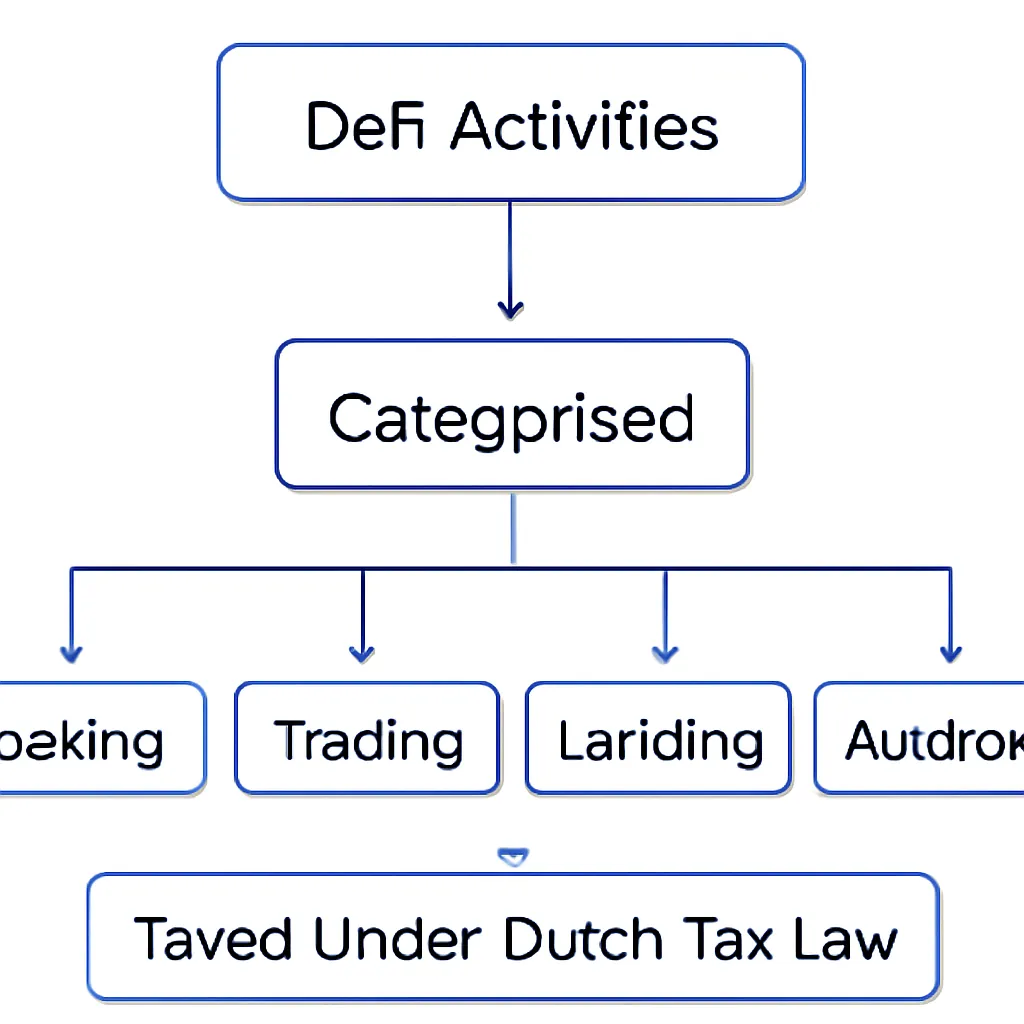
DeFi activity spans a wide range of transactions: providing liquidity to automated market makers, lending assets on protocols, yield farming, staking, and more. For Dutch tax purposes, the starting question is always the same: does this generate income taxed in Box 1, or does it simply affect the value of assets held in Box 3?
DeFi as Box 3 Investment
For most individuals, DeFi positions are treated as investment assets sitting inside Box 3. The value of your liquidity pool tokens, lending positions, or staked assets is included in your Box 3 wealth on 1 January. You are not taxed on each individual reward or fee you receive throughout the year as a separate income event, the way some other jurisdictions treat it. The whole position is swept into the deemed-return calculation.
That said, the picture is not entirely clean. If you are actively managing DeFi strategies at scale, rotating between protocols frequently, or generating income from DeFi as a primary source of livelihood, the Belastingdienst may argue that this crosses into Box 1 territory. There is no published bright-line rule. The Belastingdienst looks at factors including time spent, frequency of activity, and the systematic nature of profit-seeking.
Record-Keeping for DeFi
Keeping clear records of every DeFi transaction, including the date, the protocol, the tokens involved, and the euro value at the time, is essential. Even under Box 3, you need to be able to justify your declared asset value on 1 January if the Belastingdienst asks.
Crypto Staking Tax and Is Staking Taxable in the Netherlands
Staking is one of the most common questions among Dutch crypto holders. The short answer is yes, staking is taxable, but the mechanism is different from what many people expect.
Staking Rewards in Box 3
For most individual stakers, staking rewards do not create a taxable income event at the moment they are received. The staked assets and any accrued rewards form part of your total Box 3 wealth. If your staking position has a measurable euro value on 1 January, that value is included in your wealth declaration. The notional return is then applied to the total, and you pay tax on the deemed return rather than on the actual staking yield.
This contrasts sharply with the UK or US approach, where staking rewards are treated as income at receipt and taxed accordingly. Dutch stakers are not charged income tax every time a reward lands in their wallet. The tax arises from holding the asset, not from receiving the reward itself.
Professional Staking in Box 1
However, if staking is conducted through a business structure, or if the scale and regularity of the activity suggests a professional operation, the position shifts. In a Box 1 scenario, the value of each staking reward at receipt could be treated as business income. This is a meaningful distinction for anyone running validator nodes or managing significant delegated staking positions.
| Activity | Typical Dutch Tax Treatment | Tax Box |
|---|---|---|
| Holding crypto (passive) | Deemed return on asset value at 1 Jan | Box 3 |
| Staking rewards (individual) | Included in Box 3 wealth value | Box 3 |
| DeFi liquidity provision (individual) | Position value included in Box 3 wealth | Box 3 |
| Crypto trading (professional) | Profits taxed as income | Box 1 |
| Airdrops (individual) | Generally included in Box 3 wealth | Box 3 (case-specific) |
| NFT sales (professional) | Profits taxed as income if systematic | Box 1 (case-specific) |
Crypto Trading Tax: When Does Active Trading Change Your Obligations?
Crypto trading tax in the Netherlands depends heavily on whether your activity qualifies as investing or as a professional trade. For a typical retail investor buying and selling crypto a handful of times per year, Box 3 applies. Capital gains are not taxed directly. The value of your portfolio on 1 January is what matters.
Active Trading as Professional Activity
But frequency and intent matter. Someone who trades daily, uses leverage, and treats crypto as a business will struggle to argue that their activity is passive investing. Dutch tax case law on what constitutes a profession or business applies here, even though it predates crypto. The Belastingdienst looks at the presence of a business plan, the use of special knowledge or skill, the volume of transactions, and whether the activity is structured for profit in a systematic way.
Box 1 Tax and Loss Deduction
If Box 1 applies, you declare actual profits as income and pay progressive income tax. Losses are deductible against other Box 1 income. The record-keeping burden increases substantially, because you need transaction-level cost basis data, not just a single valuation date.
Crypto Airdrop Tax and How Airdrops Are Handled
Crypto airdrop tax is an area where Dutch rules are not perfectly codified, and individual circumstances matter. An airdrop is typically an unsolicited distribution of tokens to wallet holders. Under the general Box 3 framework, tokens you receive and hold will be included in your 1 January wealth valuation if they have a market value at that date.
Airdrop as Box 1 Income
The question of whether an airdrop triggers an immediate Box 1 income event is less settled. If you received tokens in exchange for a service, for example completing tasks or promoting a protocol, there is a stronger argument that the tokens constitute remuneration and should be declared as income in Box 1. If the airdrop was genuinely unsolicited and required no action on your part, the Box 3 treatment is more defensible.
Governance token distributions, protocol rewards paid to liquidity providers, and referral bonuses all sit in slightly different positions. The Belastingdienst has not published specific guidance covering every category of DeFi reward, so the safest approach is to document the nature of each airdrop received, the date, and the euro value at receipt, and seek advice if the amounts are material.
NFT Tax in the Netherlands
NFT tax follows the same basic framework as other crypto assets. An NFT held as an investment is included in Box 3 wealth at its fair market value on 1 January. For most collectors and passive holders, there is no tax on individual sales during the year. The gain realised on a sale does not create a separate taxable event under Box 3.
Professional NFT Activity in Box 1
The exception, again, is professional activity. An artist minting and selling NFTs as a business is clearly operating in Box 1. Someone who buys and flips NFTs at high volume, with a systematic approach to identifying profitable projects, may also find that the Belastingdienst classifies their activity as a trade. In that case, each sale generates taxable income, and the cost basis of each NFT becomes relevant.
Valuation of Illiquid NFTs
Valuing NFTs for Box 3 purposes can be practically difficult, especially for illiquid or unique pieces. Where there is no active market, the Belastingdienst expects a reasonable estimate. Documenting your valuation methodology is sensible practice.
| NFT Holder Type | Tax Treatment | Key Consideration |
|---|---|---|
| Passive collector | Box 3 wealth inclusion at 1 Jan value | Valuation of illiquid NFTs |
| Artist (primary sales) | Box 1 income from sale proceeds | Treated as self-employment income |
| Active flipper (systematic) | Potentially Box 1 if professional activity | Frequency and intent are assessed |
Illustrative Scenario
This scenario is illustrative. It does not describe a real person or client, and the figures are examples only.
To illustrate how this applies in practice, consider the following scenario:
Lars is a 34-year-old software developer based in Amsterdam. He holds Ethereum, participates in a DeFi lending protocol, and has been staking a portion of his ETH for the past two years. He also received a governance token airdrop last spring and bought two NFTs as speculative investments. Lars is not a professional trader. He works full-time and manages his crypto in the evenings.
When Lars files his Dutch income tax return, he values all of his crypto positions as of 1 January: his ETH, his lending protocol position, his staked ETH and accumulated rewards, the airdropped tokens, and the NFTs. The total is declared as part of his Box 3 wealth. He pays tax on the notional deemed return applied to that wealth, not on any actual gains or staking yields received during the year.
Lars uses CryptaTax to pull transaction data from his wallets and protocols, calculate the 1 January valuations, and generate a summary ready for his tax return. The airdrop sits in Box 3 because he took no action to receive it. His NFTs are valued using the last available sale price for comparable pieces. The whole process takes an afternoon rather than a weekend.
Frequently Asked Questions
How does defi tax work in the Netherlands?
For most individuals, DeFi positions are treated as investment assets under Box 3 of the Dutch tax system. The euro value of your DeFi holdings is included in your total wealth declaration on 1 January each year, and you pay a deemed return tax on that value. You are not taxed on individual transactions or rewards received during the year, unless your activity qualifies as professional.
Is staking taxable in the Netherlands?
Yes, staking is taxable, but not in the way many people expect. Staking rewards are generally not taxed as income when received. Instead, the value of your staked assets and rewards forms part of your Box 3 wealth on 1 January. Tax is charged on a notional deemed return applied to that total wealth, not on the actual yield your staking generated.
How are DeFi rewards taxed in the Netherlands?
DeFi rewards such as liquidity fees, yield farming returns, and lending interest are generally captured within the Box 3 wealth framework. The value of any tokens held as a result of DeFi activity is included in your 1 January wealth total. If your activity is so frequent or systematic that it constitutes a profession, rewards may instead be treated as Box 1 income.
What is the crypto trading tax rate in the Netherlands?
For passive investors, there is no direct capital gains tax on crypto trades. Box 3 applies a deemed return to your total asset wealth, and you pay income tax on that notional return. The effective rate depends on the current Box 3 rules. If the Belastingdienst classifies your trading as a profession, profits are taxed at progressive Box 1 income tax rates, which are significantly higher.
How is crypto airdrop tax handled in the Netherlands?
Unsolicited airdrops are generally included in your Box 3 wealth at their fair market value on 1 January. If you received tokens in exchange for completing tasks or providing a service, the Belastingdienst may treat the receipt as Box 1 income. Keeping a record of how and why each airdrop was received is important for defending your filing position.
What is NFT tax in the Netherlands?
NFTs held as investments are included in Box 3 wealth at their fair market value on 1 January. Individual sale gains during the year are not taxed separately under Box 3. If you are an artist selling NFTs or a systematic flipper, the activity may be classified as a profession and taxed in Box 1, meaning actual sale proceeds become taxable income.
Do I need to report every crypto transaction on my Dutch tax return?
Under Box 3, you do not report every individual transaction. You declare the total market value of all crypto assets held on 1 January. However, you should keep detailed transaction records in case the Belastingdienst audits your return or challenges your valuation. If any activity falls under Box 1, transaction-level records become essential for calculating taxable profit.
What happens if I do not declare my crypto in the Netherlands?
Failing to declare crypto assets is treated as tax evasion under Dutch law. The Belastingdienst has been actively requesting data from exchanges and using international information-sharing frameworks to identify undeclared holdings. Penalties for non-disclosure can include back taxes, interest, and fines. Voluntary correction before an audit is almost always a better outcome than being investigated.
Does the Box 3 system apply to all crypto including DeFi tokens?
Yes, Box 3 applies to all crypto assets held as investments, including tokens received through DeFi protocols, staking, airdrops, and NFT holdings. The key exception is assets held through a business structure or generated through professional activity, which shift to Box 1. The classification depends on the facts of each individual case.
How do I value my crypto for the Dutch tax return?
You use the euro market price of each asset on 1 January of the relevant tax year. For liquid assets, this is typically the closing price on a recognised exchange. For illiquid assets such as unique NFTs or low-volume DeFi tokens, you use a reasonable market estimate and document your methodology. CryptaTax can generate these valuations automatically across multiple wallets and protocols.
Source: CryptaTax