
Crypto Staking Tax: What You Actually Owe on Rewards, DeFi, and Airdrops
Crypto staking tax is one of the most searched and least understood areas of personal crypto taxation. You lock up your tokens, earn rewards for doing so, and then the question hits: do I owe tax on these, and if so, when? The answer depends on your jurisdiction, but the underlying principles are consistent enough that a clear framework helps almost any investor. This guide walks through staking rewards, DeFi income, NFT gains, airdrops, and trading profits. It explains how each category is typically treated by tax authorities, what triggers a taxable event, and how to avoid the most common mistakes that individual filers make when reporting crypto income. Switzerland is used as the primary reference jurisdiction, but the concepts apply broadly.
Is Staking Taxable? The Core Question Answered
The short answer is yes, staking rewards are taxable in most jurisdictions. The longer answer depends on two separate questions: when are the rewards taxed, and at what rate?
Staking Rewards As Ordinary Income
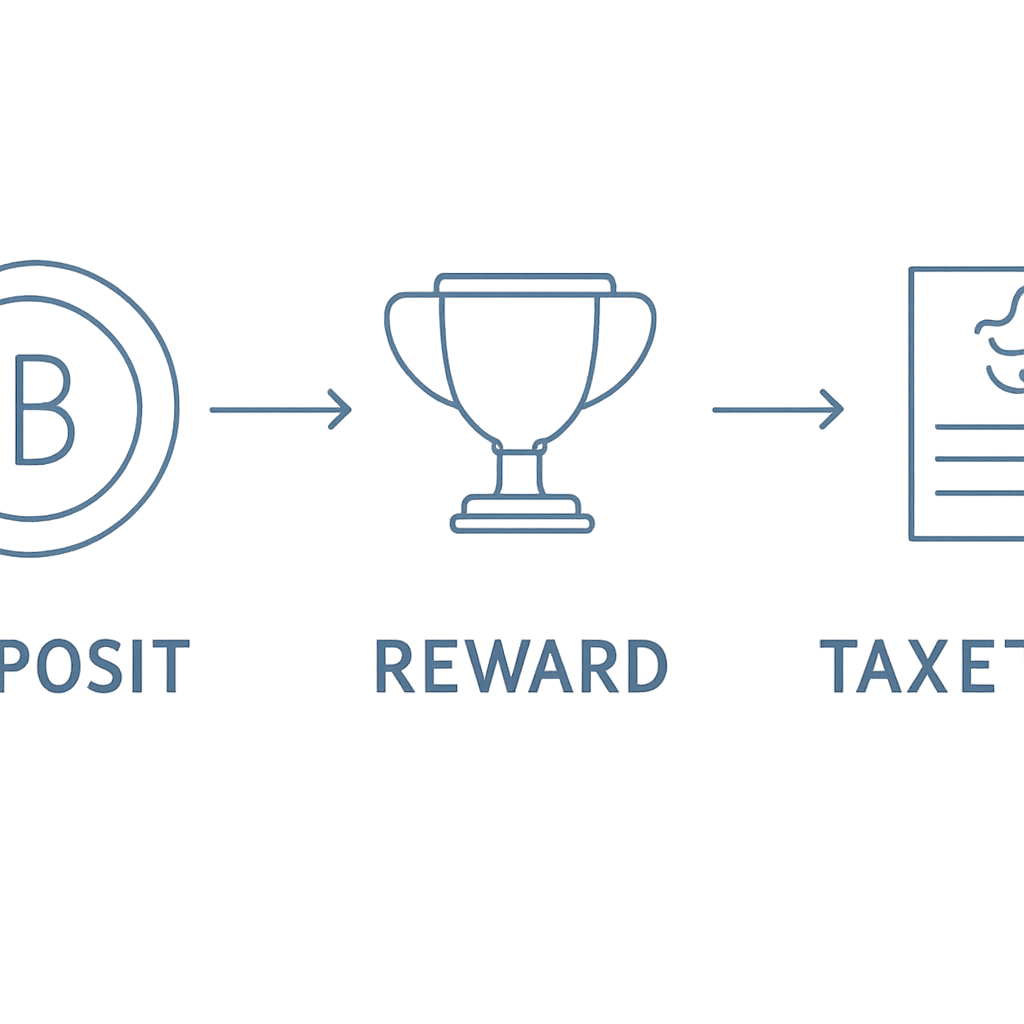
Most tax authorities treat staking rewards as ordinary income at the point you receive them. The taxable amount is the fair market value of the tokens on the day they land in your wallet. This is the approach taken in the UK, the US, Germany, and broadly across the EU. Switzerland follows a similar logic for individuals who stake as a side activity, classifying rewards as taxable income under federal income tax rules.
Disposal Event When Selling Rewards
There is a second tax event to watch for. When you later sell or exchange those staking rewards, any gain between your original cost basis (the value at receipt) and the sale price is a separate disposal event. That disposal may trigger capital gains tax depending on your jurisdiction and holding period. In Switzerland, private capital gains on movable assets are generally tax-free for individuals, which is a meaningful distinction. But the income tax on receipt still applies.
The key takeaway: receiving staking rewards and selling them are two separate potential tax events. Conflating them is one of the most common errors individual filers make.
| Jurisdiction | Tax on Staking Rewards at Receipt | Capital Gains on Disposal |
|---|---|---|
| Switzerland | Yes, income tax (for private individuals) | Generally exempt for private investors |
| United Kingdom | Yes, income tax | Yes, capital gains tax applies |
| United States | Yes, ordinary income tax | Yes, short or long-term capital gains tax |
| Germany | Yes, income tax | Tax-free after one year holding (extended to ten years if staking income earned) |
| Australia | Yes, ordinary income | Yes, CGT applies, 50% discount after 12 months |
How Are DeFi Rewards Taxed Across Different Protocols
DeFi tax is more complex than straightforward staking because the mechanics of earning vary widely between protocols. Providing liquidity, yield farming, lending, and borrowing each carry different implications, and tax authorities have been slow to produce specific guidance on all of them.
Common DeFi Income Types
The most common DeFi income types are liquidity pool rewards, lending interest, and yield from automated strategies. In most jurisdictions these are treated as ordinary income when received, just like staking rewards. The challenge is that DeFi protocols often reward users in governance tokens or protocol-native assets that have thin or volatile markets, making valuation at the point of receipt genuinely difficult.
LP Tokens And Multiple Tax Events
Wrapped tokens and liquidity pool tokens add another layer. When you deposit assets into a liquidity pool and receive an LP token in return, many jurisdictions treat that as a taxable disposal of the original asset. Unwrapping or redeeming the LP token on exit can trigger a second disposal. This means a single DeFi position can generate multiple taxable events before you ever touch a centralised exchange.
Impermanent loss is another area where guidance is almost universally absent. Most tax authorities have not issued specific rulings, leaving individual filers to rely on general principles. The conservative approach, and the one most tax advisers recommend, is to treat each leg of a DeFi transaction as a separate disposal and calculate gains or losses accordingly.
Crypto Airdrop Tax: Free Tokens Are Rarely Free
Crypto airdrop tax catches many people off guard. A project deposits tokens into your wallet without any action on your part, and the natural instinct is to assume this is not taxable until you sell. That instinct is usually wrong.
Jurisdictional Differences In Airdrop Tax
In the UK, HMRC distinguishes between airdrops received in return for a service and those received with no conditions attached. The former is income; the latter may not be taxable on receipt but becomes subject to capital gains tax on disposal. In the US, the IRS has indicated that airdrops of new tokens following a hard fork are taxable as ordinary income at the fair market value on the date of receipt. In Switzerland, the treatment depends on whether the airdrop is considered a gift, a capital gain, or income from an activity.
Recordkeeping Challenges For Airdrops
The practical problem is recordkeeping. Airdropped tokens often have no liquid market price at the point of receipt. You may receive hundreds of small airdrops across a year, each requiring a valuation. Without software tracking these automatically, the compliance burden is significant. Ignoring them is a risk, because exchanges report user data under frameworks like CARF and DAC8, and token transfer records are visible on-chain.
| Income Type | Typical Tax Treatment at Receipt | Disposal Tax? |
|---|---|---|
| Staking rewards | Ordinary income at fair market value | Yes, gain over cost basis |
| DeFi lending interest | Ordinary income | Yes, if token value changes |
| Liquidity pool rewards | Ordinary income | Yes, LP token disposal on exit |
| Airdrop (no service) | Varies by jurisdiction | Yes, CGT on disposal |
| Airdrop (in return for service) | Income tax | Yes, gain over cost basis |
| Hard fork tokens | Ordinary income (US); varies elsewhere | Yes |
NFT Tax: What Buying, Selling, and Creating Means for Your Return
NFT tax sits at the intersection of capital gains, income tax, and in some cases VAT or sales tax. The treatment depends on whether you are a collector, a trader, or a creator.
NFTs As Capital Assets
For most individual buyers and sellers, NFTs are treated as capital assets. Buying an NFT with cryptocurrency is itself a taxable disposal of the crypto used to purchase it. You must calculate the gain or loss on the crypto at the point of the purchase. Then, when you sell the NFT, any appreciation is a further capital gain. This creates a double layer of taxable events that many casual NFT participants never account for.
Tax Treatment For Creators
Creators who mint and sell NFTs are generally taxed on the sale proceeds as trading income or self-employment income, not as capital gains. Royalty income from secondary sales is typically treated the same way. In Switzerland, individuals who operate at a scale that qualifies as professional trading lose the capital gains exemption entirely, and the same logic can apply to prolific NFT creators or flippers.
The valuation challenge for NFTs is acute. Each token is unique, so there is no reference market price in the way there is for Bitcoin or Ether. Tax authorities have offered limited guidance here. Most practitioners recommend using the last verified sale price of comparable tokens or the floor price of the collection at the time of the transaction, while documenting the methodology clearly.
Crypto Trading Tax: Cost Basis Methods and What They Mean for Your Bill
Crypto trading tax is driven largely by which cost basis method your jurisdiction permits or requires. The cost basis is the original value of an asset for tax purposes, and different methods produce dramatically different taxable gains on the same set of trades.
Common Cost Basis Methods
The most common methods are FIFO (first in, first out), LIFO (last in, first out), and specific identification. The UK mandates a share pooling method with specific same-day and thirty-day bed-and-breakfasting rules. The US allows specific identification if you can substantiate it, but defaults to FIFO. Switzerland does not prescribe a single method for private individuals, but the approach must be consistent across the tax year.
Wash Sale Rules For Crypto
Wash sale rules are another important distinction. In the US, wash sale rules do not currently apply to crypto assets, meaning you can sell at a loss and immediately repurchase to crystallise the loss for tax purposes. This is a legitimate tax planning tool that equity investors do not have access to in the same way. Legislation to close this has been proposed but has not passed as of the time of writing. In the UK and Switzerland, similar restrictions apply through different mechanisms, so the strategy does not translate directly.
Keeping accurate records of every trade, including the date, the amount, the price in your home currency, and the exchange used, is non-negotiable. Without these records, any cost basis calculation is an estimate, and estimates invite scrutiny.
Illustrative Scenario
This scenario is illustrative. It does not describe a real person or client, and the figures are examples only.
To illustrate how this applies in practice, consider the following scenario:
Priya is a software developer based in Zurich. She holds Ether that she has staked through a liquid staking protocol. Over the course of a tax year she receives staking rewards in small increments every few days. She also provided liquidity to a DeFi protocol for three months and received governance tokens as rewards. In January she received an airdrop of a new token she had never interacted with. And she bought two NFTs using Ether she had held for eight months.
Priya assumed that because Switzerland generally exempts private capital gains, none of this would be taxable. She was partially right. The gains on selling her original Ether holdings are likely exempt. But the staking rewards and DeFi governance tokens she received are taxable income in the year of receipt, valued at market price on each receipt date. The airdrop requires a closer look at its structure. The NFT purchases triggered disposal events on the Ether she spent, requiring a gain calculation on that Ether even though she did not sell it for Swiss francs.
Priya used CryptaTax to import her wallet transactions and exchange data automatically, calculate her income from staking and DeFi, and produce a summary report aligned with Swiss tax filing requirements. What would have taken weeks of manual spreadsheet work was resolved in an afternoon.
Frequently Asked Questions
Is staking taxable if I have not sold my rewards yet?
In most jurisdictions, yes. Staking rewards are typically taxed as income at the point you receive them, based on their fair market value on that date. The fact that you have not sold them does not defer the income tax liability. A separate capital gains event only arises when you eventually dispose of the tokens.
How are DeFi rewards taxed compared to staking?
DeFi rewards are taxed similarly to staking rewards in most jurisdictions: as ordinary income at the fair market value on the date of receipt. The added complexity with DeFi is that interactions such as depositing into a liquidity pool or wrapping a token may themselves constitute taxable disposals, creating more events to track than simple staking does.
What is the crypto airdrop tax treatment in Switzerland?
In Switzerland, the tax treatment of airdrops depends on their nature. If an airdrop is received without any action or service provided, it may be treated as a gift, which carries different implications from income. If the airdrop rewards an activity, it is more likely to be treated as taxable income. Swiss cantonal authorities can apply additional rules, so local guidance is advisable.
Does buying an NFT with crypto trigger a tax event?
Yes, in most jurisdictions it does. Using cryptocurrency to purchase an NFT is treated as a disposal of that cryptocurrency. You must calculate any gain or loss on the crypto at the time of purchase, using your original cost basis. The NFT purchase price in crypto becomes the cost basis for the NFT itself.
What is the best cost basis method for crypto trading tax?
The best method depends on your jurisdiction. The UK requires share pooling with specific anti-avoidance rules. The US defaults to FIFO but allows specific identification with adequate records. Switzerland does not mandate a single method but requires consistency. Specific identification generally gives the most flexibility to optimise gains and losses, but it requires meticulous transaction records.
Do wash sale rules apply to crypto in the US?
As of the current legislative position, wash sale rules do not apply to cryptocurrency in the US. This means you can sell a crypto asset at a loss and immediately repurchase it to crystallise the loss for tax purposes, a strategy not available to equity investors in the same way. Proposed legislation to extend wash sale rules to crypto has been discussed but not enacted.
Are NFT royalties taxable income?
Yes. Royalties received by NFT creators from secondary market sales are generally treated as trading income or self-employment income, not as capital gains. This means they are subject to income tax and potentially self-employment or social security contributions, depending on your jurisdiction and the scale of your activity.
How do I value staking rewards or airdropped tokens with no market price?
Where no liquid market exists, most tax practitioners recommend using the best available reference price at the time of receipt, such as the first recorded trade price or an exchange-listed price shortly after listing. The methodology must be documented and applied consistently. Some jurisdictions accept a nil valuation where no market exists at receipt, with full gains taxed on disposal.
Does Switzerland tax crypto trading profits for private individuals?
Switzerland generally exempts capital gains on movable assets, including cryptocurrencies, for private individuals. However, this exemption does not apply if the tax authority classifies you as a professional trader. Factors such as high trading frequency, use of leverage, short holding periods, and significant income relative to your salary can all lead to reclassification, at which point all gains become taxable income.
What records do I need to keep for crypto tax purposes?
You need a complete transaction history including dates, amounts, asset types, prices in your home currency at the time of each transaction, and the platform or wallet involved. For staking and DeFi, daily reward records with valuations are essential. For NFTs, records of purchase price, sale price, and any royalties received should be retained. Most jurisdictions require records to be kept for at least five to seven years.
Source: CryptaTax