
Crypto Airdrop Tax in Switzerland: Airdrops, Mining, Staking and DeFi
Switzerland has a reputation as a crypto-friendly jurisdiction, but that does not mean Swiss residents escape tax obligations on their digital assets. If you have received tokens through an airdrop, earned rewards from mining, collected staking income, or generated returns through DeFi protocols, the Swiss Federal Tax Administration has something to say about each of those activities. Crypto airdrop tax in Switzerland sits within a broader framework that treats most crypto income as taxable wealth or income, depending on how it was earned. Getting the classification right matters because the wrong treatment can lead to underpayment, penalties, or a messy audit. This guide covers the key income types, how they are classified, and what you need to report.

How Switzerland Approaches Crypto Taxation Generally
Switzerland does not have a single dedicated crypto tax law. Instead, the Federal Tax Administration applies existing income tax, wealth tax, and capital gains principles to digital assets. The starting point is that crypto assets are treated as movable assets for wealth tax purposes. Every year, you must declare the total value of your crypto holdings as part of your overall taxable wealth, using the year-end market values published by the tax authorities for listed tokens.
Capital Gains Exemption for Private Investors
Capital gains on the sale of crypto are generally tax-free for private individuals in Switzerland. This is one of the more generous aspects of the Swiss system and a key reason the country attracts crypto holders. However, the capital gains exemption only applies if you are classified as a private investor. Traders who operate in a professional capacity, or whose activity crosses certain thresholds around volume, leverage, and holding periods, may be reclassified as self-employed. In that case, gains become subject to income tax and social security contributions.
The distinction between private investor and professional trader is one of the most important lines in Swiss crypto taxation. Several cantons apply slightly different interpretations, but federal guidance provides a general framework. Frequency of transactions, the use of borrowed funds, and whether crypto represents your primary income source all feed into that assessment.
Private Investor vs. Professional Trader
| Income or Gain Type | Tax Treatment in Switzerland | Applies To |
|---|---|---|
| Capital gains (private investor) | Generally tax-free | Private individuals not classified as traders |
| Capital gains (professional trader) | Subject to income tax | Individuals crossing professional trader thresholds |
| Airdrop income | Taxable as income at receipt | All Swiss residents receiving tokens |
| Mining income | Taxable as self-employment income | Individuals mining crypto regularly |
| Staking rewards | Taxable as income at receipt | All Swiss residents staking crypto |
| DeFi rewards | Taxable as income depending on structure | DeFi participants receiving yield or fees |
| Wealth (year-end holdings) | Declared as taxable wealth | All Swiss residents holding crypto |
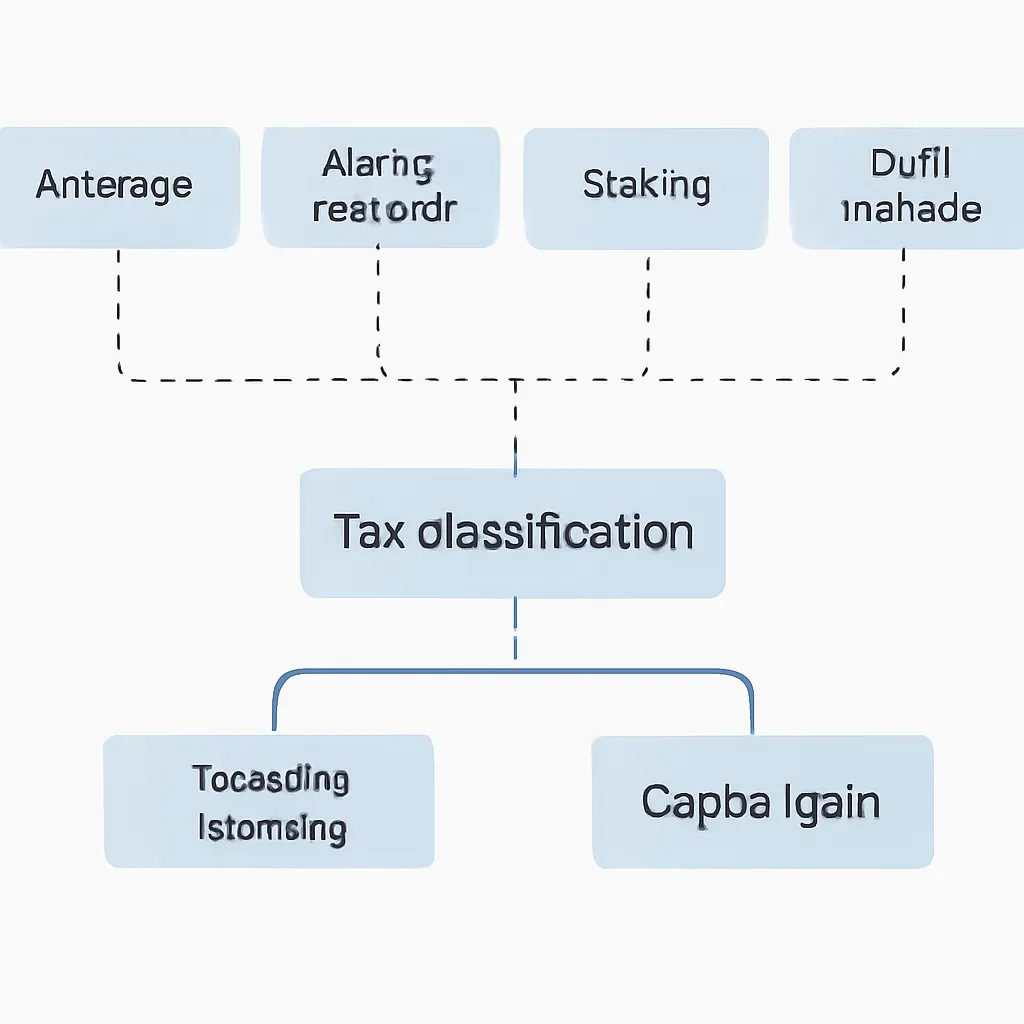
Crypto Airdrop Tax: What Swiss Residents Owe
Airdrops are one of the areas where Swiss tax rules diverge from common assumptions. Many recipients assume that because they did nothing to earn the tokens, there is no tax to pay. Swiss tax authorities take a different view. When you receive tokens through an airdrop, the fair market value of those tokens at the time of receipt is treated as taxable income. It does not matter whether the airdrop was promotional, a fork-related distribution, or a reward tied to protocol participation. The value you received is income.
Income Tax and Cost Basis Determination
That income is added to your other earnings for the year and taxed at your marginal income tax rate, which varies by canton and commune. Switzerland operates a three-tier tax system at federal, cantonal, and communal levels, so your effective rate will depend on where you live. High-cost cantons like Zurich will generate a higher overall rate than lower-tax cantons such as Zug or Schwyz.
The cost basis of the airdropped tokens is set at the fair market value at the date of receipt. If you later sell those tokens at a higher price, the gain above that cost basis would be a capital gain, which is typically tax-free for private investors. If you sell at a loss, you do not get a deduction because capital losses are not offset against income in Switzerland. Keeping a record of the token value on the day of receipt is therefore critical for every airdrop you receive.
Mining Income and Self-Employment Tax
Crypto mining is treated as a self-employment activity in Switzerland. The value of tokens received as mining rewards is taxable income at the point of receipt, and because it is classed as self-employment, you are also liable for social security contributions. This applies both to individual miners operating at home and to those running more substantial operations.
Deductibility of Mining Expenses
The deductibility of mining costs, such as electricity, hardware, and premises, is one area where Swiss rules offer some relief. Legitimate business expenses incurred in generating self-employment income can generally be deducted. Keeping clean records of your costs is therefore as important as tracking your reward income, because those deductions directly reduce the amount you owe.
If mining is a side activity rather than a primary business, some cantons may treat it more leniently, but the default federal position remains that rewards are income at receipt. The safe approach is to record each reward, its CHF value at the time of receipt, and the costs associated with earning it. Attempting to declare mining as a hobby to avoid social security contributions is a risk most tax advisers in Switzerland would not recommend taking.
Crypto Staking Tax: Is Staking Taxable in Switzerland?
Is staking taxable in Switzerland? The short answer is yes. Staking rewards are treated in a similar way to interest income or dividend income, in that they represent a return generated by an existing asset. When your staking rewards arrive in your wallet, their fair market value at that moment constitutes taxable income.
Receipt Date and Subsequent Gains
The mechanics are straightforward. You record the date of receipt, the number of tokens received, and the CHF equivalent of their market value on that date. That amount is added to your taxable income for the year. If you hold the staked tokens and they appreciate in value before you sell, the subsequent gain above the receipt-date value is a capital gain and is likely tax-free, provided you are a private investor.
Liquid staking arrangements and pooled staking through exchanges introduce some additional complexity. Where a third-party platform controls the staking process and distributes rewards periodically, the tax point is still the date of receipt. Some users receive rewards continuously or in very small amounts, which creates a record-keeping burden. Using software that automatically imports reward data and applies the correct CHF conversion rate for each receipt event is the most practical way to stay compliant.
Record-Keeping Challenges for Staking
| Activity | Tax Point | What to Record |
|---|---|---|
| Airdrop received | Date tokens arrive in wallet | Token name, quantity, CHF value at receipt |
| Mining reward received | Date of reward credit | Token quantity, CHF value, mining costs incurred |
| Staking reward received | Date of reward distribution | Token name, quantity, CHF value at receipt |
| DeFi yield received | Date of yield receipt or accrual | Token name, quantity, CHF value, protocol name |
| NFT sale proceeds | Date of sale | Sale price in CHF, original acquisition cost |
How Are DeFi Rewards Taxed in Switzerland?
DeFi tax in Switzerland is one of the more unsettled areas of the current guidance. The Swiss Federal Tax Administration has not issued specific rules for every DeFi activity, which means practitioners apply general principles and interpret them to individual situations. The key question is whether a DeFi activity generates income, a capital gain, or simply a restructuring of an existing asset.
Taxation of Yield Farming and LP Tokens
Yield farming and liquidity provision typically generate income in the form of fee rewards or protocol tokens. Those rewards are taxable at receipt, using the same logic as staking. Providing liquidity to a decentralised exchange and receiving LP tokens in return is more complex. The LP token may represent a new asset for tax purposes, or it may be treated as a continuation of your existing position. On exit, any gain is assessed against the original cost basis.
Lending protocols that pay interest in crypto also generate taxable income. Each interest payment is a receipt with a corresponding CHF value. Borrowing against crypto collateral is generally not a taxable event, because you have not disposed of your asset. However, if a liquidation occurs, that is treated as a disposal and any gain or loss is realised at that point.
Documenting Rationale for DeFi Tax Treatment
The lack of specific DeFi guidance in Switzerland means that documenting your rationale for each tax treatment is good practice. If the tax authority later disagrees with your interpretation, showing a consistent and well-reasoned approach is much better than having no records at all.
NFT Tax in Switzerland
NFT tax in Switzerland follows the same private investor logic as other crypto assets. If you buy an NFT and later sell it at a profit, the gain is generally tax-free for private investors. The wealth tax declaration still applies: NFTs with a determinable market value should be included in your year-end wealth declaration.
Income-Generating NFTs and Business Activity
Things become more complicated when NFTs generate income. If you hold an NFT that entitles you to royalties, staking rewards, or revenue-sharing, those distributions are taxable income at receipt. Similarly, if you create and sell NFTs as a business activity, the profits are treated as self-employment income and subject to both income tax and social security contributions. The distinction between a hobbyist selling a few pieces and a professional creator selling at volume follows a similar logic to the professional trader classification for crypto trading tax.
NFTs received as airdrops or prizes are also taxable at their fair market value on the date of receipt. Valuing NFTs can be genuinely difficult given the thinness of some markets. Using the most recent comparable sale price at the time of receipt, or a documented valuation methodology, gives you the best defence in the event of a query from the tax authority.
Illustrative Scenario
This scenario is illustrative. It does not describe a real person or client, and the figures are examples only.
To illustrate how this applies in practice, consider the following scenario:
Sophie is a freelance graphic designer based in Lausanne. She has been active in crypto for several years, holding a mix of Bitcoin, Ethereum, and various DeFi tokens. During the tax year, she received a token airdrop from a protocol she used, earned staking rewards on her Ethereum, and collected yield from a liquidity pool on a decentralised exchange. She also sold two NFTs she had purchased as investments.
Sophie logs into CryptaTax, connects her wallets and exchange accounts, and lets the platform pull in all her transactions automatically. The software identifies the airdrop receipt and assigns a CHF value based on the market price on the day the tokens landed in her wallet. It does the same for her staking rewards, treating each distribution as a separate income event. Her DeFi yield is captured as income at each point of receipt. The NFT sales are assessed against her original purchase prices, and because she is classified as a private investor, the gains are flagged as likely tax-free.
When she sits down to file her cantonal and federal tax return, Sophie has a clean income summary, a wealth declaration figure for her year-end holdings, and documentation she can attach to her return if the cantonal authority asks any questions.

Frequently Asked Questions
Is crypto airdrop tax payable in Switzerland even if I did not ask for the tokens?
Yes. Swiss tax authorities treat the fair market value of airdropped tokens as taxable income at the point of receipt, regardless of whether you requested them or took any action to receive them. The CHF value on the date they arrive in your wallet is the amount you must declare as income for that tax year.
How do I value an airdrop or staking reward for Swiss tax purposes?
You use the fair market value of the tokens in Swiss francs at the exact time of receipt. For listed tokens, this is typically the market price on a recognised exchange at the time the tokens entered your wallet. Keeping a record of that price and the source you used is important in case the tax authority later requests supporting documentation.
Is staking taxable as income or as a capital gain in Switzerland?
Staking rewards are taxable as income in Switzerland, not as capital gains. The value of each reward at the moment it is received is added to your taxable income for the year. Any future appreciation of those staking tokens above their receipt-date value may qualify as a tax-free capital gain if you are a private investor.
How are DeFi rewards taxed in Switzerland?
DeFi rewards such as yield farming income, liquidity pool fees, and lending interest are generally treated as taxable income at the point of receipt. Switzerland has not issued specific DeFi guidance, so practitioners apply general income tax principles to each reward type. Documenting your approach and keeping detailed transaction records is strongly advised given the lack of explicit rules.
What is the crypto trading tax position for private investors in Switzerland?
Private investors in Switzerland are generally exempt from capital gains tax on crypto disposals. However, if your trading activity crosses the thresholds used to define a professional trader, those gains become subject to income tax and social security contributions. Key factors include transaction frequency, use of leverage, and whether trading is your primary income source.
Do I have to pay NFT tax in Switzerland if I sell at a profit?
If you are a private investor and the NFT was held as an investment, a sale at a profit is generally treated as a tax-free capital gain in Switzerland. However, if you received the NFT as an airdrop or prize, its value at receipt is taxable income. If you create and sell NFTs professionally, those profits are classed as self-employment income and are fully taxable.
Does crypto wealth tax apply to DeFi and staking positions?
Yes. All crypto assets you hold at the end of the tax year, including tokens locked in staking contracts or DeFi protocols, should be declared as part of your taxable wealth. You use the year-end market value in CHF for each asset. The wealth tax rate itself is relatively low in Switzerland but the obligation to declare applies regardless of asset type.
What records do I need to keep for crypto tax in Switzerland?
You should keep a record of every transaction: the date, the token name and quantity, the CHF value at the time of the event, and the nature of the transaction. For income events like airdrops, staking, and DeFi rewards, you also need the price source you used for valuation. Good records reduce the risk of errors on your return and give you solid ground to stand on if a cantonal authority asks questions.
Are there canton-specific differences in how crypto income is taxed?
Federal rules on income classification apply across Switzerland, but the effective tax rate you pay on crypto income varies significantly by canton and commune because Switzerland has a three-tier tax system. Cantons like Zug and Schwyz are known for lower overall rates, while other cantons apply higher combined rates. The classification rules themselves, however, are largely consistent at the federal level.
Source: CryptaTax