
How to Report Crypto on Your Tax Return Using a Crypto Tax Calculator
If you have bought, sold, swapped, or earned cryptocurrency at any point during the tax year, you almost certainly have a reporting obligation. Tax authorities in most major jurisdictions now treat crypto as a taxable asset, and they have the data-sharing tools to match. A crypto tax calculator takes the complexity out of the process: it pulls your transaction history together, applies the correct cost-basis method for your country, and produces a tax report you can hand to an accountant or enter directly onto your return. This guide explains how the process works, what triggers a taxable event, how gains are calculated, and what can go wrong if you try to do it manually. Whether you are a casual investor with a handful of trades or an active trader juggling multiple wallets, understanding the steps will save you time, money, and stress come filing season.
Why Crypto Is Taxable and What the Authorities Already Know
Crypto is not a tax-free zone. Most countries classify it as property or a capital asset, which means any disposal, including a sale, a swap for another token, or a purchase of goods, can trigger a taxable gain or loss. Some jurisdictions also tax crypto received as income, whether from staking rewards, referral bonuses, airdrops, or salary payments made in digital assets.
The information asymmetry that once protected crypto holders is shrinking fast. Under frameworks like the OECD's Crypto-Asset Reporting Framework and the EU's DAC8 directive, exchanges are required to report user transaction data to tax authorities automatically. In the United States, the IRS has introduced Form 1099-DA for brokers. In the UK, HMRC has been receiving bulk data from exchanges for several years. This means the question is rarely whether the authority will eventually see your activity. The question is whether your own figures match what they receive.
Filing an accurate crypto tax report before any inquiry is always the better position. Voluntary disclosure attracts lower penalties than a prompted correction, and in most countries penalties for failure to notify can compound over multiple tax years if left unaddressed.
What Counts as a Taxable Event
Not every interaction with crypto creates a tax liability, but the list of events that do is longer than many people expect. Understanding the distinction between taxable and non-taxable events is the first thing a good crypto tax calculator handles for you.
The following table summarises the most common event types and their typical tax treatment across major jurisdictions. Always verify the rules for your specific country, as treatment varies.
| Event Type | Typical Tax Treatment | Notes |
|---|---|---|
| Selling crypto for fiat | Capital gains tax on the gain | Gain = proceeds minus cost basis |
| Swapping one crypto for another | Capital gains tax in most jurisdictions | Treated as a disposal at market value |
| Buying crypto with fiat | Not a taxable event at purchase | Sets your cost basis for future disposal |
| Receiving staking rewards | Income tax at receipt in many countries | Later disposal may also trigger capital gains |
| Receiving an airdrop | Income tax in some jurisdictions, capital gains in others | Treatment varies significantly by country |
| Transferring between your own wallets | Generally not a taxable event | Must be able to prove ownership of both wallets |
| Paying for goods or services with crypto | Capital gains tax on the disposal | Market value at time of payment is the proceeds figure |
| Gifting crypto to a spouse or civil partner | Often exempt depending on jurisdiction | Recipient inherits original cost basis in some countries |
How to Calculate Crypto Taxes: Cost Basis Methods Explained
The core of any capital gains calculation is the cost basis: the original value you paid for an asset, including any fees. Subtract that from what you received when you disposed of it, and the difference is your gain or loss. Simple in principle, complicated in practice when you have hundreds of transactions across multiple exchanges and wallets.
The method used to identify which specific units of crypto you sold matters enormously, and countries mandate different approaches. When you calculate crypto taxes correctly, you must use the method your tax authority requires, not the one that produces the lowest bill.
Common Cost Basis Methods by Jurisdiction
The table below outlines the methods required or commonly used in key markets.
| Jurisdiction | Required or Common Method | Description |
|---|---|---|
| United Kingdom | Share Pooling (Section 104) | All units of the same asset pooled; average cost calculated across all acquisitions |
| United States | FIFO default; specific ID permitted with adequate records | First-in first-out unless you can identify specific lots |
| Germany | FIFO | First units acquired are treated as the first units sold |
| Australia | FIFO or specific identification | CGT discount available for assets held over 12 months |
| Canada | Adjusted Cost Base (ACB) | Similar to UK pooling; average cost adjusted on each acquisition |
| France | Weighted average (PUMP) | Portfolio-level average applied across all holdings |
A crypto capital gains calculator built for a specific jurisdiction applies these rules automatically. Trying to replicate them in a spreadsheet across thousands of rows of data is where most manual filing attempts break down.
How a Crypto Tax Calculator Works in Practice
The core workflow of modern crypto tax software follows a consistent pattern regardless of which platform you use. Understanding each step helps you prepare your data properly and spot problems before they reach your return.
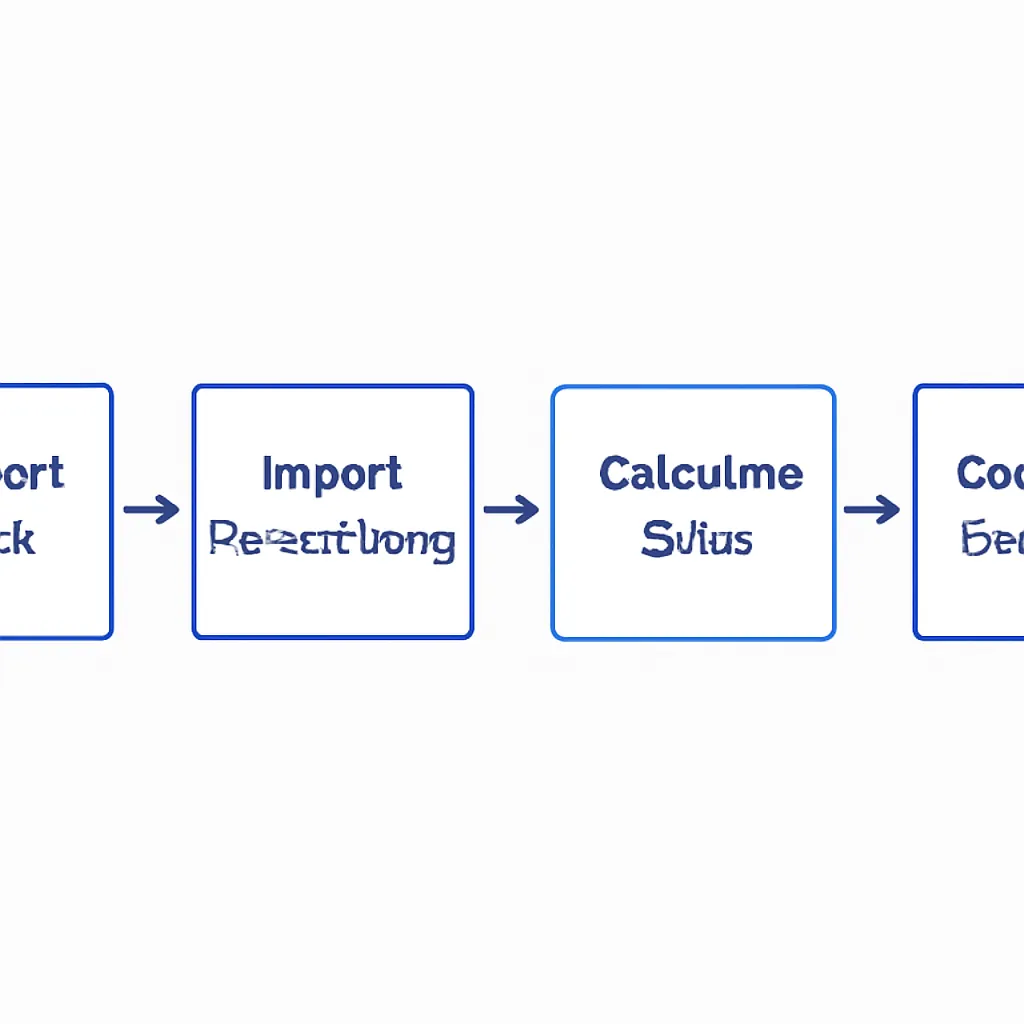
The first step is importing your transaction history. Most tools connect directly to exchanges via API or accept CSV file uploads. Wallet addresses for on-chain activity can usually be added directly. The software fetches every transaction: buys, sells, transfers, staking rewards, gas fees, and anything else recorded on-chain or in your exchange history. The completeness of this import step determines the accuracy of everything that follows.
The second step is classification. The software categorises each transaction according to its type: disposal, acquisition, income, transfer, or fee. Some transactions require manual review, particularly DeFi interactions where the on-chain data does not map neatly to a standard event type.
The third step is the calculation itself. The tool applies your jurisdiction's cost basis method, identifies gains and losses on each disposal, and separates income events from capital events. Short-term and long-term holding periods are applied where relevant.
The final step is the report. A good crypto tax report will produce a summary of total gains and losses, a breakdown by asset, a full transaction-level audit trail, and the specific figures needed for your country's tax return form. Some tools produce pre-filled forms directly. CryptaTax generates jurisdiction-specific reports designed to map onto the relevant filing forms, so you know exactly which number goes where.
Common Mistakes When Filing Crypto Taxes Manually
Manual filing is not impossible, but the error rate is high. The mistakes that create the most risk are not always the obvious ones.
Missing exchange data is the most frequent problem. Traders who moved between exchanges over several years often find they no longer have access to historical data from platforms that have closed, been acquired, or restricted access to older records. A crypto tax calculator can sometimes reconstruct partial histories from on-chain data, but gaps in centralised exchange records are harder to fill.
Ignoring fees is a related issue. Transaction fees paid in crypto are often themselves disposals and can also be added to cost basis in some jurisdictions. Leaving them out understates the cost basis and overstates the gain.
Applying the wrong cost basis method, particularly using FIFO when your jurisdiction requires pooling, can produce figures that are materially incorrect. HMRC's same-day and 30-day rules in the UK add further complexity that spreadsheet users routinely miss.
Finally, treating every wallet transfer as a disposal is a surprisingly common error in the other direction. Some filers report gains on every movement of crypto between their own wallets, which is generally not required. Getting this wrong in either direction creates a mismatch with exchange-reported data that can trigger an inquiry.
What You Need Before You Start Filing
Gathering the right records before you open any software makes the process significantly faster. At a minimum, you need complete transaction history from every exchange account you used during the tax year, including any that are now closed. You also need records of any wallet addresses you controlled, any DeFi protocols you interacted with, and any crypto received as income, including the market value at the date of receipt.
If you received crypto as part of employment or as a freelancer, you may need payslips or invoices showing the sterling, dollar, or euro equivalent at the time of payment. Some jurisdictions require this to be based on the closing price on a recognised exchange on the date of receipt.
When you file crypto taxes, the burden of proof sits with you. Tax authorities do not have to prove you made a gain. You have to prove you did not, or that the gain was smaller than their data suggests. Good records, backed by a clear audit trail from your crypto tax software, are your defence.
Illustrative Scenario
This scenario is illustrative. It does not describe a real person or client, and the figures are examples only.
To illustrate how this applies in practice, consider the following scenario:
Priya is a freelance designer based in the UK. Over the last three tax years she bought Ethereum regularly through a UK exchange, received some tokens through a DeFi yield protocol, and sold a portion of her holdings to cover a large project expense. She had also moved funds between a hardware wallet and her exchange account multiple times. When she tried to complete her self-assessment manually, she found she had no record of the token prices at the dates she received the DeFi rewards, and she was unsure whether her wallet transfers counted as disposals.
She connected her exchange account and imported her wallet address into CryptaTax. The software identified the wallet-to-wallet transfers as non-taxable, priced the DeFi income using historical market data at the correct dates, and applied HMRC's Section 104 pooling rules and 30-day matching rules automatically. Her crypto tax report showed the exact figures for her capital gains summary pages and her miscellaneous income entry. The entire process took under two hours, compared to the three weekends she had already spent on the spreadsheet approach.
Frequently Asked Questions
What is a crypto tax calculator and do I actually need one?
A crypto tax calculator is software that imports your transaction history, applies the correct cost basis rules for your jurisdiction, and produces a tax report showing your gains, losses, and income. If you have more than a handful of transactions or have used more than one exchange or wallet, calculating this manually is very likely to produce errors. A dedicated tool pays for itself quickly when you consider the time saved and the risk of an incorrect return.
Do I have to report crypto if I made a loss?
In most jurisdictions, yes. You are generally required to disclose crypto disposals even when they result in a loss. The benefit is that reported losses can often be offset against gains in the same tax year or carried forward to reduce future tax bills. Failing to report losses means you miss out on legitimate relief.
How do I file crypto taxes if I used multiple exchanges?
You need to consolidate the transaction history from every exchange into a single calculation. Most crypto tax software accepts API connections or CSV imports from major exchanges, allowing you to bring everything together before the cost basis calculation runs. Trying to calculate each exchange in isolation will produce incorrect figures because your cost basis pools or lot histories span across all of them.
Is swapping one cryptocurrency for another a taxable event?
In most jurisdictions, yes. Swapping crypto is treated as a disposal of the asset you give up at its market value at the time of the swap, and an acquisition of the new asset at that same value. This means you can trigger a capital gain even if you never touched fiat currency. A crypto capital gains calculator handles these swap events automatically.
What records do I need to keep for crypto taxes?
You need records of every transaction including the date, the amount in crypto, the market value in your local currency at the time, the type of transaction, and any fees paid. Most tax authorities expect you to keep these records for at least five years after the relevant filing date. Exporting a full transaction-level report from your crypto tax software satisfies this requirement in most cases.
Can I use a crypto tax calculator if I also do DeFi or staking?
Yes, though DeFi transactions can be more complex. Quality crypto tax software will classify staking rewards as income at the value on the date of receipt and handle common DeFi interactions such as liquidity pool entries and exits. Some edge cases may need manual classification, particularly with newer protocols, but the bulk of the work is automated.
What happens if I did not report crypto in previous tax years?
Voluntary disclosure is almost always the right approach. Most tax authorities have processes for amending previous returns or making a formal disclosure. Penalties for voluntary correction are generally lower than those imposed after an authority-initiated investigation. A complete crypto tax report covering the missed years, generated by reliable software, gives you the figures you need to make an accurate disclosure.
How do I know which cost basis method my country uses?
The required method is set by your national tax authority. The UK uses share pooling under Section 104, the US defaults to FIFO, Germany requires FIFO, and France uses a weighted average method. A jurisdiction-specific crypto tax calculator applies the correct method automatically once you select your country, removing the risk of applying the wrong rules to your data.
Are crypto-to-crypto trades reported the same way as crypto-to-fiat sales?
In most countries, yes. Both are treated as disposals and the gain or loss is calculated the same way: proceeds minus cost basis. The proceeds for a crypto-to-crypto trade are the market value of the asset received at the time of the swap. Your crypto tax report will show both types of disposal in the same capital gains summary.
What is the difference between short-term and long-term crypto gains?
Some jurisdictions apply different tax rates depending on how long you held an asset before disposing of it. In the United States, assets held for more than one year qualify for lower long-term capital gains rates. In Australia, a 50% CGT discount applies to assets held for more than 12 months. A crypto capital gains calculator tracks holding periods automatically and applies the appropriate rate where relevant.
Source: CryptaTax