
Hard Fork Taxation for Individuals: Use a Crypto Tax Calculator to Get It Right
A hard fork can feel like a windfall. One morning you hold one token; by evening you hold two. What most individual crypto holders do not realise is that those newly received coins can trigger an immediate tax liability in many jurisdictions, long before you sell a single unit. The rules are not straightforward, they vary by country, and they interact with your existing portfolio in ways that are easy to mishandle. A reliable crypto tax calculator takes the guesswork out of the process by automatically assigning cost basis, flagging taxable events, and feeding the numbers directly into your tax report. This guide explains what a hard fork is, how tax authorities around the world treat the coins you receive, what happens when you eventually sell, and how to make sure you are not caught short at filing time.

What a Hard Fork Actually Is
A hard fork is a permanent divergence in a blockchain's protocol. When the network's participants cannot agree on a rule change, the chain splits. Anyone who held the original asset at the moment of the split receives an equivalent quantity of the new coin automatically, credited to whatever wallet or exchange account held the original tokens. No action is required on your part, which is precisely why the tax treatment catches people off guard.
The most widely known example is the split that produced Bitcoin Cash from Bitcoin, but dozens of smaller forks have occurred across various networks over the years. Each one potentially creates a new taxable position, and the fact that you did not ask for the coins is not a defence under most tax codes. The key variables are: when did you receive the coins, what were they worth at that moment, and does your jurisdiction tax receipt, disposal, or both?
It is also worth separating hard forks from soft forks. A soft fork is a backward-compatible upgrade that does not produce a new asset, so no new coins land in your wallet and there is no taxable event to consider. This guide is concerned only with hard forks that result in a new, separately tradeable asset appearing in your account.
How Tax Authorities Treat Hard Fork Receipts
Tax treatment differs meaningfully between the major jurisdictions where most individual filers are based. The table below summarises the current general approach in several key markets. Because rules change and personal circumstances vary, you should always verify the current guidance with a qualified adviser or check your country's revenue authority directly.
| Jurisdiction | Tax event at receipt? | Basis for valuation | Tax on disposal? |
|---|---|---|---|
| United States | Yes, ordinary income | Fair market value at time of receipt | Yes, capital gains |
| United Kingdom | Generally no income tax at receipt for most forks; HMRC assesses case by case | Nil or negligible cost basis in many cases | Yes, capital gains on full disposal proceeds |
| Australia | Generally no income tax at receipt | Cost basis typically nil | Yes, capital gains; 50% discount if held over 12 months |
| Germany | Taxable as other income at fair value | Fair market value at receipt | Tax-free after 12-month holding period in most cases |
| Canada | Treated as income at fair market value | Fair market value at receipt | Yes, 50% inclusion rate on capital gains |
The US position is the strictest. The Internal Revenue Service has stated clearly that receiving new coins through a hard fork is ordinary income in the year of receipt, valued at fair market value on the date the coins are available to you. That income then becomes the cost basis you use when you eventually dispose of the coins. The UK approach is more nuanced: HMRC's guidance distinguishes between situations where the new coin has genuine economic value at receipt and those where it is effectively worthless at the moment of the fork. Germany's rule is notable because it resets the holding period clock, meaning the one-year tax-free window for long-term holders applies to the new coins from their date of receipt, not from when you first acquired the original asset.
Cost Basis Assignment After a Hard Fork
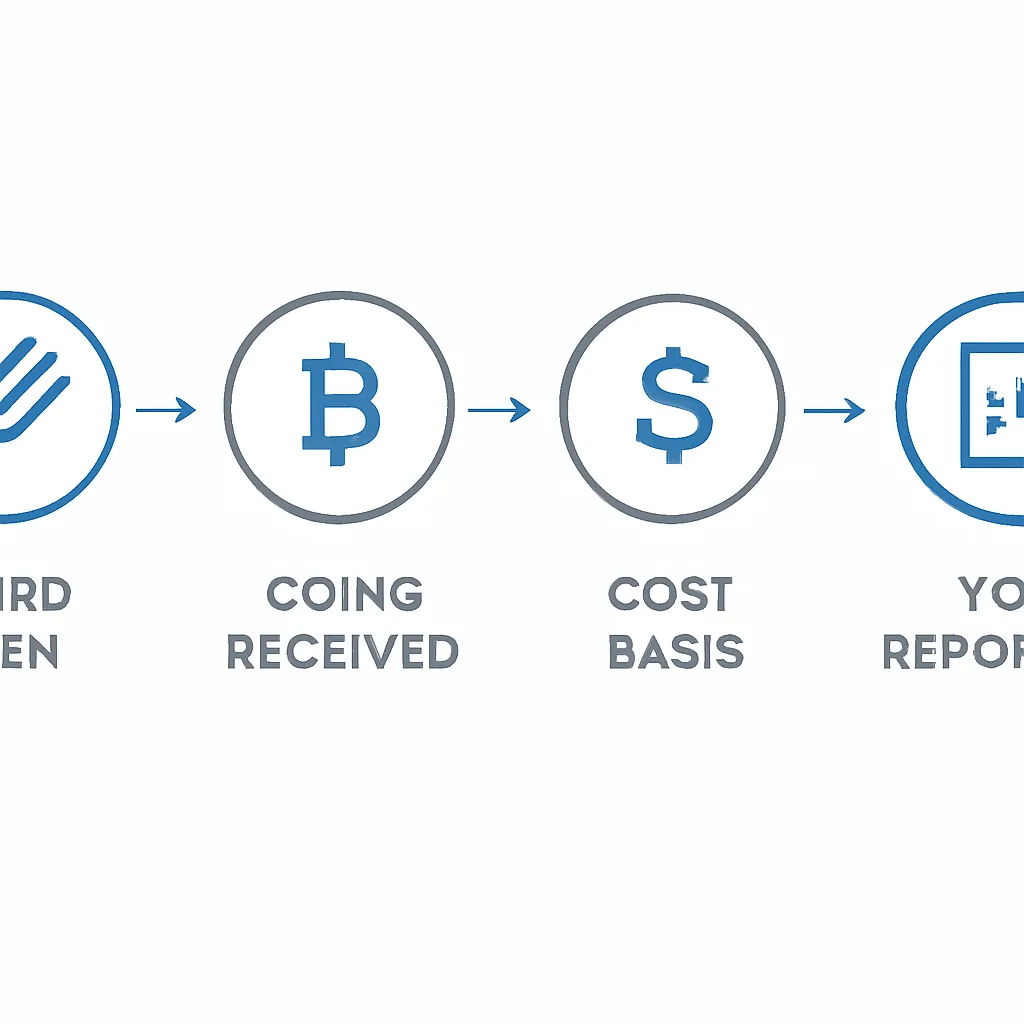
Getting cost basis right is arguably the most technically demanding part of hard fork taxation. In jurisdictions that treat receipt as an income event, the fair market value at receipt becomes the cost basis for future capital gains calculations. If a jurisdiction assigns a nil cost basis, as Australia and parts of UK guidance do in certain circumstances, the entire disposal proceeds eventually become a taxable gain. Neither outcome is inherently better; it depends on your individual holding period and the price trajectory of the coin after the fork.
The challenge compounds when you hold the original asset across multiple wallets or exchanges. Each holding at the fork date theoretically generates a separate lot of new coins, each with its own acquisition date and cost basis. Manual spreadsheets break down fast. When you then factor in that many forks happen with little warning and that the market price of a newly forked coin can swing wildly in the first hours of trading, pinpointing the correct fair market value for tax purposes becomes a genuine problem.
A crypto capital gains calculator that integrates with your exchange and wallet history can pull in the fork event automatically, stamp each received lot with a timestamp and market price, and carry the correct cost basis forward for every subsequent disposal. That eliminates the risk of using the wrong price or accidentally double-counting a lot.
What Happens When You Sell or Swap Forked Coins
Disposal triggers the second tax event. Whether you sell the forked coins for fiat, swap them for another cryptocurrency, or use them to pay for goods or services, a taxable disposal has occurred in almost every jurisdiction. The gain or loss is calculated as the difference between the disposal proceeds and your cost basis in those specific coins.
Holding period matters enormously in several jurisdictions. In Germany, coins held for more than a year are generally exempt from capital gains tax. In Australia, the 50% capital gains discount applies to assets held for more than twelve months. In the US, the difference between short-term and long-term rates can be substantial depending on your income bracket. Timing a disposal strategically is therefore not just sensible planning; it can make a material difference to your bill.
One common mistake is treating forked coins as if they were purchased at zero cost. This produces an inflated gain on disposal, potentially pushing you into a higher bracket unnecessarily. The correct approach depends entirely on what your jurisdiction said about the receipt event. If you recorded income at receipt in a prior year, your basis is not zero; it is whatever value you declared as income. Using a crypto tax report that carries this data consistently across tax years prevents exactly this kind of costly error.
| Scenario | Tax event triggered? | Notes |
|---|---|---|
| Sell forked coins for fiat | Yes | Capital gain or loss on proceeds minus cost basis |
| Swap forked coins for another crypto | Yes in most jurisdictions | Disposal at fair market value of coins received |
| Transfer to another wallet you own | No | Not a disposal; cost basis transfers with the coins |
| Use forked coins to pay for goods | Yes | Disposal at market value of goods received |
| Gift forked coins to another person | Depends on jurisdiction | May trigger capital gains or gift tax; verify locally |
Record-Keeping Requirements You Cannot Ignore
Every jurisdiction that taxes crypto expects you to maintain records sufficient to substantiate your gains, losses, and income figures. For hard forks that means documenting: the date and time the new coins became available in your wallet or account, the fair market price at that moment, the quantity received, the exchange or wallet where they landed, and every subsequent transaction involving those coins up to disposal.
Many exchanges do not generate a separate statement for fork events. They may not even label the credit clearly in your transaction history. This is where relying on a single exchange CSV export can cause gaps. A proper crypto tax software solution that connects directly to your wallets and exchange accounts via API will capture the fork credit automatically, match it to a verified price feed, and create a permanent record. When HMRC, the IRS, or the ATO asks how you calculated your figures, you need to be able to show a clean audit trail, not a set of notes in a personal spreadsheet.
Retention periods vary: the IRS expects records to be kept for at least three years from the filing date of the return on which the income was reported, and longer if there is any potential understatement of income. HMRC expects records for at least five years after the filing deadline for self-assessment. Australian taxpayers must keep records for at least five years from when the relevant transaction occurred. Build a habit of archiving records at the end of each tax year rather than scrambling when an enquiry arrives.
How to Calculate Crypto Taxes on Hard Fork Coins Step by Step
The process to calculate crypto taxes on hard fork receipts follows a consistent logic regardless of jurisdiction, even though the tax treatment at each step differs.
Step 1: Identify all fork events in the tax year
Review your exchange and wallet history for any credits labelled as a fork, airdrop from fork, or new token receipt. Cross-reference against publicly known fork dates for networks you held at the time.
Step 2: Record the fair market value at receipt
Use the price from a credible market data source at the specific date and time the coins were credited to your account. If the fork produced a coin that was not immediately tradeable, you may need to use the price on the first day it became available on a recognised exchange.
Step 3: Determine whether receipt is taxable in your jurisdiction
Apply your country's current guidance. In the US, record the amount as ordinary income. In Australia or the UK, check whether the coins had genuine value at receipt and follow the appropriate guidance for your situation.
Step 4: Assign cost basis to each lot
Each separate holding of the original coin at the fork date may produce a separate lot of new coins. Assign the correct cost basis to each lot based on what step 3 determined.
Step 5: Track every subsequent disposal
Record the date, amount, disposal proceeds, and cost basis for every sale, swap, or use of the forked coins. Calculate the gain or loss and apply any available reliefs such as the long-term holding discount before reporting.
Illustrative Scenario
This scenario is illustrative. It does not describe a real person or client, and the figures are examples only.
To illustrate how this applies in practice, consider the following scenario:
Priya is a freelance graphic designer based in London who has held Bitcoin since 2020. When a hard fork creates a new coin credited to her hardware wallet, she initially ignores it, assuming it has no real value. Two years later, the coin has appreciated and she swaps it for Ethereum on a centralised exchange. She then starts preparing her self-assessment return and realises she has no record of what the forked coin was worth when she received it, nor when exactly it appeared in her wallet.
Using CryptaTax, Priya connects her hardware wallet and exchange account. The software identifies the fork credit in her transaction history, matches it to a verified market price feed for that date, and assigns the correct cost basis. It then tracks her swap as a disposal event, calculates the capital gain using the proceeds from the Ethereum received, and generates a crypto tax report ready to drop into her self-assessment. What had looked like an administrative nightmare resolves in under an hour. Priya also discovers she is eligible to use HMRC's same-day and 30-day matching rules, which the software applies automatically, reducing her taxable gain slightly. She files with confidence and keeps the full audit trail archived in her account.

Frequently Asked Questions
Do I have to pay tax on coins I received from a hard fork?
It depends on your jurisdiction. In the United States, coins received through a hard fork are treated as ordinary income at fair market value on the date of receipt. In the UK and Australia, the rules are more nuanced and depend on whether the coins had genuine value at receipt. Always check the current guidance from your country's tax authority or consult a qualified adviser.
What is the cost basis of coins received in a hard fork?
In jurisdictions that treat receipt as an income event, the cost basis is the fair market value you declared as income at the time of receipt. In jurisdictions where receipt is not taxable, the cost basis may be nil, meaning the full disposal proceeds become a taxable gain when you eventually sell. Getting this right matters because errors flow forward into every future calculation.
How does a crypto tax calculator handle hard fork events?
A crypto tax calculator imports your transaction history from connected wallets and exchanges, identifies fork credits, matches them to a market price at the time of receipt, and assigns cost basis automatically. It then tracks every subsequent disposal against those lots. This removes the need for manual record-keeping and reduces the risk of using incorrect cost basis figures.
Does swapping forked coins for another cryptocurrency trigger a tax event?
In most jurisdictions, yes. A swap is treated as a disposal of the forked coins at their fair market value at the time of the swap. The difference between that value and your cost basis is a capital gain or loss. The only common exception is a direct transfer between wallets you own, which is not a disposal in any major jurisdiction.
How do I find out the fair market value of forked coins at receipt?
Use a reputable market data provider's historical price for the specific date and time the coins were credited to your account. If the coin was not immediately tradeable, use the price on its first day of trading on a recognised exchange. A crypto tax software solution with built-in price feeds handles this automatically for most major forked assets.
What records do I need to keep for hard fork taxation?
You need to retain the date and time of receipt, the quantity received, the fair market value at receipt, the wallet or exchange where the coins appeared, and a record of every subsequent transaction. Retention periods vary by jurisdiction, ranging from three years in the US to five or more years in the UK and Australia. Keeping these records in a dedicated crypto tax report platform makes retrieval straightforward.
Can I use a crypto capital gains calculator for both receipt income and disposal gains?
Yes. A good crypto capital gains calculator handles both stages. It records the income event at receipt, assigns the resulting cost basis, and then calculates capital gains or losses at disposal. The two figures need to be reported in the correct sections of your tax return, and the calculator should produce a crypto tax report that maps clearly to those sections.
What happens if I forgot to report a hard fork receipt in a previous tax year?
You may need to file an amended return or a voluntary disclosure, depending on your jurisdiction. In the US, you can file an amended Form 1040. In the UK, you can correct a self-assessment return within a certain window, after which you would need to contact HMRC directly. Acting promptly generally reduces any penalties. A tax professional who specialises in crypto can help you assess the exposure and manage the correction process.
Does the holding period for the original coin transfer to the forked coins?
No. The forked coins are treated as a new asset with a new acquisition date, which is the date you received them. The holding period starts from receipt, not from when you first bought the original coin. This matters significantly in jurisdictions like Germany and Australia, where a long-term holding period reduces or eliminates the tax on disposal.
Is there a difference between how to file crypto taxes on fork income versus staking rewards?
The mechanics are similar in many jurisdictions: both may be treated as ordinary income at receipt, with the receipt value becoming the cost basis for future disposals. However, the specific guidance differs. Staking rewards have attracted their own regulatory clarifications in several jurisdictions, and you should not assume that the rule for one type of income automatically applies to the other. Use a crypto tax software tool that distinguishes between event types to avoid misclassification.
Source: CryptaTax