
Crypto Staking Tax in Singapore: What You Actually Owe
Singapore has a reputation as one of the more crypto-friendly jurisdictions in the world, but that does not mean your crypto activities are automatically tax-free. Crypto staking tax, DeFi income, NFT sales, and trading gains all sit in a grey zone that trips up thousands of individual holders every year. The Inland Revenue Authority of Singapore (IRAS) has published guidance on digital tokens, but the rules are principle-based rather than prescriptive, which means the tax outcome often depends on the specific facts of your situation. This guide cuts through the complexity and explains, in plain English, what Singapore residents need to understand about their crypto tax obligations in 2025 and beyond.
How Singapore Taxes Crypto: The Core Framework
Singapore does not have a capital gains tax. That single fact is the starting point for almost every crypto tax question in the country. If you buy Bitcoin, hold it, and later sell it at a profit, that gain is generally not taxable, provided the activity is characterised as capital in nature. The key word is "generally". IRAS applies a facts-and-circumstances test to decide whether your crypto activity is a trading activity or a capital investment.
IRAS Facts-and-Circumstances Test
The factors IRAS considers include how frequently you transact, your intention when you first acquired the asset, the holding period, and whether you have a structured approach to buying and selling. A person who bought Ethereum years ago and sold a portion is treated very differently from someone running a high-frequency trading strategy across multiple exchanges. The former is likely capital; the latter may well be income subject to income tax at your personal rate. Getting this characterisation right is the foundation for everything else.
The table below summarises the two broad categories and their general tax treatment under Singapore principles.
Summary Table of Tax Treatments
| Activity Type | Characterisation | General Tax Treatment |
|---|---|---|
| Long-term holding, occasional disposal | Capital | Generally not taxable (no capital gains tax) |
| Active, frequent trading with profit motive | Income (trading) | Taxable as income at personal tax rates |
| Staking, DeFi rewards, airdrops received | Income (on receipt) | Potentially taxable as ordinary income |
| Mining rewards | Income (business) | Taxable if carried on as a trade or business |
Crypto Staking Tax: Is Staking Taxable in Singapore?
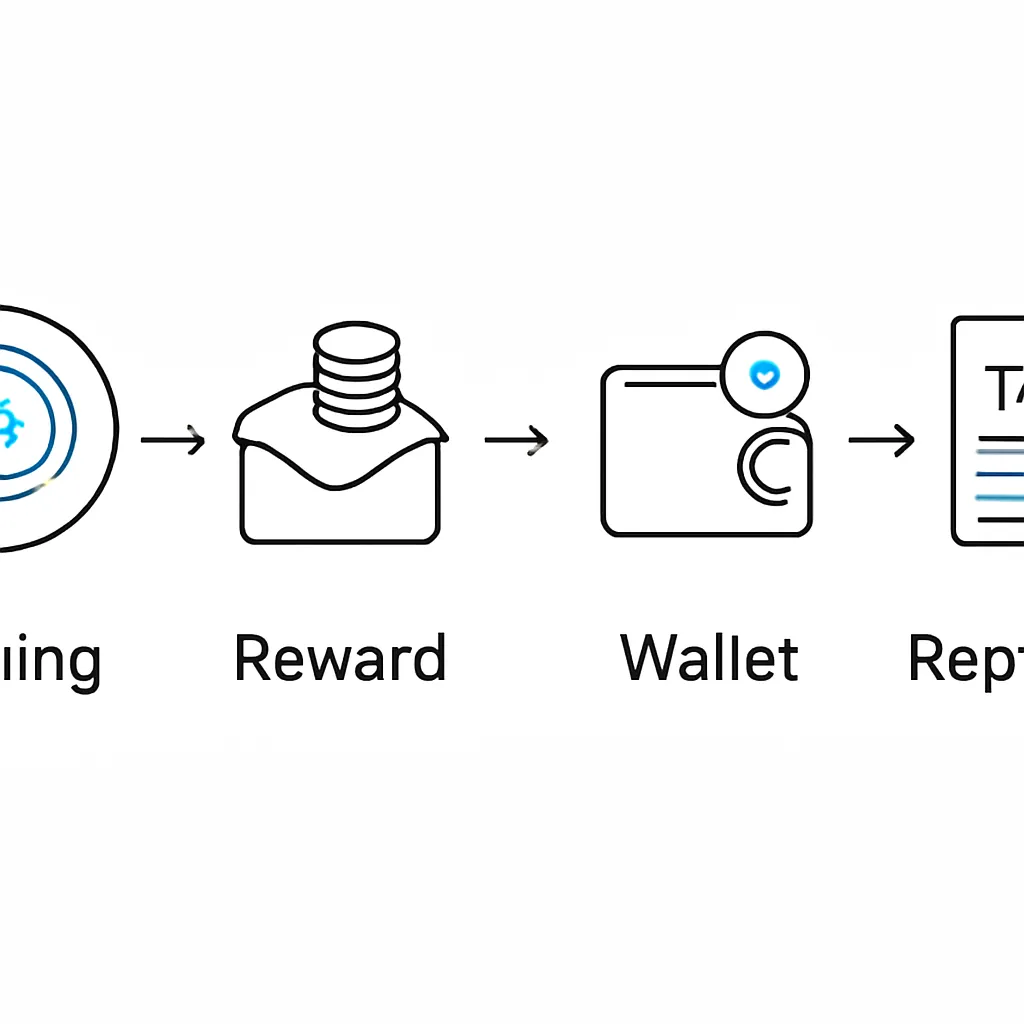
This is the question most crypto holders ask first, and the honest answer is: it depends on the nature of the staking activity. IRAS guidance treats tokens received as a form of consideration for services or activities as potentially taxable income. When you stake cryptocurrency and receive rewards in return, those rewards are generally considered income at the point of receipt. The market value of the tokens at the time you receive them forms the basis for calculating any income.
Delegated vs. DeFi Staking Nuances
The crypto staking tax position becomes more nuanced when you consider what type of staking you are doing. Delegated proof-of-stake staking, where you lock up tokens through a validator on a network such as Ethereum or Solana, is different from providing liquidity to a DeFi protocol in exchange for yield. IRAS has not issued token-by-token guidance, so both activities are assessed using the same income-versus-capital principles.
Taxable Event at Receipt, Not Sale
A practical point many people overlook: the taxable event occurs when you receive the reward, not when you eventually sell the tokens. If you receive staking rewards worth SGD 500 in January and those tokens later drop in value to SGD 100, you still had SGD 500 of potential income in January. When you eventually sell those tokens, you calculate any further gain or loss from the SGD 500 receipt value, not from zero. Keeping accurate records of receipt dates and market values is therefore essential.
How Are DeFi Rewards Taxed in Singapore?
DeFi introduces a much wider range of reward types than simple staking, and the tax question becomes correspondingly more complex. Liquidity pool fees, yield farming returns, lending interest, and governance token distributions all have different economic characteristics, but IRAS assesses them through the same income-versus-capital lens.
Liquidity Pool Rewards as Income
How are DeFi rewards taxed when you provide liquidity to an automated market maker? The fees and additional token rewards you earn from providing liquidity are generally treated as income in the period you receive them. The underlying capital you deposited, your original tokens, retains its own cost basis for any future capital or income calculation on disposal.
Wrapping and Unwrapping Tokens
Wrapped tokens add another layer. When you wrap Ether into wETH to use in a DeFi protocol, IRAS may treat that as a disposal of the original token and an acquisition of a new one. The same logic can apply when you unwrap. This means wrapping and unwrapping could theoretically trigger a taxable event even if no cash changes hands, though the practical tax impact depends on whether any gain or loss arises at the point of exchange. The safest approach is to record every wrapping transaction with the market value of both the disposed token and the received token at the time of the swap.
NFT Tax in Singapore
NFTs are treated as digital tokens under Singapore's broader digital asset framework, which means the same capital-versus-income test applies. If you buy and sell NFTs as a hobby or for personal use, any gain is more likely to be characterised as capital and therefore not taxable. If you are an active NFT trader or creator selling NFTs as a commercial activity, your profits are more likely to be treated as trading income.
Creator and Royalty Tax Implications
NFT tax considerations also arise for creators. If you mint an NFT and sell it, the proceeds are potentially taxable as business income if you are operating as a creator or artist in a commercial capacity. Royalty income from secondary sales is similarly treated as recurring income and taxable in the year received.
The table below sets out the most common NFT scenarios and their likely tax characterisation under Singapore principles.
Common NFT Scenarios and Tax Treatment
| NFT Activity | Likely Characterisation | Tax Implication |
|---|---|---|
| Buying and holding NFTs as collectibles | Capital | Generally not taxable on disposal |
| Active NFT trading for profit | Trading income | Taxable at personal income tax rates |
| Minting and selling NFTs commercially | Business income | Taxable in year of receipt |
| NFT royalties from secondary sales | Recurring income | Taxable in year received |
Crypto Airdrop Tax: What Happens When Tokens Land in Your Wallet
Crypto airdrop tax is one of the most misunderstood areas for Singapore-based holders. An airdrop is a distribution of free tokens, usually as a promotional event or as part of a protocol's launch. IRAS has not issued specific airdrop guidance, but the general principle is that if you receive something of value without paying for it, that value may constitute income at the point of receipt.
Conditional vs. Unsolicited Airdrops
The key question is whether any service or condition was attached to receiving the airdrop. If you had to hold a certain token, complete a task, or meet any criteria to qualify, the argument that the airdrop represents compensation for that activity is stronger, making it more likely to be treated as income. Purely unsolicited airdrops with no conditions attached sit in a genuinely uncertain position, but the conservative and IRAS-preferred approach is to record the market value at receipt and treat it as potential income.
Sale of Airdropped Tokens
When you later sell the airdropped tokens, your gain or loss is calculated from that receipt value. If the token had negligible value at the time of the airdrop and appreciated substantially before you sold, most of that appreciation could be a capital gain rather than additional income, provided you are not trading actively.
Crypto Trading Tax: When Does Active Trading Become Taxable?
Crypto trading tax in Singapore hinges entirely on whether your trading is classified as a business or investment activity. IRAS uses several indicators to make this determination, and no single factor is decisive. Frequency of transactions, the sophistication of your strategy, the use of leverage, the short duration of holding periods, and evidence of a profit-seeking motive all point toward a trading characterisation.
Taxable Income and Deductible Expenses
If IRAS classifies your activities as trading, your net profits are taxable as income in the year they arise. You are also entitled to deduct allowable business expenses, such as platform fees and subscription costs for trading tools, against that income. Losses from one year may be carried forward to offset future trading profits, subject to IRAS rules on loss relief.
Record-Keeping for Middle-Ground Traders
Many individual traders in Singapore fall into a middle ground: they trade more than a casual investor but less than a professional. In these cases, maintaining detailed records of your intent at the time of each acquisition, your holding periods, and your overall pattern of behaviour can make a material difference to how IRAS views your position if it ever asks questions.
Illustrative Scenario
This scenario is illustrative. It does not describe a real person or client, and the figures are examples only.
To illustrate how this applies in practice, consider the following scenario:
Wei Ling is a 34-year-old software engineer based in Singapore. She holds Ethereum that she bought several years ago and stakes a portion of it through a liquid staking protocol, receiving stETH rewards monthly. She also participates in a DeFi lending platform, earning interest in a stablecoin, and received a governance token airdrop from a protocol she used last year. She has never sold her original Ethereum holdings.
Wei Ling's staking rewards are potentially taxable as income at the market value on each receipt date. Her DeFi lending interest is similarly treated as income in the period earned. The governance token airdrop requires a judgment call: because she had to have used the protocol to qualify, there is a reasonable argument it represents compensation for her activity, making it taxable income at receipt. Her original Ethereum is likely capital, so any eventual sale of that original holding would likely not attract capital gains tax.
Wei Ling uses CryptaTax to import her wallet transactions, automatically calculate the SGD value of each reward at receipt, and generate a summary of her potential income for the year, making her self-assessment filing significantly more straightforward.
Frequently Asked Questions
Is crypto staking tax applicable in Singapore even if I do not sell my rewards?
Yes, the taxable event for staking rewards is generally the point of receipt, not the point of sale. You are expected to record the market value of the tokens at the time they are credited to your wallet. When you eventually sell those tokens, your gain or loss is calculated from that receipt value, not from zero.
Is staking taxable if I only stake a small amount?
There is no de minimis threshold in Singapore's tax framework that exempts small staking amounts. All staking income is potentially reportable, though the practical tax liability on very small amounts may be negligible. The more important discipline is keeping accurate records regardless of the amount, in case IRAS asks for a full transaction history.
How are DeFi rewards taxed differently from staking rewards?
Both DeFi rewards and staking rewards are generally treated as income at the point of receipt, but DeFi activities can also trigger disposal events. Swapping tokens within a DeFi protocol, wrapping assets, or removing liquidity may each constitute a separate taxable event in addition to the rewards themselves, making DeFi positions more complex to track than straightforward staking.
What is the NFT tax position for someone who just bought and holds NFTs?
If you hold NFTs as a collector or for personal enjoyment and do not trade them actively for profit, any eventual gain on disposal is more likely to be characterised as capital and therefore not taxable in Singapore. The critical factor is your intent at the time of purchase and your overall pattern of behaviour with NFTs.
Do I need to report crypto airdrop tax in Singapore?
If your airdrop tokens had material value at the time of receipt, the conservative position is to include them as income in your tax return. IRAS has not published a specific exemption for airdrops. Recording the market value at receipt protects you from any suggestion that you underreported income, even if the amounts involved are small.
How does crypto trading tax work if I also have a salaried job?
If IRAS classifies your trading as a business activity, the profits are added to your other income and taxed at your applicable personal income tax rate, which is progressive in Singapore. This means your trading profits stack on top of your salary, potentially pushing you into a higher tax band. Keeping clear separation between your investment holdings and your trading activity in your records is advisable.
Can I deduct losses from crypto trading against my staking income in Singapore?
You can only offset losses against income of the same source if IRAS has classified both activities as trading income. Capital losses cannot be offset against income. If your staking is treated as income and your trading is also treated as income from the same trade or business, there may be scope to net them, but this depends on the specific facts and you should seek professional advice.
What records do I need to keep for my crypto tax return in Singapore?
You should retain transaction-level records including dates, token quantities, the SGD market value at the time of each transaction, the nature of each transaction (purchase, sale, reward, airdrop), and the platform or wallet involved. IRAS can request records going back several years, so maintaining a complete and organised transaction history from day one saves significant time and potential penalties later.
Source: CryptaTax