
Crypto Capital Gains Tax in the Netherlands: How a Crypto Tax Calculator Helps
If you hold cryptocurrency in the Netherlands, the question of what you actually owe the tax authority is more nuanced than in most countries. The Dutch tax system does not tax capital gains on crypto in the traditional sense. Instead, it applies a wealth tax under box 3, using a deemed return model that taxes assumed income rather than realised profits. Many holders are caught off guard by this, especially those who made losses on paper but still receive a tax bill. Using a reliable crypto tax calculator is one of the most practical ways to understand your position before the filing deadline arrives. This guide explains how Dutch crypto taxation works, what the box 3 rules mean for your portfolio, and how to avoid the most common mistakes that lead to incorrect declarations.
How the Dutch Tax System Treats Crypto Assets
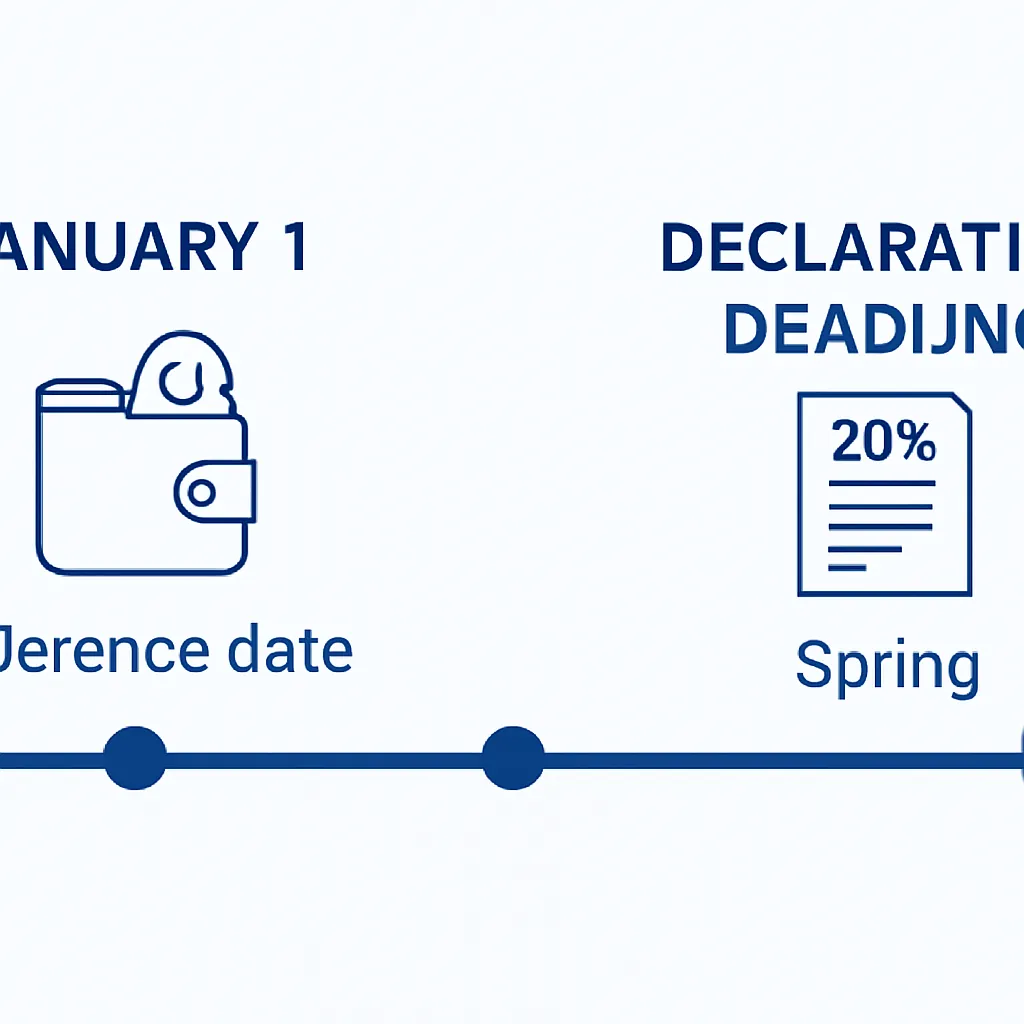
The Netherlands taxes most private individuals on their wealth rather than on the gains they realise when selling assets. Crypto assets fall into box 3, which covers savings, investments, and other assets. The key date is 1 January each year. Whatever the total value of your crypto holdings on that date, that figure forms part of your box 3 wealth base for that tax year. It does not matter whether you sold anything during the year or whether the value subsequently fell. The valuation snapshot is taken once, at the start of the year, and that is the figure used for tax purposes.
The Key Date for Tax Valuation
This creates a situation that surprises many newer crypto holders. If you bought bitcoin at a high price in late December and the price then dropped sharply, you might still owe tax based on the higher January 1 value. Conversely, if you sold during the year and reinvested, the tax calculation still only looks at what you held at midnight on New Year's Day. Understanding this timing is essential before you attempt to calculate crypto taxes manually or interpret any automated output from a crypto tax calculator.
Crypto Treated Like Other Assets
The Belastingdienst, the Dutch tax authority, treats crypto holdings the same way it treats stocks and savings deposits for box 3 purposes. There is no separate crypto-specific legislation at this stage, though the broader European framework introduced by DAC8 is expected to bring more detailed reporting requirements in coming years.
The Box 3 Deemed Return System Explained
Rather than taxing actual investment returns, the Dutch system applies a deemed return to different categories of assets within box 3. Each category carries a fixed assumed rate of return, regardless of what your portfolio actually earned or lost. The deemed return is then taxed at the box 3 rate. This is the figure that matters when you want to calculate crypto taxes under Dutch law.
Crypto in the Investment Category
Crypto assets are classified within the investment category, which historically carries a higher deemed return rate than the savings category. This means that holding crypto is treated as generating a relatively high assumed return, even in years when the market fell. The distinction between asset categories is important when you are preparing a crypto tax report, because an incorrect classification can result in either overpaying or underpaying tax.
Asset Category Comparison Table
The table below summarises how the box 3 asset categories generally apply to common holdings, so you can see where crypto sits relative to other assets. These are structural category distinctions rather than specific rate figures, which are set annually by the Dutch legislature.
| Asset Category | Typical Examples | Deemed Return Level | Applies to Crypto? |
|---|---|---|---|
| Bank savings | Current and savings accounts | Lower | No |
| Investments | Stocks, crypto, bonds, property | Higher | Yes |
| Debts | Personal loans, mortgages | Offsetting (negative) | Only if debt-financed |
Key Thresholds and the Tax-Free Allowance
Not every crypto holder in the Netherlands owes box 3 tax. The system includes a tax-free allowance, known as the heffingvrij vermogen, which exempts a portion of your total box 3 wealth from taxation. If the combined value of all your box 3 assets on 1 January falls below this threshold, you have no box 3 liability for that year. For most individual filers, there is one allowance per person, and partners or fiscal partners may be able to combine or optimise their allowances.
Practical Impact of the Threshold
This threshold makes a practical difference to a significant number of smaller crypto holders. Someone with modest holdings who also has some savings may find that their total box 3 position is below the exemption limit and that no tax is due at all. A crypto capital gains calculator that is configured for the Dutch system will take this allowance into account automatically, but it is worth checking that any tool you use applies the correct threshold for the year you are filing.
Box 3 Calculation Steps Table
The table below shows the structural components of the box 3 calculation to help you understand which inputs matter when you use a crypto tax calculator.
| Calculation Step | Description | Key Input Required |
|---|---|---|
| 1. Total box 3 assets | Sum of all savings, investments, and crypto on 1 Jan | Portfolio value at midnight 1 January |
| 2. Deduct liabilities | Qualifying debts reduce the taxable base | Outstanding debt balances on 1 Jan |
| 3. Apply tax-free allowance | Exempt amount subtracted from net wealth | Allowance for your personal situation |
| 4. Apply category weighting | Assets split between savings and investment categories | Asset type classification |
| 5. Apply deemed return rates | Assumed return calculated per category | Annual rates set by Dutch legislature |
| 6. Apply box 3 tax rate | Tax charged on total deemed return | Current year box 3 rate |
What Counts as a Crypto Asset for Dutch Tax Purposes
The scope of what Dutch tax law considers a crypto asset for box 3 purposes is broader than many filers assume. Bitcoin and ether are obvious examples, but the Belastingdienst applies its treatment to a wide range of digital tokens and crypto-related holdings. This includes altcoins, stablecoins held as investments, tokens received through airdrops, and in many cases, staking rewards that have been received and now sit in your wallet.
NFTs Need Careful Classification
Non-fungible tokens present a more nuanced situation. Whether an NFT is treated as an investment asset in box 3 or as something else depends on the specific characteristics of the token and the nature of your holding. If you hold NFTs with potential investment value, it is safer to include them in your box 3 declaration and seek specific guidance if the amounts are material. A crypto tax software tool built for Dutch filers should flag these edge cases rather than simply ignore asset types it cannot categorise cleanly.
Foreign Crypto Holdings Count Too
Crypto held on foreign exchanges also counts. The Belastingdienst requires residents to declare worldwide assets, so holdings on a US or Singapore-based exchange are no different from holdings on a Dutch platform. This is an area where people frequently under-declare, sometimes unknowingly. When you connect exchange accounts to a crypto tax calculator, ensure you include every platform where you held a balance on 1 January of the relevant tax year.
How to File Crypto Taxes in the Netherlands
Filing your Dutch tax return, the aangifte inkomstenbelasting, involves declaring your box 3 assets as part of the annual income tax return submitted to the Belastingdienst. The process itself is online, and most filers access it through the Mijn Belastingdienst portal using DigiD authentication. The filing window typically opens in the spring following the tax year, and the standard deadline for most individuals falls in May, though extensions are available in certain circumstances.
Gathering Accurate Valuations
The practical challenge is not the submission process itself but gathering accurate valuations. You need the euro-denominated value of every crypto holding as it stood on 1 January. If you held tokens across multiple wallets and exchanges, calculating a single consolidated portfolio value in euros at a specific moment in time is time-consuming without software support. This is precisely where crypto tax software adds clear value: it aggregates your transaction history, identifies the correct balances at the reference date, applies the current exchange rates, and produces a crypto tax report you can use directly when completing your return.
Common Filing Mistakes to Avoid
One common mistake is using the current price at the time of filing rather than the price on 1 January. Another is failing to account for crypto held in DeFi protocols or hardware wallets, which may not appear in any exchange export. A thorough approach means accounting for every token, in every location, at the correct date.
Illustrative Scenario
This scenario is illustrative. It does not describe a real person or client, and the figures are examples only.
To illustrate how this applies in practice, consider the following scenario:
Lars is a software developer based in Amsterdam who began investing in crypto during a previous bull market. By 1 January of the relevant tax year, he holds bitcoin across two exchanges and a hardware wallet, a selection of altcoins on a third platform, and a small amount of ether staked through a liquid staking protocol. He also holds a stablecoin balance on one exchange. He has never sold his entire position, so he assumed his tax obligation was minimal.
When Lars uses CryptaTax, he connects all four platforms and imports his hardware wallet via a public address. The tool calculates his total euro-denominated portfolio value as of 1 January, classifies his holdings under the investment category of box 3, and generates a crypto tax report showing his taxable base after the heffingvrij vermogen is applied. Lars discovers that his total box 3 wealth, including savings and crypto, exceeds the threshold, and that he has a genuine tax liability. The report gives him the exact figures he needs to complete his aangifte inkomstenbelasting accurately, and he files before the May deadline with confidence.
Frequently Asked Questions
Do I pay capital gains tax on crypto in the Netherlands?
Not in the traditional sense. The Netherlands does not tax realised capital gains on crypto for private individuals. Instead, crypto holdings are taxed under box 3 as part of your overall wealth, using a deemed return model based on the value of your assets on 1 January each year. Whether you sold during the year is not relevant to the box 3 calculation.
What is the reference date for crypto tax in the Netherlands?
The reference date is 1 January. The Belastingdienst uses the value of your crypto holdings at midnight on 1 January to determine your box 3 taxable base for that tax year. You should record or export the value of every wallet and exchange balance at that specific moment, converted to euros.
How does a crypto tax calculator help with Dutch tax filings?
A crypto tax calculator connects to your exchanges and wallets, retrieves your transaction history and balances, and calculates the euro value of your holdings at the 1 January reference date. It then applies the relevant box 3 category, the tax-free allowance, and the deemed return rates to produce a crypto tax report you can use when filing your aangifte inkomstenbelasting.
What if I hold crypto on a foreign exchange?
You must still declare it. The Belastingdienst requires Dutch residents to declare worldwide assets under box 3, regardless of where the exchange is based. Crypto held on US, Singaporean, or any other foreign platform is treated identically to crypto held on a Dutch exchange. Failing to declare foreign holdings is a common error that can lead to penalties.
Does staking income affect my Dutch crypto tax position?
Staking rewards received during the year and held in your wallet on 1 January would be counted as part of your box 3 asset base on that reference date. Whether the rewards themselves are separately taxable as income under box 1 depends on the nature and scale of the activity. For most casual stakers, the box 3 wealth treatment is the primary consideration.
Are NFTs included in my box 3 declaration?
NFTs with investment characteristics are generally considered box 3 assets and should be included in your declaration. The Belastingdienst has not issued specific guidance that excludes NFTs from the wealth tax framework. If you hold NFTs with significant value, include them in your return and seek professional advice if the amounts are material.
When is the Dutch tax filing deadline for crypto holders?
The standard deadline for submitting your aangifte inkomstenbelasting is typically in May of the year following the tax year in question. Extensions are available in certain circumstances. Filing on time avoids penalties, and using crypto tax software to prepare your box 3 figures in advance makes meeting the deadline much more manageable.
What happens if I under-declare my crypto holdings?
Under-declaring box 3 assets, including crypto, can result in corrections, interest charges, and financial penalties from the Belastingdienst. In more serious cases involving deliberate evasion, criminal proceedings are possible. The increasing use of data-sharing frameworks across EU member states means that foreign exchange data is becoming progressively more accessible to tax authorities.
Can I deduct crypto-related debts in box 3?
If you took out a loan to purchase crypto, that qualifying debt may be deductible against your box 3 wealth base, reducing your taxable position. The debt must meet the Belastingdienst's criteria for box 3 liabilities. A small threshold applies before debts become deductible, so very small loan balances may not produce any benefit.
Do I need separate software if I only hold a small amount of crypto?
Even small holdings must be declared if your total box 3 wealth exceeds the tax-free allowance. A crypto tax calculator is useful even for modest portfolios because it automates the euro valuation at the 1 January reference date and ensures you do not overlook balances on secondary wallets or smaller exchanges. The time saved is significant compared to calculating values manually.
Source: CryptaTax