
Crypto Airdrop Tax: What You Actually Owe
Receiving free tokens sounds like a straightforward win. The tax reality is less simple. Crypto airdrop tax is one of the most misunderstood obligations in personal crypto taxation, and it is far from the only one. Mining income, staking rewards, DeFi earnings, and NFT sales all carry their own treatment, and getting any of them wrong on your return can lead to penalties, interest, or an unwelcome letter from your tax authority. This guide walks through each income type clearly, explains the key principles that drive the tax treatment, and helps you understand what you need to record, report, and pay. Whether you have received a handful of tokens from a new protocol or you are actively farming DeFi yields, the same core logic applies: the taxman wants to know about it.

How Crypto Airdrop Tax Works
An airdrop is a distribution of tokens sent directly to a wallet address, usually as part of a project launch, a community reward, or a protocol migration. From a tax perspective, the central question is whether you received something of value without paying for it. In most jurisdictions, the answer is yes, and that means the tokens are treated as income at the point you receive them.
Income Event at Receipt
The taxable amount is typically the fair market value of the tokens on the date they arrive in your wallet. If you receive 100 tokens and each is worth a certain amount on that day, your income figure is 100 multiplied by that day's price. You pay income tax on that figure, at whatever rate applies to your income bracket. Later, if you sell or swap those tokens, a second event occurs: a capital gain or loss based on the difference between your sale proceeds and the value you already declared as income. That original income value becomes your cost basis for capital gains purposes.
Some tax authorities draw a distinction between unsolicited airdrops, where you did nothing to receive the tokens, and participation-based airdrops, where you completed tasks or held a qualifying asset. Unsolicited airdrops may be treated more leniently in certain jurisdictions, sometimes deferred until disposal. You should always check the specific guidance for your country rather than assuming a universal rule applies.
Unsolicited vs Participation-Based Airdrops
| Airdrop Type | Common Tax Treatment | When Tax Arises |
|---|---|---|
| Unsolicited airdrop | Income tax on receipt (some jurisdictions defer to disposal) | Date tokens arrive in wallet |
| Participation-based airdrop | Income tax on receipt at fair market value | Date tokens arrive in wallet |
| Hard fork tokens | Income tax on receipt or zero cost basis on disposal | Date of fork or date of disposal |
Mining Income Tax and How It Differs
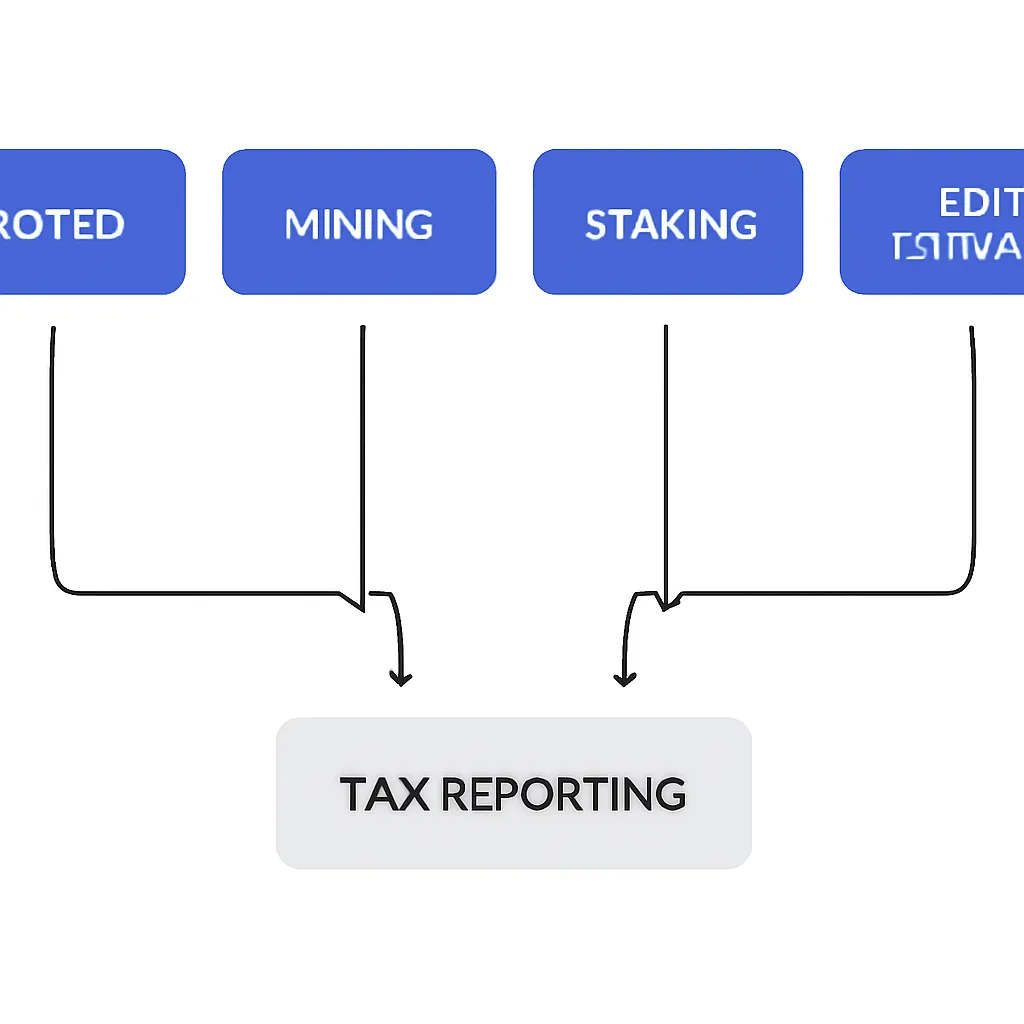
Crypto mining income is generally treated as trading or self-employment income rather than a capital receipt. When you successfully mine a block and receive a reward, that reward is income at its fair market value on the date you receive it. The distinction between hobby mining and commercial mining matters here. If you mine occasionally on a personal computer, some tax authorities treat the activity as a hobby and apply different rules. If you run dedicated hardware, claim electricity costs, and mine with a profit motive, you are almost certainly running a trade.
Expense Deductions for Miners
Commercial miners can often deduct allowable expenses: electricity, hardware depreciation, cooling costs, and relevant software subscriptions. These deductions reduce your taxable profit but they do not eliminate the income event entirely. You must still record the value of every mining reward on the date it is received, which means maintaining a transaction-by-transaction log rather than simply looking at your year-end wallet balance.
Capital Gains on Sale of Mined Tokens
When mined tokens are subsequently sold, the disposal triggers a capital gains calculation. Your acquisition cost is the value you already recognised as income, so there is no double taxation on that amount, only on any additional gain above it.
Is Staking Taxable? Understanding Crypto Staking Tax
Is staking taxable? In most jurisdictions that have issued guidance, yes. Crypto staking tax follows a similar logic to mining: you are providing a service to a network and receiving a reward in return. That reward is income at the point you receive it, valued at the prevailing market price.
Jurisdictional Differences
The picture is not entirely uniform. The US Internal Revenue Service confirmed that staking rewards are gross income upon receipt. The UK's HMRC takes the same position for most staking arrangements. Some European jurisdictions are still developing their formal guidance, and a small number treat staking rewards as capital receipts only taxable on disposal.
Liquid Staking Complications
Liquid staking adds another layer. When you stake a token and receive a liquid staking derivative in return, that exchange may itself constitute a disposal of your original token, triggering a capital gain or loss before any staking reward is even considered. If you then earn yield on the derivative, that yield carries its own income tax treatment. Tracking this accurately requires clean records of every swap, receipt, and disposal event.
| Activity | Income Tax on Receipt? | Capital Gains on Disposal? |
|---|---|---|
| Proof-of-stake rewards | Yes, in most jurisdictions | Yes, on gain above cost basis |
| Liquid staking derivative receipt | Possibly (exchange may be a disposal) | Yes, on the derivative when sold |
| Delegated staking rewards | Yes, at fair market value on receipt | Yes, on subsequent disposal |
How Are DeFi Rewards Taxed
DeFi tax is arguably the most complex area of personal crypto taxation because the underlying transactions are so varied. Liquidity provision, yield farming, lending, borrowing, governance rewards, and protocol incentives all generate different economic outcomes, and the tax treatment can differ for each one.
Income Treatment for Rewards
The core question for how DeFi rewards are taxed is the same as for staking: did you receive tokens with value? If yes, that value is income. When you provide liquidity to an automated market maker and earn trading fees paid in a token, those fees are income. When a protocol distributes governance tokens as an incentive, those too are likely income on receipt. The fact that you may not have sought them out, or that the tokens are illiquid, does not generally exempt them.
Impermanent Loss Complications
Impermanent loss is a complication unique to liquidity provision. When you withdraw from a liquidity pool, you may receive back a different ratio of tokens than you deposited. Whether impermanent loss is a deductible loss depends on your jurisdiction and how the pool interaction is classified. In many cases, each deposit and withdrawal is treated as a disposal and acquisition, meaning you could have multiple taxable events within a single farming strategy without ever converting to fiat.
Keeping clean records of every wallet interaction is not optional. A tool like CryptaTax can pull your on-chain data automatically, classify each transaction type, and surface your estimated tax position before you file.
NFT Tax: Sales, Royalties, and Creator Income
NFT tax covers two distinct scenarios: buying and selling NFTs as an investor, and creating and selling NFTs as an artist or developer. For investors, each NFT sale is a disposal. The gain or loss is calculated against the acquisition cost, which includes the price paid plus any gas fees attributable to the purchase. Short holding periods may attract higher rates in some jurisdictions, such as the short-term capital gains rates in the United States.
Creator Income and Royalties
For creators, the initial sale of an NFT is typically trading income, not a capital gain. You created an asset in the course of a trade and sold it. Secondary market royalties, where a percentage of each resale flows back to the original creator, are also trading income, received each time a qualifying resale occurs. Both the primary sale and subsequent royalties need to be reported as income in the year they are received.
Two Taxable Events per Purchase
Purchasing an NFT with cryptocurrency is itself a disposal of that cryptocurrency, so a single NFT buy can generate a capital gains event on your crypto and then a separate disposal event when you later sell the NFT. Two taxable events from one transaction is a common surprise for NFT traders who do not keep detailed records.
Crypto Trading Tax and Cost Basis Methods
Crypto trading tax applies every time you sell, swap, or otherwise dispose of a token. A disposal includes selling for fiat, swapping one token for another, using crypto to buy goods or services, and gifting crypto in some jurisdictions. Each of these creates a capital gain or loss.
Cost Basis Methods
The gain is the difference between the disposal proceeds and the allowable cost. The cost basis method you use determines which acquisition cost is matched to which disposal. Different jurisdictions mandate or permit different methods. The UK requires a same-day and 30-day matching rule before applying a pooled average cost. The US permits specific identification, FIFO, or HIFO in many situations. Using the wrong method, or switching methods without authorisation, can produce an incorrect return even if your transaction data is otherwise accurate.
Wash Sale Rules
Wash sale rules add complexity for US filers. Crypto is not currently subject to the same wash sale restrictions as securities in the US, but proposed legislative changes have been discussed. Staying informed about rule changes in your jurisdiction is part of managing your crypto trading tax position responsibly.
Illustrative Scenario
This scenario is illustrative. It does not describe a real person or client, and the figures are examples only.
To illustrate how this applies in practice, consider the following scenario:
Priya is a software engineer based in London. Over the past tax year, she received an airdrop of tokens from a DeFi protocol she had used, earned staking rewards on her proof-of-stake holdings, provided liquidity to two pools, and sold three NFTs she had purchased six months earlier. She also sold a portion of her main crypto holding to cover expenses.
Each of these events carries a separate tax obligation. The airdrop is income on the date of receipt. The staking rewards are income each time they were credited. The liquidity pool interactions involve multiple disposals and acquisitions. Each NFT sale is a capital disposal. The crypto sale is a capital disposal matched against her pooled cost basis under UK rules.
Priya tries to reconcile everything manually using spreadsheets but quickly realises the on-chain data across five wallets and two exchanges is too fragmented to track reliably. She connects her wallets to CryptaTax, which imports all transactions, classifies each one, and generates a report that separates her income events from her capital gains events. With the report in hand, she can hand her accountant the correct figures and file with confidence before the self-assessment deadline.
Frequently Asked Questions
What is crypto airdrop tax and when do I owe it?
Crypto airdrop tax arises when you receive tokens for free and those tokens have a fair market value on the date of receipt. In most jurisdictions you owe income tax on that value in the tax year the airdrop lands in your wallet. A second tax event, capital gains, may arise when you later sell or swap the tokens.
Do I have to pay tax on tokens I never sold?
In many jurisdictions, yes. If you received tokens as income, through an airdrop, staking, mining, or DeFi rewards, the income tax point is receipt, not sale. You may owe tax even if you still hold the tokens and even if their value has since fallen. Check the specific rules for your country, as a small number of jurisdictions defer taxation to disposal.
Is staking taxable in the UK and US?
Yes, in both jurisdictions. HMRC in the UK treats staking rewards as miscellaneous income taxable at receipt. The IRS in the US confirmed that staking rewards are gross income on the date received. Both countries then treat a later sale of those tokens as a capital disposal with the original income value as the cost basis.
How are DeFi rewards taxed differently from regular staking?
The underlying principle is similar: rewards received have value, and that value is typically income. The difference is complexity. DeFi strategies often involve pool deposits, token swaps, and withdrawal events that each qualify as separate taxable disposals, not just the reward payment itself. Every interaction with a smart contract may need to be logged and classified individually.
What is the NFT tax treatment for a buyer who later sells?
For investors, selling an NFT is a capital disposal. The gain is calculated as the sale proceeds minus the original purchase cost, including gas fees. If you bought the NFT using cryptocurrency, that purchase was also a disposal of the crypto you spent, so two taxable events can arise from one transaction: a crypto capital gain and later an NFT capital gain.
Can I deduct expenses against my mining income?
Commercial miners operating as a trade can generally deduct allowable business expenses: electricity, hardware costs, maintenance, and relevant software. Hobbyist miners may face a more restricted regime. The classification of your activity as trade or hobby depends on factors like scale, regularity, and profit motive, and it varies by jurisdiction.
What cost basis method should I use for crypto trading tax?
This depends entirely on your jurisdiction. The UK mandates a specific share pooling method with same-day and 30-day matching rules. The US allows FIFO, HIFO, or specific identification in most cases. Using the wrong method produces an incorrect return even if your underlying data is accurate, so confirming the required method for your country before filing matters.
What records do I need to keep for crypto tax purposes?
You need the date, type, amount, and fair market value of every transaction: receipts, disposals, swaps, and income events. For DeFi and NFT activity, you also need records of gas fees and pool interactions. Most tax authorities require you to keep these records for at least five years, and in some jurisdictions longer. Automated tools that pull on-chain data directly reduce the risk of gaps in your records.
Does sending crypto between my own wallets trigger a tax event?
In most jurisdictions, transferring crypto between wallets you own is not a disposal and does not trigger a tax event on its own. However, any gas fees paid in crypto during the transfer may constitute a small disposal. Keeping records of your wallet addresses and being able to demonstrate ownership of both sides of the transfer is important if your tax authority ever reviews your returns.
What happens if I forgot to report airdrop income in a previous year?
Unreported income can attract penalties and interest. Most tax authorities allow you to file an amended return or make a voluntary disclosure to correct past errors, often with reduced penalties compared to being investigated. Acting proactively is almost always better than waiting. A tax adviser familiar with crypto can help you quantify the liability and manage the disclosure process.
Source: CryptaTax