
NFT Tax in Malta: Sales, DeFi, Staking and Airdrops Explained
NFT tax in Malta sits in a grey zone that trips up a surprising number of holders. Malta has built a reputation as a crypto-friendly jurisdiction, but friendly does not mean tax-free. Whether you sold an NFT at a profit, received staking rewards, collected a DeFi yield, or picked up an airdrop, the Maltese tax authority may have an interest in what landed in your wallet. The rules are not always obvious, and the consequences of getting them wrong range from unexpected bills to penalties. This guide walks through each transaction type clearly so you can understand what you owe, or at least what questions to ask your accountant, before the filing deadline arrives.
How Malta Approaches Crypto and NFT Tax Generally
Malta does not have a standalone digital asset tax code. Instead, the Malta Tax and Customs Administration applies existing income tax and capital gains principles to crypto and NFT transactions, interpreting them through the lens of the Income Tax Act. The classification of any given transaction depends heavily on the facts: who you are, how frequently you transact, what your intention was when you acquired the asset, and whether you are acting in a business capacity or as a private individual.
No Standalone Digital Asset Tax Code
For most private individuals, gains on capital assets are not subject to capital gains tax in Malta in the same way they would be in, say, the United Kingdom. Malta does not impose a general capital gains tax on assets disposed of by individuals unless the asset falls into specific categories defined by statute. Crypto assets and NFTs do not sit neatly inside those categories, which creates both opportunity and uncertainty. Where transactions are deemed to be trading activity rather than capital disposal, income tax applies at the standard progressive rates. The distinction between capital and income is therefore one of the most consequential questions a Maltese NFT holder needs to resolve.
The frequency and volume of your transactions, whether you hold assets for short or long periods, and whether you have a professional or commercial setup all feed into that classification. A hobbyist who sold one NFT once sits in a very different position from someone running a high-volume NFT flipping operation. The table below summarises the broad framework before we examine each transaction type individually.
Classification and Tax Treatment Table
| Holder Profile | Likely Classification | Potential Tax Treatment |
|---|---|---|
| Occasional private seller | Capital disposal | Potentially outside capital gains tax scope |
| Frequent trader or flipper | Trading income | Subject to income tax at progressive rates |
| Creator selling own NFTs | Self-employment or business income | Income tax applies on proceeds |
| DeFi or staking participant | Income on receipt | Taxable as income when rewards received |
NFT Tax on Sales and Trades in Malta
When you sell an NFT for more than you paid for it, you have a gain. The critical question in Malta is whether that gain is a capital gain or a trading profit. As noted above, Malta does not levy a broad capital gains tax on individuals disposing of movable property in the way many other EU member states do. If your NFT activity is characterised as investment rather than trade, a private individual may find the gain falls outside the chargeable income categories entirely.
Capital Gain vs Trading Profit
However, do not read that as a blanket exemption. If the tax authority views your activity as a business or trade, every profit becomes chargeable income. Indicators that point toward trading include holding NFTs for very short periods before resale, systematically buying underpriced assets with the clear intent to flip them quickly, and generating meaningful revenue through repeat transactions. The burden of demonstrating that your activity is not trading sits in practice on the taxpayer, so documenting your intent and holding patterns matters.
Trading one NFT directly for another also creates a taxable event. The disposal of the first NFT is treated as if you sold it at its fair market value at the moment of exchange, and that value becomes the acquisition cost of the new NFT. This is where many holders run into unexpected tax bills: they assume a swap is not a sale. In Malta, as in most jurisdictions, it is. Crypto trading tax principles apply here just as they do to straightforward cash sales.
Taxable Events Summary Table
| Transaction Type | Taxable Event? | Basis of Charge |
|---|---|---|
| Sale of NFT for fiat | Yes (if gain arises) | Proceeds minus acquisition cost |
| NFT swapped for another NFT | Yes | Fair market value at date of swap |
| NFT sold at a loss | Loss realised | May offset against other trading income |
| NFT gifted | Potentially yes | Depends on relationship and intent |
NFT Creators and Royalties: A Different Tax Picture
If you mint and sell your own NFTs, the position is clearer and generally less favourable than that of a passive investor. Revenue from selling creative work is income from self-employment or a business activity, and Malta taxes that under the standard income tax framework. You are, in effect, selling a product you created. The proceeds are taxable in the year you receive them, less any allowable expenses you can demonstrate were incurred wholly and exclusively in producing the work.
Royalties as Chargeable Income
Royalties present their own question. Many NFT platforms build in automatic royalty payments each time the token is resold on the secondary market. Those ongoing royalty streams are income. They are received in exchange for the continued use of your creative work, and Malta's income tax rules treat recurring payments of that nature as chargeable income in the year of receipt. The value to use for tax purposes is the fair market value of whatever asset you received, whether that is fiat, Ether, or another token, at the time the royalty payment landed in your wallet.
Creators should also keep detailed records of their production costs: software subscriptions, hardware, platform fees, and any professional services used. These may be deductible against creative income, reducing the taxable figure. The record-keeping requirement is not optional; without documentation, the tax authority may disallow claims.
Crypto Staking Tax and DeFi Rewards in Malta
Staking and DeFi participation have grown into major income streams for many crypto-native individuals, and the question of whether staking is taxable in Malta follows a broadly consistent logic with other income streams. When you receive staking rewards, you receive something of value in exchange for locking up your tokens to support a network. Malta's tax framework treats receipts of value as income unless there is a specific exemption, and no such exemption exists for staking rewards.
Staking Rewards Taxed as Income
The practical result is that staking rewards are likely to be treated as income at the time of receipt, valued at the fair market price on that date. This means crypto staking tax obligations arise continuously if you are actively earning rewards, not just when you eventually sell the tokens. How are DeFi rewards taxed? The same principle applies. Yield farming returns, liquidity pool fees, and lending interest all involve receiving tokens or other assets in exchange for deploying capital or providing a service to a protocol. That receipt is income. The subsequent disposal of those tokens then triggers a separate question about whether any gain or loss arose relative to the value recorded on the day you received them.
The table below outlines how these passive crypto income types map to likely tax treatments under Maltese principles.
Passive Income Tax Treatment Table
| Income Type | Taxable on Receipt? | Further Tax on Disposal? |
|---|---|---|
| Staking rewards | Yes, as income | Yes, on gain above receipt value |
| DeFi yield / liquidity fees | Yes, as income | Yes, on gain above receipt value |
| Lending interest in crypto | Yes, as income | Yes, on subsequent disposal |
| Liquidity pool token redemption | Depends on structure | Gain on withdrawal likely taxable |
Crypto Airdrop Tax and Hard Forks
Crypto airdrop tax is one of the most debated areas across all jurisdictions, and Malta is no exception. An airdrop delivers tokens to your wallet, sometimes because you held another asset, sometimes because you completed a task, and sometimes for no apparent reason at all. The tax treatment often depends on that context.
Airdrops as Income or Gifts
Where an airdrop is received in exchange for some action on your part, such as promoting a project, testing a protocol, or providing wallet data, it is difficult to argue that the receipt is not income. You provided something and received something in return. Income tax on the fair market value at receipt is the expected treatment. Where tokens arrive entirely unsolicited and you did nothing to receive them, there is an argument that no income arises at the point of receipt since you did not earn them. The gain would then crystallise only on disposal. That argument is not settled law in Malta, and caution is warranted.
Hard fork tokens, which appear in your wallet following a protocol split, follow a similar logic. Most practitioners treat them as having a nil acquisition cost, meaning the full proceeds on any future sale represent a taxable gain. Tracking these events carefully in your records is essential because the volumes can be small individually but add up to a meaningful tax exposure over time.
Record-Keeping and Reporting Obligations
No tax analysis is useful without understanding what you actually need to do at filing time. Maltese resident individuals file an income tax return, and any crypto or NFT income that is chargeable needs to be declared. The obligation sits on you to identify, value, and report each taxable event. The tax authority does not receive automatic data feeds from every blockchain or NFT marketplace, but that does not mean transactions are invisible. Blockchain data is public and increasingly analysed by tax authorities across the EU, and Malta is part of DAC8, the EU directive that requires crypto asset service providers to report user transaction data to tax authorities from 2026 onward.
Transaction Logging Requirements
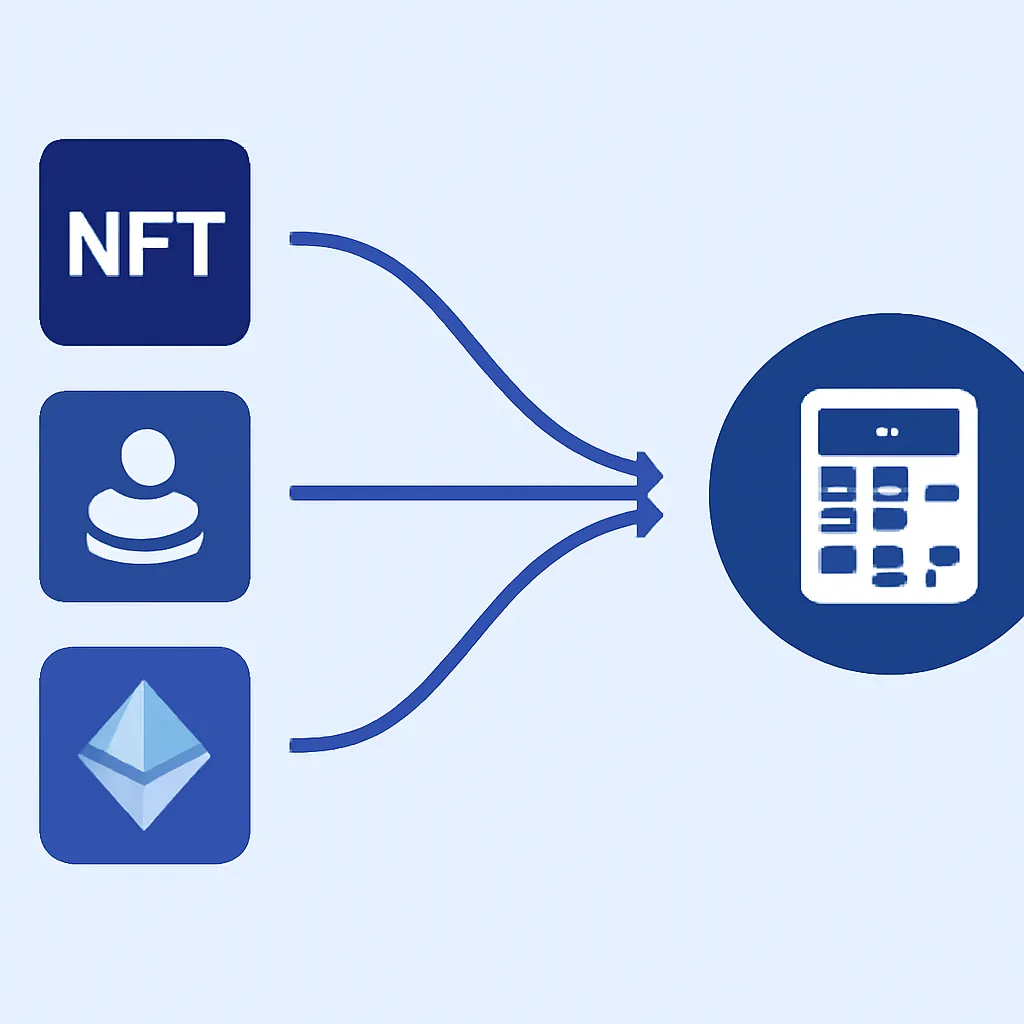
Good record-keeping means logging every transaction: the date, the asset, the amount received or disposed of, the fair market value in euros at that moment, and the resulting gain or loss. For active DeFi or staking participants, this can run to thousands of entries annually. Spreadsheets become unmanageable quickly, which is where purpose-built crypto tax software earns its value by pulling transaction data from wallets and exchanges and calculating your position automatically.
CryptaTax connects to wallets and exchanges, calculates gains and income across NFT sales, staking rewards, DeFi returns, and airdrops, and generates a report you can hand to your accountant or use to complete your return. Keeping this kind of structured record protects you if the tax authority ever asks questions about past years.
Illustrative Scenario
This scenario is illustrative. It does not describe a real person or client, and the figures are examples only.
To illustrate how this applies in practice, consider the following scenario:
Maria is a Maltese resident who has been active in the NFT space for two years. She bought several NFTs as a collector, sold two at a profit, swapped one for a different NFT she preferred, and received a small airdrop from a platform she used. She also staked some Ethereum throughout the year and earned regular staking rewards. At year end, she realises she has no clear record of what any of these assets were worth on the individual transaction dates.
When Maria starts trying to reconstruct her position, the swap transaction is the surprise. She assumed exchanging one NFT for another was not a sale, but her accountant explains that the first NFT was disposed of at fair market value on the swap date, creating a taxable event. Her staking rewards also need to be valued at receipt across dozens of small distributions. Using CryptaTax, Maria imports her wallet history, and the software calculates the euro value of each reward on the day it arrived and totals her staking income automatically. She files a complete return, avoids underreporting, and has a clean audit trail if the Malta Tax and Customs Administration ever asks for evidence.
Frequently Asked Questions
Is NFT tax payable in Malta if I only made a small profit?
Malta does not have a minimum threshold below which NFT gains are automatically exempt. If your activity is classified as trading, income tax applies to profits regardless of size. If the gain is capital in nature, the picture is more complex, but you should not assume small gains are ignored. Always report and seek advice if uncertain.
How are NFT sales taxed differently from regular crypto trading tax?
NFTs and fungible crypto assets follow similar principles in Malta, but NFTs are unique assets with more varied use cases. A creator selling their own NFTs faces income tax on the proceeds as self-employment income, while a collector may argue a capital disposal. Regular crypto trading tax applies to frequent buying and selling of fungible tokens and typically falls into the trading income category more readily because of the volume and intent involved.
Is staking taxable in Malta?
Yes, staking rewards are generally treated as income in Malta at the time of receipt. The fair market value of the tokens received on the date they arrive in your wallet is the figure used to calculate your income. When you later sell those tokens, any gain above that receipt value may be taxable again as a separate disposal event.
How are DeFi rewards taxed in Malta?
DeFi rewards, whether from yield farming, liquidity provision, or lending protocols, are treated as income on receipt under Maltese tax principles. The value of tokens received at the time of receipt is your taxable income. A subsequent sale of those tokens triggers a further calculation based on any price movement since you received them.
What is the crypto airdrop tax position in Malta?
Airdrops received in exchange for completing a task or providing a service are likely treated as income at receipt. Unsolicited airdrops where you did nothing to earn them may be taxed only on disposal, but this is not settled law. The safest approach is to record the fair market value on the date of receipt and discuss the treatment with a qualified adviser.
Do I need to report NFT transactions even if I made a loss?
Losses should still be recorded carefully because they may be offset against trading income in the same or future years, depending on how your activity is classified. Keeping records of losses is just as important as recording gains. Failing to report at all, including loss-making years, leaves you without the documentation needed to support your overall tax position.
When do DAC8 rules affect Maltese crypto holders?
DAC8 is the EU directive requiring crypto asset service providers to report user transaction data to tax authorities. It applies from 2026, meaning platforms operating in the EU will begin sharing data on Maltese users with the Malta Tax and Customs Administration. If your transaction history is not already clean and declared, this represents a meaningful change in visibility for the tax authority.
How do I calculate my NFT cost basis for tax purposes?
Your cost basis is the amount you paid to acquire the NFT, including any platform fees or gas costs directly attributable to the purchase. When you sell, you subtract the cost basis from the proceeds to find your gain or loss. For NFTs received as gifts or through airdrops, the cost basis is either nil or the fair market value at receipt, depending on the circumstances.
Can I deduct gas fees and platform costs from my NFT tax liability?
Yes, costs directly and wholly incurred in acquiring or disposing of an NFT are generally deductible against any resulting gain or income. Gas fees paid on purchase form part of your acquisition cost, and platform fees on sale reduce your disposal proceeds. Keep records of all associated costs as they can reduce your taxable figure meaningfully on high-value transactions.
Do I need specialist software to calculate my NFT and crypto tax in Malta?
For anyone with more than a handful of transactions, manual calculation becomes error-prone and time-consuming. Purpose-built crypto tax software like CryptaTax automates the import of wallet and exchange data, values each transaction at the correct historical rate, and produces a summary report ready for your tax return. It reduces the risk of errors and gives you a defensible audit trail.
Source: CryptaTax