
Crypto Staking Tax in Ireland: Income Tax, CGT, and DeFi Explained
Crypto staking tax in Ireland is not a single flat rate applied at one moment. Depending on how you earn and when you sell, Irish Revenue can tax the same asset twice: once when you receive it and again when you dispose of it. That surprises a lot of people. Staking rewards, DeFi yields, NFT sales, and airdrop tokens all sit inside the Irish tax framework, even though Revenue has not published one single definitive staking-specific guidance document. The rules that apply come from existing Income Tax legislation and Capital Gains Tax principles. This guide walks through each category clearly, so you know what you owe, when you owe it, and what records you need to keep before your self-assessed tax return is due.
How Irish Revenue Treats Crypto Assets Generally
Irish Revenue does not treat cryptocurrency as currency. It treats it as a capital asset for Capital Gains Tax purposes and, where crypto is received as a form of income, as a taxable receipt subject to Income Tax and the Universal Social Charge. This dual treatment is central to understanding crypto staking tax and every other form of crypto income.
Crypto as a Capital Asset for CGT
When you buy and later sell a cryptocurrency, the gain is within the scope of CGT, currently charged at 33% on chargeable gains above the annual exemption threshold. When you receive crypto as a reward for an activity, whether that is staking, lending, or providing liquidity, Irish Revenue's position is that the value of the token at the point of receipt is income. That income value then becomes your cost base for CGT purposes if you later sell the token at a higher price.
There is no separate crypto-specific tax code in Ireland. You apply the general rules of the Taxes Consolidation Act 1997 and the CGT rules under that same legislation. Understanding this framework first makes every other category easier to follow.
| Tax Type | When It Applies to Crypto | Current Rate (Ireland) |
|---|---|---|
| Income Tax | Receipt of staking rewards, DeFi yields, airdrops, mining income | 20% or 40% depending on income band, plus USC and PRSI |
| Capital Gains Tax | Disposal of crypto assets (sale, swap, gift, or spend) | 33% on gains above the annual exemption |
| CGT Annual Exemption | First portion of net gains each tax year | €1,270 per individual |
Is Staking Taxable in Ireland? Understanding the Two-Stage Tax Event
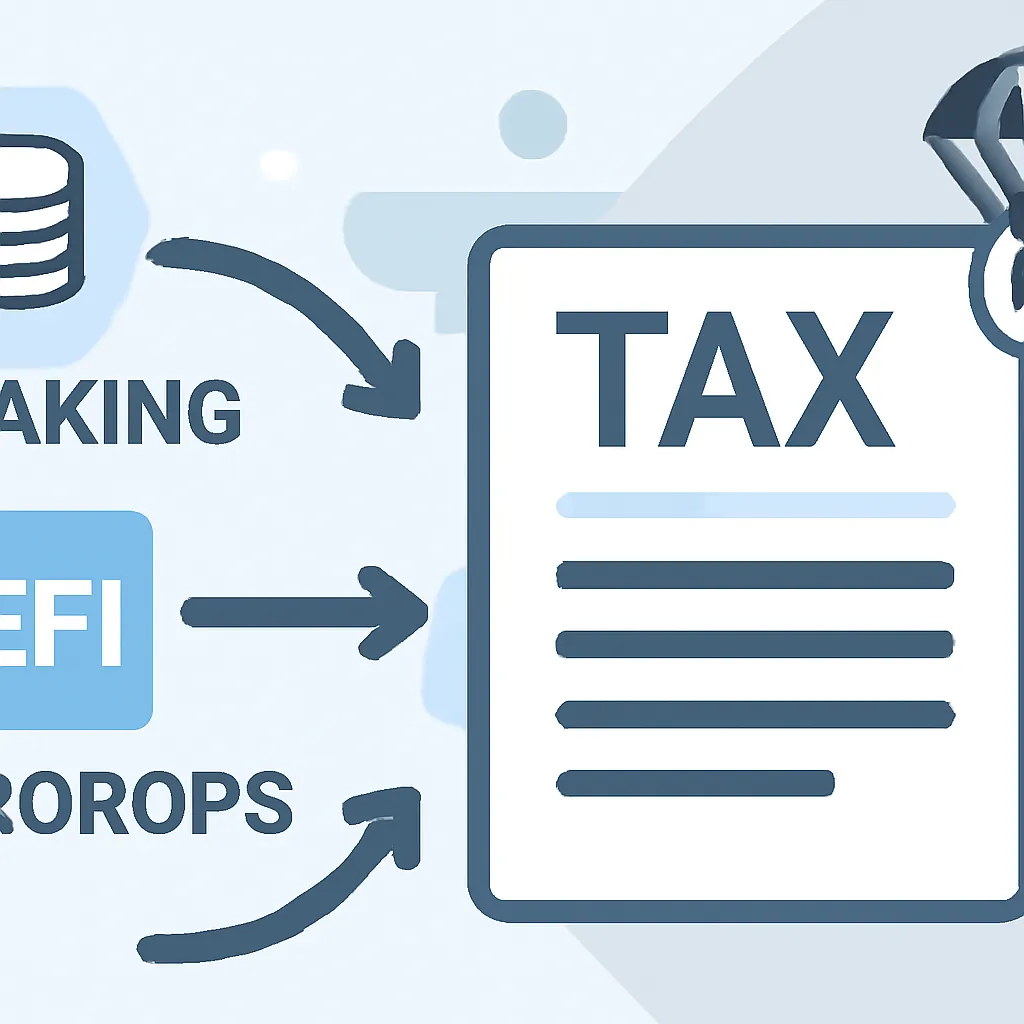
Is staking taxable in Ireland? Yes, and it typically creates two separate taxable events. The first happens the moment you receive a staking reward. At that point, the fair market value of the tokens in euro is treated as miscellaneous income and is subject to Income Tax, USC, and PRSI in the same way that any self-employment or investment income would be. You do not need to sell anything for this tax liability to arise.
Receipt of Rewards as Income
The second taxable event happens when you eventually dispose of those staking reward tokens. If you sell them, swap them for another asset, or use them to pay for something, you are making a disposal for CGT purposes. The gain is calculated as the sale proceeds minus the cost base, and the cost base is the income value you already declared at the time of receipt. This prevents double taxation on the same growth, but it does mean you need meticulous records of every receipt and its euro value on that date.
Disposal of Reward Tokens
The practical challenge is that staking rewards can arrive daily or even multiple times per day, particularly on proof-of-stake networks. Each individual receipt is technically a separate income event. Over a full tax year this can mean hundreds or thousands of individual records, which is why crypto tax software that automates valuation at the time of receipt is genuinely useful rather than optional.
How Are DeFi Rewards Taxed in Ireland
How are DeFi rewards taxed is one of the most searched questions among Irish crypto users, and the honest answer is that the tax treatment depends on the specific activity. DeFi covers a wide range of protocols: liquidity provision, yield farming, lending, borrowing, and automated market maker participation. Irish Revenue has not issued protocol-by-protocol guidance, so practitioners apply general principles.
Income on Receipt of Yield
Where you deposit tokens and receive a yield or reward token in return, the yield is treated as income at the point of receipt, much like staking. The value on that date is taxable income. Where you deposit tokens into a liquidity pool and receive LP tokens representing your share of the pool, the initial deposit may itself be treated as a disposal of the underlying tokens, triggering CGT if those tokens had increased in value since you acquired them.
Disposal Events in DeFi
When you eventually withdraw from the pool, you are disposing of the LP tokens and reacquiring the underlying assets. Each step is a potential CGT event. This complexity makes defi tax one of the most error-prone areas in self-assessed Irish returns, partly because users often do not realise that moving tokens between protocols counts as a disposal.
| DeFi Activity | Likely Tax Treatment in Ireland | Key Risk |
|---|---|---|
| Yield farming rewards received | Income Tax on receipt value | Daily or frequent receipts require per-event valuation |
| Depositing into a liquidity pool | Potential CGT disposal of deposited tokens | Gain on deposited tokens realised at point of deposit |
| Receiving LP tokens | Acquisition at market value | Cost base tracking required for later disposal |
| Withdrawing from a liquidity pool | CGT disposal of LP tokens | Impermanent loss does not reduce CGT liability directly |
| Lending crypto and receiving interest | Income Tax on interest received | Interest may also attract USC and PRSI |
NFT Tax and Crypto Airdrop Tax in Ireland
NFT tax in Ireland follows the same CGT framework that applies to other crypto disposals. When you sell an NFT, the gain over your original acquisition cost is subject to CGT at 33%. If you created and sold NFTs as a business or as a consistent commercial activity, Revenue may treat the income as trading income subject to Income Tax rather than CGT, which changes both the rate and the allowable deductions significantly. The distinction between a hobbyist creator and a trader is not always obvious, but frequency of activity and commercial intent are the key factors Revenue would consider.
Airdrop Receipt as Income
Crypto airdrop tax is similarly straightforward in principle, even if it feels unfair to people who received tokens without asking for them. Where you receive an airdrop of tokens that have a market value, Irish Revenue's general approach treats the receipt as miscellaneous income at the fair market value on the date of receipt. The subsequent disposal of those tokens is then a CGT event, with your cost base being the income value already taxed.
Some airdrops arrive with near-zero market value and only appreciate later. In those cases the income tax charge at receipt may be negligible, but the full gain on disposal is taxable as CGT. Record the receipt date, the token quantity, and the euro value at that time regardless of how small it appears in the moment.
Crypto Trading Tax: CGT Calculation and the Bed and Breakfast Rule
Crypto trading tax in Ireland is governed by the same CGT rules that apply to shares and other assets, including the specific share identification rules. This matters because Ireland uses a first-in-first-out method for identifying which tokens are being disposed of when you sell part of a holding, unless the bed and breakfast rule applies.
Bed and Breakfast Rule Explained
The bed and breakfast rule states that if you dispose of an asset and reacquire the same asset within four weeks, the disposal is matched to the reacquisition rather than to the original holding. This rule was designed to prevent investors from crystallising losses artificially at year end and immediately buying back in. Crypto traders who attempt to sell and rebuy the same token within that four-week window to lock in a loss will find that the loss is deferred, not realised.
Allowable deductions against a CGT gain include the original cost of acquisition, reasonable transaction fees paid at the time of purchase, and fees paid at the time of disposal. General exchange subscription fees are less clearly deductible and depend on the facts. Losses from one disposal can be offset against gains in the same tax year, which is why a full record of all disposals across all wallets and exchanges matters even when individual transactions seem too small to worry about.
Record-Keeping and Filing Deadlines for Irish Crypto Taxpayers
Irish self-assessed taxpayers file under the self-assessment system. CGT on disposals made between 1 January and 30 November is due by 15 December of the same year. CGT on disposals made in December is due by 31 January the following year. Income Tax, including any income from staking or DeFi rewards, is reported on your annual Form 11 or Form 12, with the filing deadline of 31 October for paper returns or mid-November for ROS online filers in most years.
Record-Keeping Requirements
The record-keeping obligation is real and Revenue can request records going back several years. For crypto you should retain: the date of every transaction, the type of transaction, the amount in the native token, the euro value at the time, the wallet or exchange involved, and any fees paid. Blockchain records are immutable but they do not automatically tell you the euro value at a specific historical moment. That valuation step requires either manual lookup or software that pulls historical price data automatically.
| Filing Obligation | Deadline | What to Include |
|---|---|---|
| CGT on Jan to Nov disposals | 15 December, same year | All crypto disposals, gains and losses |
| CGT on December disposals | 31 January, following year | Disposals made in December only |
| Income Tax return (Form 11 / ROS) | 31 October or mid-November via ROS | Staking income, DeFi rewards, airdrop income |
Illustrative Scenario
This scenario is illustrative. It does not describe a real person or client, and the figures are examples only.
To illustrate how this applies in practice, consider the following scenario:
Ciara is a software engineer based in Dublin who has been staking Ethereum since early in the tax year. She receives small amounts of staking rewards into her wallet every few days. She also provided liquidity on a DeFi protocol for several months and received reward tokens in return. Towards the end of the year she sold a portion of her ETH holdings at a profit and disposed of an NFT she had purchased at a lower price.
Ciara realises she has four separate tax obligations: Income Tax on her staking rewards based on their euro value at each receipt date, Income Tax on her DeFi reward tokens at their receipt value, CGT on her ETH disposal above her €1,270 annual exemption, and CGT on her NFT sale. She also needs to check whether depositing ETH into the liquidity pool was itself a disposal triggering CGT.
Rather than attempting to price hundreds of individual staking events manually, Ciara connects her wallets and exchange accounts to CryptaTax, which pulls transaction history and applies historical euro valuations automatically. The software produces a summary she can use directly when filing her Form 11 via ROS, reducing what would have been days of spreadsheet work to a straightforward review.
Frequently Asked Questions
Is staking taxable in Ireland?
Yes. Staking rewards are treated as miscellaneous income by Irish Revenue and are subject to Income Tax, USC, and PRSI at the time of receipt. The euro value of the tokens on the date you receive them is the taxable amount. When you later sell or swap those tokens, any gain over that income value is also subject to Capital Gains Tax at 33%.
Do I pay tax twice on staking rewards?
Not on the same amount. You pay Income Tax on the value of the reward when you receive it. If you later sell those tokens at a higher price, you pay CGT only on the additional gain above the value you already declared as income. The income value becomes your cost base, so you are not taxed twice on the same growth.
How are DeFi rewards taxed in Ireland?
DeFi rewards received as yield or interest are generally treated as income at their fair market value on the date of receipt. Separately, depositing tokens into a liquidity pool and withdrawing them later may each be treated as a disposal for CGT purposes. The specific treatment depends on the protocol and the structure of the transaction.
What is the NFT tax position in Ireland?
Selling an NFT is a disposal for CGT purposes, and any gain above your cost of acquisition is taxed at 33%. If you create and sell NFTs as a business or trade, Revenue may treat the income as trading income instead, which is subject to Income Tax. The line between hobby and trade depends on the frequency and commercial nature of your activity.
Is crypto airdrop tax applicable even if I did not ask for the tokens?
Yes. Irish Revenue's general position treats airdrops with a market value as miscellaneous income at the point of receipt, regardless of whether you requested them. The euro value on the date of receipt is taxable income. A later disposal of those tokens is a CGT event with the income value as your cost base.
What is the crypto trading tax rate in Ireland?
Gains from selling or swapping crypto assets are subject to CGT at 33% on gains above the €1,270 annual exemption. If Revenue determines you are carrying on a trade in crypto rather than investing, the profits would instead be subject to Income Tax, which can be higher depending on your total income. Most retail traders are treated as investors, not traders.
When is the CGT filing deadline for crypto in Ireland?
CGT on disposals made between 1 January and 30 November must be paid by 15 December of the same year. CGT on disposals made in December is due by 31 January the following year. You also report your gains on your annual income tax return, which is due by 31 October for paper filers or mid-November for ROS online filers.
What records do I need to keep for Irish crypto tax?
You should keep the date, type, and amount of every transaction, the euro value at the time of each transaction, the wallet or exchange involved, and any fees paid. Revenue can request records for several years after the tax year in question. Manual record-keeping across multiple wallets is error-prone, so using software that automatically logs historical valuations is the most reliable approach.
Can I offset crypto losses against gains in Ireland?
Yes. CGT losses from one disposal can be offset against CGT gains in the same tax year, reducing your overall liability. Losses cannot be offset against income tax liabilities. Unused losses can be carried forward to future tax years. The bed and breakfast rule applies to crypto, so selling and rebuying the same token within four weeks does not crystallise a loss for offset purposes.
Does the bed and breakfast rule apply to cryptocurrency in Ireland?
Yes. If you dispose of a crypto asset and reacquire the same asset within four weeks, the disposal is matched to the reacquisition rather than your original holding. This means a loss crystallised by selling and quickly rebuying is deferred, not realised. You need to wait more than four weeks between the disposal and reacquisition for a loss to count in the tax year of disposal.
Source: CryptaTax