
Greece Approves a 10% Crypto Gains Tax From 2027
Greece's parliament has approved a 10% tax on profits from selling crypto assets, plus a higher 15% rate on income from staking, crypto lending and providing liquidity to decentralized protocols. Both take effect on 1 January 2027. If you earn rewards from staking or DeFi, that second rate is the one that changes your planning, because it treats yield differently from a simple sale. Annual net gains up to 500 euros are exempt, and there is a 12-month window to declare gains you never reported.

The measures passed on Thursday as part of a broader bill covering loan oversight, debt protections and financial market regulation. The details come from a report in the Greek financial publication Oikonomikos Tachydromos, relayed by Cointelegraph. Because we're working from that reporting rather than the final legal text, treat the specifics below as the headline framework and confirm the exact wording with the Greek tax authority or a local adviser before you file anything.
What Greece Has Approved on Crypto Staking Tax and Sale Gains
The law sets up two distinct tax treatments. One covers gains when you sell a crypto asset. The other covers income that your crypto generates while you hold or deploy it. Knowing which bucket a transaction falls into will decide your rate.
The 10% rate on gains from selling crypto
Profits from crypto asset sales will be taxed at 10%. There's an exemption for investors whose annual net gains don't exceed 500 euros, which is about $560 at the rate quoted in the report. The word "net" matters here. It points to gains after offsetting what you've lost, so your total across the year, not each individual trade, appears to be the test.
It's also worth reading the exemption carefully. The source describes it as covering investors whose gains don't exceed 500 euros. It doesn't say whether the first 500 euros is deducted once you go over. Until the detailed guidance is published, don't assume a tax-free slice applies to larger gains.
The 15% rate on staking, lending and liquidity income
The legislation applies a 15% tax to income from staking, crypto lending and providing liquidity to decentralized protocols. That's a higher rate than the 10% on sale gains. For anyone running validators through a delegation service, lending stablecoins, or supplying assets to a liquidity pool, this is the rate that will hit regular yield.
This answers a question many holders ask: is staking taxable? Under this framework, yes, from 2027, and at a rate above the one for ordinary disposals. The same goes for the common question of how DeFi rewards are taxed: lending income and liquidity-provision income fall into the 15% category, according to the report.
How Different Transactions Are Treated
Most people don't just buy and sell. They swap tokens, spend crypto and farm yield. The report gives a short but useful steer on how those activities are handled.
Swaps between crypto assets
Swapping one crypto asset for another does not generate taxable gains, according to the report. That is a notable feature. In many countries a token-for-token swap is a disposal and triggers a gain or loss. If Greece genuinely leaves these out of the charge, active traders who rotate between tokens won't face a tax event on each rotation.
There's a catch to think about. If swaps aren't taxed, the gain is presumably realised later, when you sell into euros or spend. That makes your cost basis and the original acquisition date far more important, because the whole embedded gain can land in a single later sale. The source doesn't spell out how basis is carried across a swap, so this is an area to watch for official guidance.
Spending crypto on goods or services
Using crypto to buy goods or services may also trigger capital gains tax. The source uses cautious language ("may"), so the outcome likely depends on whether you've made a gain relative to what you originally paid. If you bought a token at a low price and use it to pay for something when it's worth more, the difference could be taxable at the 10% rate.
A quick reference
This table summarises what the source reports, and nothing beyond it.
| Activity | Reported treatment |
|---|---|
| Selling crypto at a profit | 10% tax, exempt if annual net gains are 500 euros or less |
| Staking income | 15% tax |
| Crypto lending income | 15% tax |
| Providing liquidity to decentralized protocols | 15% tax |
| Swapping one crypto asset for another | No taxable gain |
| Using crypto to buy goods or services | May trigger capital gains tax |
The 12-Month Window to Declare Past Gains
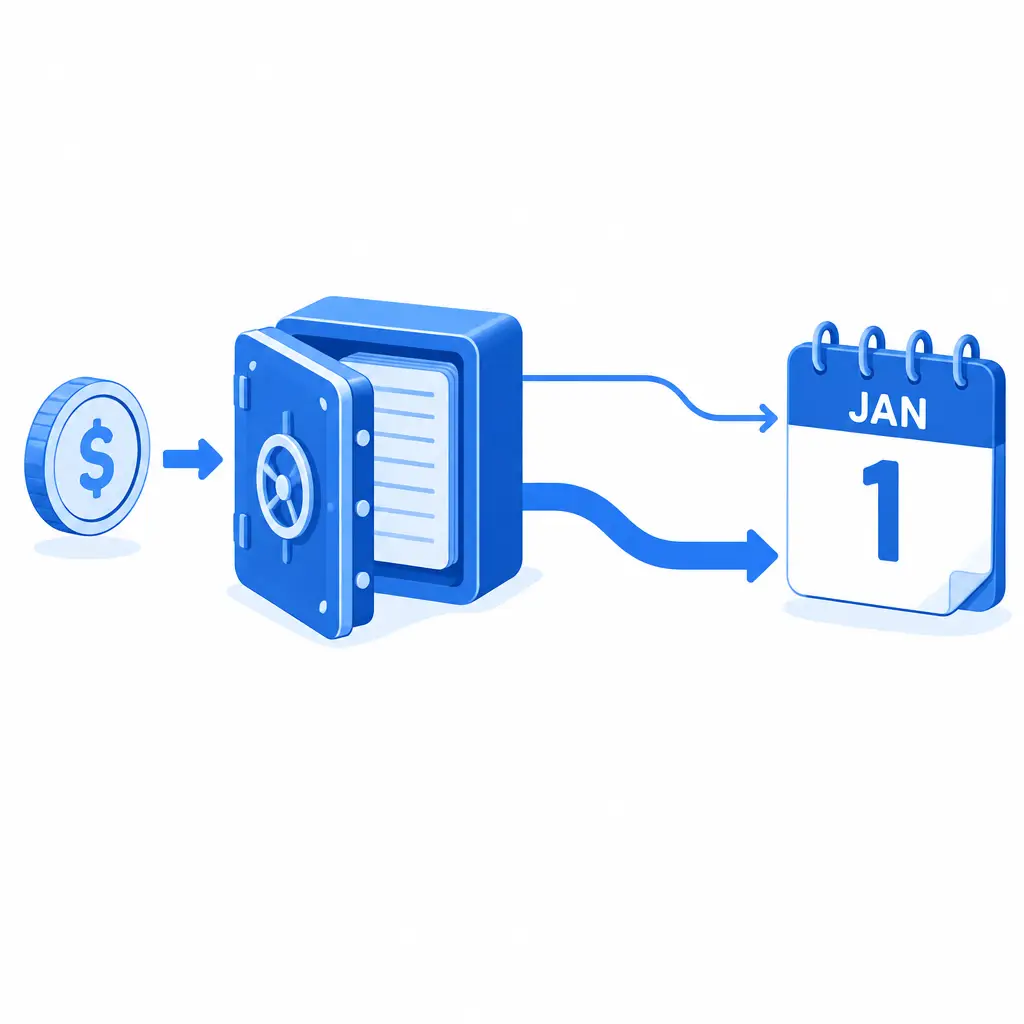
One of the most practical parts of the law is a voluntary declaration window. Investors get 12 months to declare previously unreported crypto gains. Once you file, you must pay the resulting tax within 60 days to avoid penalties and interest.
Why the 60-day payment clock matters
The two timelines work together. Declaring is the easy part. The payment deadline starts after you file, so you need to know roughly what you owe before you submit. Filing first and working out the number afterwards could leave you short of cash when the 60 days run out, and penalties and interest are the stated consequence of paying late.
Who should consider declaring
This is aimed at people who've held crypto, realised gains in earlier years and never reported them. The source doesn't say which past years are covered or what rate applies to old gains, so those questions need an answer from the authorities or an adviser before you commit. What the window clearly offers is a structured route to come forward and pay, with the penalty exposure limited if you meet the payment deadline. If you're in this position, it's far better to use a deliberate process than to wait and hope nobody asks. Our look at how a voluntary disclosure window works in practice in another jurisdiction shows why preparation beats speed.
What This Means for How You Keep Records
A tax that distinguishes between sale gains and yield income only works if your records separate them cleanly. This is where many people will struggle.
Splitting yield from disposals
From 2027 you'll want every staking reward, lending payout and liquidity-pool return logged as its own income line, with the date, the token, the quantity and the euro value at the time you received it. Sales go in a separate record with proceeds and acquisition cost. Mixing the two will make it hard to apply 15% to one and 10% to the other.
DeFi makes this harder than it looks. Liquidity positions can return fees, reward tokens and a changed mix of assets when you withdraw. Working out what counts as income and what counts as a disposal is exactly the type of question covered in our explainer on how each DeFi building block affects your return. The Greek law names liquidity provision as a 15% income category, but the finer mechanics of pool entries and exits aren't in the source, so keep detailed notes on each one.
Using a crypto tax calculator or software
A crypto tax calculator can help you calculate crypto taxes once you've got complete transaction data, including wallet addresses, exchange exports and on-chain history. The calculator is only as good as the inputs. If you moved assets between your own wallets, make sure those transfers are marked as internal moves and not as sales. If you used several platforms, reconcile balances so no purchase or reward is missing. Ask any crypto tax software you consider whether it can apply different rates to different income types and whether it can produce a clear crypto tax report you could hand to an adviser. Don't rely on a tool to decide Greek tax treatment for you, because the guidance isn't final.
Practical Next Steps Before 1 January 2027
You have some time before the rates apply, and the declaration window gives you a separate deadline to manage. Here's how to use both.
Build your history now
Export your full transaction history from every exchange and wallet you've used. Gaps are far easier to fix now than under deadline pressure. Pay special attention to older years, especially if you think you may have unreported gains, because those are the ones the 12-month window is designed for.
Estimate your exposure
Run a rough calculation in two parts. First, estimate your likely annual net gains from sales and see whether you'd sit under the 500 euro exemption. Second, estimate your yearly staking, lending and liquidity income and apply the 15% rate to see what that would cost. If most of your return comes from yield and not from selling, the higher rate is the figure that will matter. This is also a good time to think about whether your current strategies still make sense after tax, though that's a decision for you and your adviser, not something this article can settle.
Plan the cash for your tax bill
Staking and lending rewards are often paid in tokens, not euros. If tax is due in euros, you need to have a way to fund it without being forced to sell at a bad moment. The 60-day payment rule for declared past gains makes this especially relevant, because a tax bill on old gains has a fixed deadline once you file.
Ask about the details you can't see yet
The source leaves several practical questions open. How is the euro value of a reward fixed on the day you receive it? How are losses used against gains? What happens to cost basis after a swap? Greece's Ministry of National Economy and Finance is named in the report, and its guidance will be the place to look for these answers. Watching how another EU country weighing new crypto reporting duties sequences its rules is a reminder that the principle usually arrives first and the detail follows.
What We Don't Know Yet
It's easy to read a headline rate and assume you understand the full picture. With this law, a few things are still unclear from the source material.
Open points to verify
The report doesn't give the exact definition of what counts as staking, lending or liquidity income, nor how a taxable event is timed (when a reward is received versus when it's sold). It doesn't say how euro values are determined, how losses are handled, or how the 500 euro exemption behaves once exceeded. It also doesn't detail how the declaration process works in practice or which past periods it covers. Anything we say about those points would be guesswork, so we're leaving them out.
Why the rate gap matters
The five-point difference between 10% and 15% is small on paper, yet it pushes the classification of each transaction to the centre of your return. A reward you call a sale gain, when the authority views it as income, could mean underpaying. Careful records and a cautious reading of the final text are your best protection.
Frequently Asked Questions
Is staking taxable in Greece from 2027?
According to the report on the approved legislation, yes. Income from staking will be taxed at 15% from 1 January 2027. The same rate applies to crypto lending income and to income from providing liquidity to decentralized protocols.
How are DeFi rewards taxed under the new Greek rules?
The reported framework puts liquidity provision and lending income in the 15% category. Profits from selling crypto assets are taxed separately at 10%. The source doesn't detail how individual DeFi transactions such as pool entries and exits are classified, so check the official guidance.
Is there a tax-free amount for crypto gains?
Investors whose annual net gains don't exceed 500 euros are exempt from the 10% tax on sale profits. The report doesn't say how the exemption works for people who go above that figure, so don't assume the first 500 euros is automatically deducted.
Do I pay tax when I swap one crypto for another?
The report says swapping one crypto asset for another does not generate taxable gains. Using crypto to buy goods or services may, however, trigger capital gains tax. Keep good cost basis records either way, since the gain is likely to show up when you eventually sell or spend.
What if I never reported past crypto gains in Greece?
The legislation gives investors 12 months to voluntarily declare previously unreported crypto gains. You must pay the resulting tax within 60 days of filing to avoid penalties and interest. Work out what you owe before you file so the payment deadline doesn't catch you out.
Source: Cointelegraph Regulation