
Crypto Tax Netherlands: A Complete Guide for Individuals
If you hold cryptocurrency in the Netherlands, the tax treatment may surprise you. Unlike many countries that tax every trade as a capital gain, the Dutch system takes a different approach, one built around a deemed return on wealth rather than tracking each individual profit or loss. Understanding crypto tax in the Netherlands, or crypto belasting as it is known locally, is not optional. The Dutch Tax and Customs Administration (Belastingdienst) has made clear that digital assets are reportable property, and failure to declare them can result in penalties, interest charges, and in serious cases, criminal prosecution. This guide explains how the system works, what you need to report, and how to avoid the most common mistakes made by individual filers.
How Crypto Belasting Works Under the Dutch Tax System
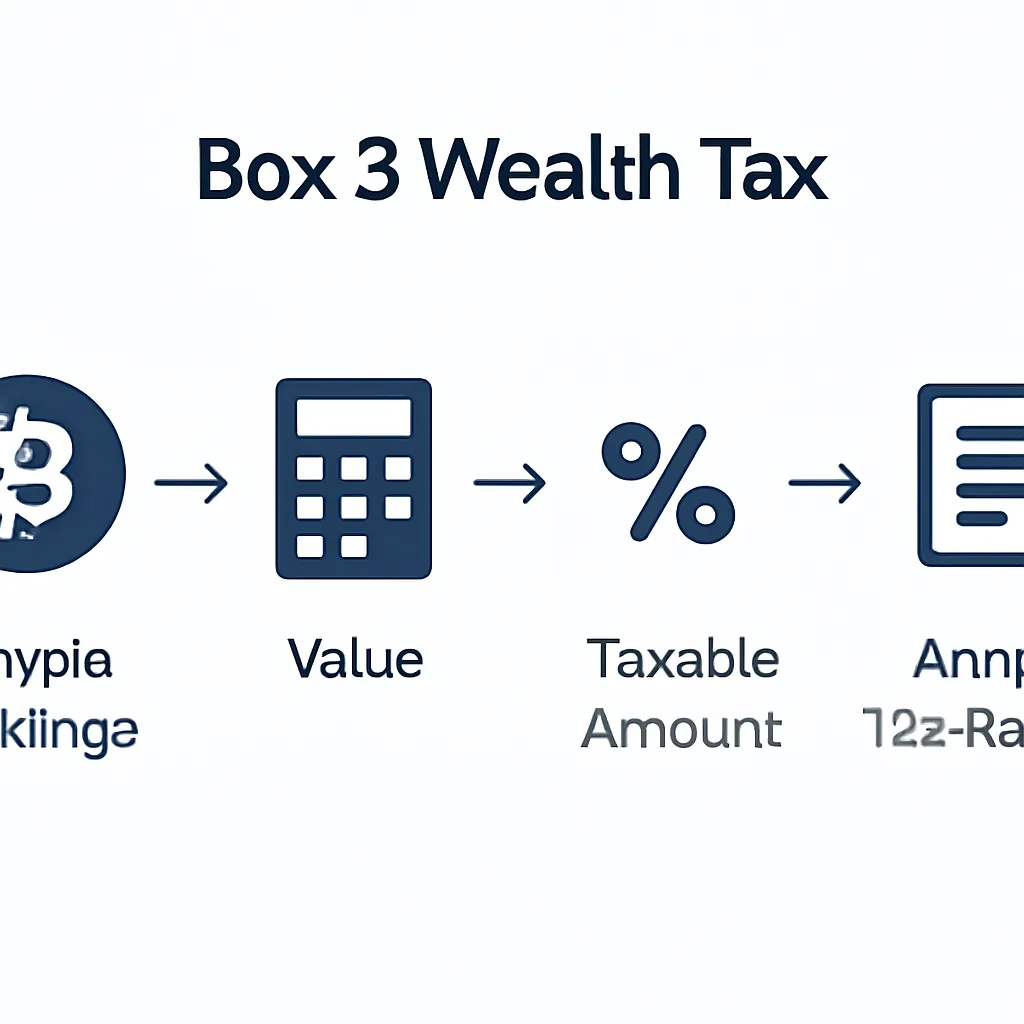
The Netherlands uses a schedular income tax system divided into three boxes. For most individual crypto investors, digital assets fall into Box 3, which covers savings, investments, and other assets. Box 3 does not tax your actual gains. Instead, it applies a notional or deemed return on the total value of your net assets above a tax-free threshold. That deemed return is then taxed at a flat rate.
Box 3 Deemed Return Explained
This means whether your portfolio doubled in value or lost half its worth during the year, your tax bill is calculated on a fictional return percentage applied to your holdings as they stood on 1 January of the tax year, not on what you actually earned. For crypto holders this can feel counterintuitive, especially in a bear market where a tax charge applies even when no profit was made. The asset value used is the fair market value of your crypto on 1 January, typically measured in euros using a recognised exchange rate for that date.
There is a tax-free threshold for Box 3, known as the heffingvrij vermogen. Assets below this threshold are not subject to Box 3 tax at all. Crucially, debts can be offset against your assets, which reduces the taxable base. Only net assets above the threshold are subject to the deemed return calculation.
Tax-Free Threshold and Debt Offset
| Box | What it covers | How crypto fits |
|---|---|---|
| Box 1 | Employment income, self-employment, rental income | Applies if crypto activity is treated as a business or professional trading |
| Box 2 | Substantial shareholdings (5% or more in a company) | Rarely applies to individual crypto holders directly |
| Box 3 | Savings, investments, other assets | Default treatment for most individual crypto investors |
When Does Crypto Tax in the Netherlands Shift to Box 1?
Box 3 is the default, but it is not universal. The Belastingdienst can reclassify crypto activity as Box 1 income if the activity goes beyond passive investment. If you are actively trading in a way that constitutes a business, mining crypto at scale, or earning consistent income from crypto-related services, the tax authority may determine that your profits are taxable as ordinary income under Box 1, at progressive rates that can reach higher levels than Box 3.
Factors for Reclassification to Box 1
There is no single bright-line test for when trading becomes professional. The Belastingdienst looks at factors including the frequency of transactions, the sophistication of the activity, the time invested, and whether the activity resembles a business operation rather than personal wealth management. Casual investors who buy, hold, and occasionally sell are unlikely to be reclassified. Active day traders running dozens of transactions each week face a higher risk of Box 1 treatment.
Staking and DeFi Income Treatment
Staking rewards and DeFi yields are an area of ongoing development. Where such income is received regularly and in significant amounts, there is a credible argument that it constitutes income taxable under Box 1 rather than passive wealth subject to Box 3. The safest approach, absent specific guidance, is to take professional advice if your crypto activity extends beyond straightforward holding and occasional disposal.
How Is Crypto Taxed in the Netherlands: Key Dates and Deadlines
The Dutch tax year runs from 1 January to 31 December. Your crypto holdings are valued on 1 January of the relevant tax year. That single snapshot date determines your Box 3 exposure for the entire year, regardless of what happens to prices during the rest of the year.
Valuation Snapshot Date
The annual income tax return (aangifte inkomstenbelasting) must generally be filed by 1 May following the end of the tax year, although extensions are available in many circumstances. Taxpayers who receive a pre-completed return from the Belastingdienst will find that crypto assets are not automatically populated, since the tax authority does not yet have systematic data feeds from all exchanges. You are responsible for adding the value of your crypto holdings manually.
Filing Deadline and Pre-Completed Return
| Key date | What happens | Action required |
|---|---|---|
| 1 January (tax year) | Crypto holdings valued in euros for Box 3 purposes | Record fair market value of all holdings on this date |
| 31 December (tax year) | Tax year closes | Ensure all transactions are documented |
| 1 May (following year) | Standard deadline for filing income tax return | Submit aangifte including Box 3 crypto values |
What Records Do You Need to Keep?
Because the tax liability in Box 3 is based on the value of your holdings on 1 January, the most critical record is the euro value of every crypto asset you held on that date. You should capture this from a reputable exchange or price aggregator and retain it alongside evidence of the source, such as a screenshot or export with a timestamp.
Why Year-Round Records Matter
Beyond that snapshot, good record-keeping across the year matters for several reasons. If the Belastingdienst ever questions whether your activity should be reclassified to Box 1, a full transaction history becomes essential. Detailed records also allow you to offset losses in one asset against gains in another if Box 1 treatment does apply, and they support any claim that debts should reduce your Box 3 base.
Essential Transaction Records
Practically, you should retain transaction histories from every exchange and wallet you use, records of purchases including purchase price and date, records of any disposals or conversions, and records of any income received such as staking rewards or airdrops. A Netherlands crypto tax calculator that connects to your exchange accounts can automate much of this, pulling data directly and generating a valuation report for 1 January.
Comparing Dutch Crypto Tax to Other Jurisdictions
The Dutch wealth-based approach contrasts sharply with how other countries handle the same question. In the UK, for example, crypto is subject to Capital Gains Tax on each disposal, meaning every trade, swap, and sale is a potential taxable event. Crypto tax in the UK requires tracking the cost basis of every transaction, applying specific pooling rules, and reporting net gains above an annual exempt amount. The administrative burden is considerably higher than the Dutch system for active traders.
Comparison With UK Crypto Tax
In India, the picture is different again. Crypto tax in India is governed by a flat rate applied to gains from virtual digital assets, with limited ability to offset losses across different assets or carry them forward. An India crypto tax calculator needs to handle this flat-rate structure and the additional levy that applies on certain transactions. Understanding how crypto is taxed in India is a separate exercise from the Dutch framework, but the underlying obligation to report is the same: declare what you hold or earn and pay accordingly.
Comparison With Indian Crypto Tax
| Jurisdiction | Tax basis | Key feature |
|---|---|---|
| Netherlands | Box 3 deemed return on net assets at 1 January | Notional return, not actual gains |
| UK | Capital Gains Tax on each disposal | Per-transaction tracking required, pooling rules apply |
| India | Flat rate on virtual digital asset gains | Limited loss offset, additional transaction levy |
Common Mistakes Dutch Crypto Investors Make
The most frequent error is simply not declaring crypto at all. Some investors assume that because they have not cashed out to euros, there is nothing to report. That is incorrect. Crypto held on an exchange or in a private wallet still counts as a Box 3 asset and must be included in the return based on its 1 January value.
Forgetting Foreign Exchange Holdings
A second common mistake is forgetting assets held on foreign exchanges. The Dutch obligation to declare applies to worldwide assets, not only those held with Dutch-based providers. If you hold crypto on an international exchange, that balance still needs to be reported. Equally, some filers forget about smaller altcoin positions or tokens received as staking rewards, assuming they are too minor to matter. All holdings with a meaningful value should be included.
Relying Solely on Exchange Statements
Relying on an exchange's year-end statement without cross-checking it against your own records is another source of error. Exchange reports can miss wallets you self-custody, tokens held on DeFi protocols, or assets bridged across chains. A thorough reconciliation before filing is essential.
Illustrative Scenario
This scenario is illustrative. It does not describe a real person or client, and the figures are examples only.
To illustrate how this applies in practice, consider the following scenario:
Lars is a software developer based in Amsterdam who has been investing in cryptocurrency since 2021. By 1 January of the relevant tax year, he holds Bitcoin, Ethereum, and a small position in a DeFi governance token across two exchanges and a hardware wallet. He has not made any major trades during the year and considers himself a passive investor.
When preparing his tax return, Lars logs into each exchange and exports the balance as at 1 January, then checks his hardware wallet using a block explorer to confirm the value of those holdings on the same date. He converts each balance to euros using a widely referenced exchange rate for that date and records the total. The combined value exceeds the Box 3 tax-free threshold, so the excess feeds into his Box 3 calculation alongside his savings account balance.
Lars uses CryptaTax to pull his transaction history automatically, generate the 1 January valuation report, and produce a summary he can attach to his aangifte. The process takes under an hour. Without the tool, manually checking three wallets and two exchanges for a single historical date would have taken considerably longer and left more room for error.

Frequently Asked Questions
Do I have to pay crypto belasting if I have not sold any crypto?
Yes. In the Netherlands, crypto is taxed under Box 3 as part of your wealth, not based on whether you sold it. If your total net assets including crypto exceeded the tax-free threshold on 1 January of the tax year, you are liable for Box 3 tax regardless of whether you made any disposals.
What value do I use for my crypto on my Dutch tax return?
You use the fair market value in euros on 1 January of the tax year. You should document this value from a recognised exchange or price source and retain evidence of the rate you used. If you hold multiple assets, each one needs a separate valuation on that date.
What is the tax-free threshold for Box 3 in the Netherlands?
The Belastingdienst sets a tax-free allowance, known as heffingvrij vermogen, which applies to the total value of your Box 3 assets after deducting qualifying debts. Only the net amount above this threshold is subject to the deemed return calculation. The threshold amount is reviewed periodically by the Dutch government.
Can staking rewards push me from Box 3 into Box 1?
Possibly, depending on the scale and regularity of your activity. Occasional staking rewards from a passive holding are unlikely to trigger Box 1 treatment. However, if staking forms part of a broader pattern of crypto activity that resembles a business, the Belastingdienst may take a different view. Professional advice is recommended if staking forms a significant part of your income.
How does crypto tax in the Netherlands compare to crypto tax in the UK?
The systems are quite different. The UK taxes crypto under Capital Gains Tax, meaning each disposal is a separate taxable event and cost basis tracking is required for every transaction. The Netherlands uses a deemed return on total wealth at 1 January, so individual trades do not trigger tax events in the same way. Dutch rules are simpler for active traders but can produce a tax bill even in loss-making years.
Do I need to report crypto held on foreign exchanges?
Yes. Dutch tax residents must report their worldwide assets. Crypto held on overseas exchanges counts as a Box 3 asset in exactly the same way as crypto on a Dutch platform. Omitting foreign exchange balances is a common mistake that can lead to underpayment penalties if the Belastingdienst later obtains data through international information exchange agreements.
How is crypto taxed in India compared to the Netherlands?
India applies a flat tax rate to gains from virtual digital assets, with an additional levy charged on certain transactions above a threshold. Unlike the Dutch system, the Indian approach is gains-based rather than wealth-based, so you are taxed when you realise a profit. The rules on loss offsetting are restrictive in India, making the calculation structure quite different from the Dutch Box 3 framework.
Can I use a Netherlands crypto tax calculator to generate my Box 3 valuation?
Yes, and it is strongly recommended. A Netherlands crypto tax calculator can connect to your exchange accounts and wallets, pull balances as at 1 January automatically, and generate a valuation report you can use for your aangifte. This reduces the risk of missing assets or using an incorrect exchange rate, both of which are common causes of errors on Dutch crypto returns.
What happens if I forget to declare crypto on my Dutch tax return?
The Belastingdienst can issue a revised assessment with interest charges if it later identifies undeclared assets. In cases of deliberate concealment, penalties can be significant and the matter can be referred for criminal investigation. The authority increasingly receives data from exchanges through European and international information sharing frameworks, so the risk of detection is real and growing.
Is DeFi activity taxed differently under crypto belasting rules?
There is no specific DeFi legislation in the Netherlands yet, but the underlying assets you hold in DeFi protocols should still be declared as part of your Box 3 wealth. The challenge is that some DeFi positions are complex, involving liquidity pool tokens or wrapped assets, and determining the correct euro value on 1 January requires careful reconciliation. Where DeFi generates regular income, there is an argument for Box 1 treatment that is worth discussing with a tax adviser.
Source: CryptaTax