
Crypto Tax Netherlands: How Box 3 Crypto Belasting Works
Crypto tax in the Netherlands works differently from almost every other country. Rather than taxing your gains when you sell, the Dutch system taxes what you own. Your crypto holdings are treated as savings or investment assets and sit inside the Box 3 wealth tax framework. This means the taxable date that matters is 1 January each year, not the date you trade or cash out. For anyone holding crypto in the Netherlands, understanding crypto belasting is not optional. The Belastingdienst, the Dutch tax authority, expects you to declare your holdings and calculate your liability based on the value of those assets on the first day of the year. Get it wrong and you face penalties, not just a correction. This guide explains exactly how the system works, what exemptions exist, and how it compares to approaches in the UK and India.

What Is Box 3 and Why Does Crypto Sit Inside It?
The Dutch income tax system divides income into three boxes. Box 1 covers employment income and home ownership. Box 2 covers substantial shareholdings in companies. Box 3 covers savings, investments, and other assets, including cryptocurrency. The logic behind placing crypto in Box 3 is straightforward: the Belastingdienst treats crypto as a capital asset rather than a form of income-producing work. You are not taxed on what the asset earns or on the profit you make when you sell. You are taxed on the notional return the government assumes your wealth generates each year.
Why Crypto Falls Under Box 3
This notional return system has been contentious in the Netherlands for years. Courts have challenged its fairness, particularly when actual investment returns fall below the assumed rate. The government has been moving toward a system based on actual returns, but as of the 2025 tax year, the notional return method still applies to most taxpayers. Crypto holders must therefore value their portfolio on 1 January, check whether their total Box 3 assets exceed the tax-free threshold, and apply the relevant rates. Selling at a loss during the year does not reduce your Box 3 liability for that year. The snapshot date is what counts.
How Crypto Belasting Is Calculated Step by Step
The calculation for crypto belasting follows a clear sequence. First, you establish the market value of all your crypto holdings at midnight on 1 January of the relevant tax year. This is your reference valuation. Second, you add together all your Box 3 assets: savings accounts, shares, bonds, crypto, and other investments. Third, you subtract any Box 3 debts above the debt threshold. Fourth, you check whether the resulting net figure exceeds the heffingvrij vermogen, which is the tax-free capital allowance. Fifth, the amount above that threshold is subject to the notional return calculation and the Box 3 tax rate.
Key Box 3 Parameters for 2025
The table below summarises the key Box 3 parameters as they apply to the 2025 tax year. Always verify current figures with the Belastingdienst before filing, since thresholds and assumed return rates are adjusted annually.
| Box 3 Parameter | Detail |
|---|---|
| Valuation date | 1 January of the tax year |
| Tax-free capital threshold (2025) | Subject to annual update by Belastingdienst |
| Notional return rate | Set annually; varies by asset category |
| Box 3 tax rate | Flat rate applied to notional return |
| Filing deadline | 1 May following the tax year (extensions available) |
Which Crypto Assets Are Taxable in the Netherlands
Almost every crypto asset you hold falls within Box 3. Bitcoin, Ethereum, altcoins, stablecoins, and tokens held on centralised exchanges or in self-custody wallets all count toward your Box 3 wealth. The physical location of the exchange does not change your obligation. If you are a Dutch tax resident, you must declare worldwide assets.
Tax Treatment of Staking and DeFi
Staking rewards and DeFi yields are an area where Dutch guidance is still developing. The general principle is that if staking rewards arrive in your wallet before 1 January, they form part of your Box 3 valuation on that date. If they arrive after 1 January, they form part of next year's snapshot. The point of receipt matters, not the point of accrual. NFTs are also treated as Box 3 assets if they have a determinable market value. If a token is genuinely illiquid and has no verifiable market price, you should document why you have assigned whatever value you declare, since the Belastingdienst may request evidence during a review.
Business Crypto Assets and Box 1
One situation worth understanding is crypto held through a business structure. If you operate as a sole trader or through a Dutch entity and hold crypto as part of that business, different rules may apply. Business crypto assets can fall into Box 1 under entrepreneurial profit, rather than Box 3. The boundary between personal investment and business activity is a question of fact and substance, and the Belastingdienst looks at the nature of the activity rather than simply how you have labelled it.
How Crypto Tax Netherlands Compares to the UK and India
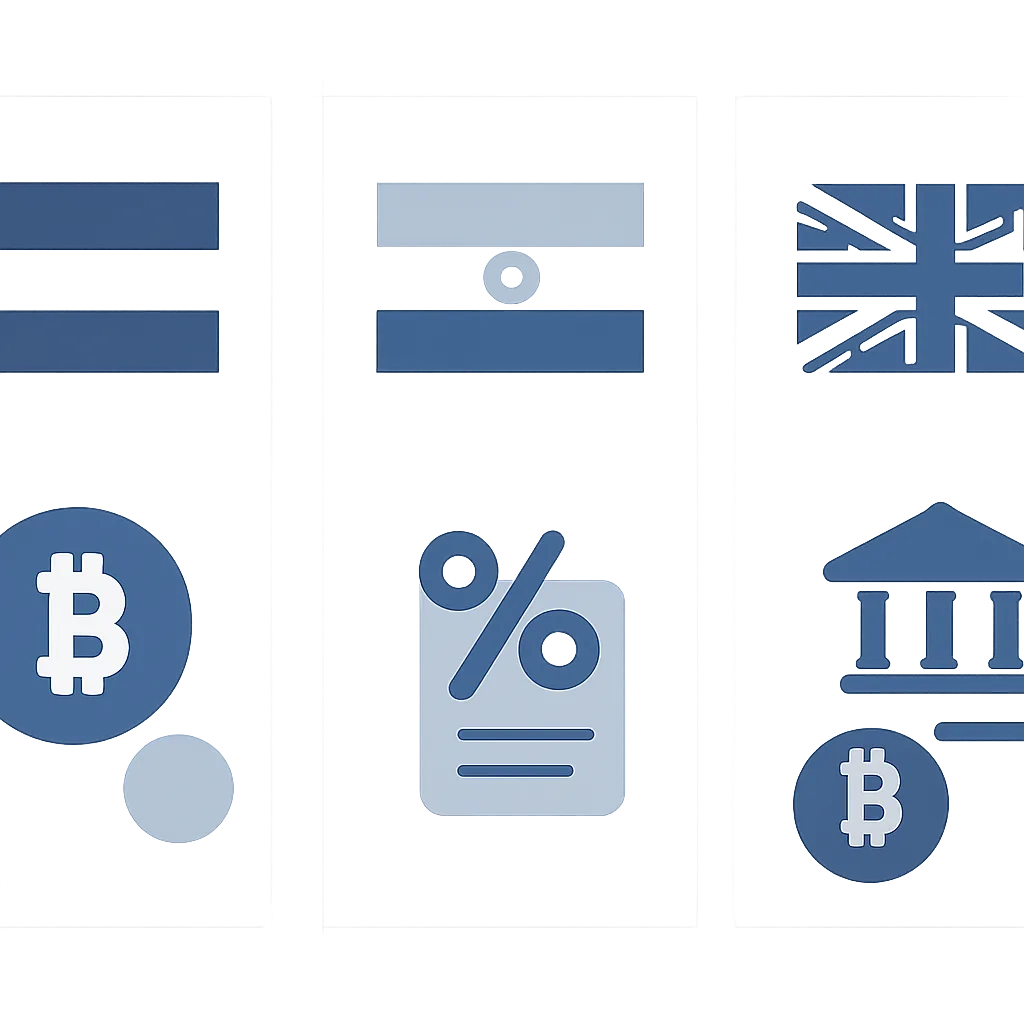
The Netherlands wealth tax approach stands in sharp contrast to the systems used in the UK and India. Understanding those differences helps Dutch residents with international connections get their obligations right, and it helps people who have moved between jurisdictions understand which rules apply to them.
Comparison of Tax Models
| Country | Tax Model | Taxable Event | Rate Approach |
|---|---|---|---|
| Netherlands | Wealth tax (Box 3) | Holding as at 1 January | Flat rate on notional return |
| United Kingdom | Capital gains tax | Disposal (sale, swap, spend) | 10% or 20% depending on income band |
| India | Virtual Digital Asset tax | Transfer of VDA | 30% flat on gains, 1% TDS on transactions |
Crypto tax in the UK is triggered by a disposal. Selling, swapping one token for another, spending crypto on goods, and gifting crypto outside marriage all count as disposals that create a capital gains event. HMRC has published detailed guidance on this. Each disposal produces either a gain or a loss, and losses can be offset against gains in the same tax year or carried forward. This makes a netherlands crypto tax calculator and a UK CGT calculator very different tools built around very different questions.
When asking how is crypto taxed in India, the answer involves a flat 30% rate on gains from the transfer of virtual digital assets, with no ability to offset losses from one VDA against gains from another. India also introduced a 1% tax deducted at source on transactions above a threshold, which created significant compliance pressure on Indian crypto exchanges. The india crypto tax calculator question is therefore about a very different type of calculation than the Dutch Box 3 method, since Indian taxpayers need to track every trade individually.
Common Mistakes Dutch Crypto Holders Make
The most frequent error is using the wrong valuation date. Some taxpayers mistakenly report the value of their crypto at the time they file, typically in April or May, rather than going back to 1 January. If the market moved significantly in the intervening months, this can produce a substantially incorrect figure in either direction.
Crypto on Foreign Exchanges
A second common problem is forgetting about crypto held on foreign exchanges. Dutch tax residency means worldwide assets must be declared. If you hold tokens on a non-European exchange, those assets still count toward your Box 3 wealth. The Belastingdienst has been increasing its use of international data exchange frameworks to cross-check declarations, and CARF, the OECD's Crypto-Asset Reporting Framework, will accelerate this over the coming years as more jurisdictions begin sharing data automatically.
Holding Creates Tax Liability
A third mistake is assuming that because you did not sell anything, you owe nothing. In the Netherlands, this assumption is incorrect. Holding crypto with a value above the tax-free threshold at the start of the year creates a taxable position regardless of what you did or did not do during the year. A netherlands crypto tax calculator that understands the Box 3 methodology will help you test your liability before the filing deadline arrives.
Using a Netherlands Crypto Tax Calculator
A netherlands crypto tax calculator designed for Box 3 will ask you to input your total crypto portfolio value as at 1 January. It will then combine that figure with your other Box 3 assets and your Box 3 debts to produce a net wealth figure. Once it checks that figure against the current tax-free threshold, it applies the notional return rate and the Box 3 tax rate to produce your estimated liability. This is structurally different from calculators built for CGT regimes, which require a full transaction history to calculate gains per disposal.
CryptaTax for Box 3 Filing
CryptaTax supports Dutch Box 3 filing by pulling in portfolio values across connected wallets and exchanges and generating the 1 January snapshot you need to complete your aangifte inkomstenbelasting, the Dutch personal income tax return. The process does not require you to log every trade you made during the year for Box 3 purposes. The key data point is the opening value. That said, if you are also a Dutch business owner or if the Belastingdienst categorises any of your crypto activity as entrepreneurial, CryptaTax can help you identify which parts of your holdings may fall into a different box.
Illustrative Scenario
This scenario is illustrative. It does not describe a real person or client, and the figures are examples only.
To illustrate how this applies in practice, consider the following scenario:
Lars is a 34-year-old software developer based in Amsterdam. He has been accumulating Bitcoin and Ethereum since 2021 and also holds a small position in a DeFi protocol token. He does not trade frequently. In January 2025, he realises he has never formally declared his crypto holdings in his aangifte. He checks the combined value of his crypto portfolio on 1 January 2025 and adds it to his savings account balance. The total exceeds the Box 3 tax-free threshold. Lars had assumed that because he had not sold anything, there was nothing to declare. He logs into CryptaTax, connects his exchange accounts and hardware wallet, and the platform generates a verified 1 January valuation across all his holdings. Lars uses the calculated figure to complete the Box 3 section of his tax return before the May deadline. He also sets a calendar reminder for 1 January 2026 to take a confirmed snapshot of his portfolio value on that date, so he is not scrambling for exchange rate data several months later.
Frequently Asked Questions
How is crypto taxed in the Netherlands?
Crypto is taxed in the Netherlands under Box 3, the wealth tax framework. You are taxed on the value of your crypto holdings as at 1 January each year, not on gains when you sell. The taxable amount is derived from a notional return applied to your net Box 3 assets above the tax-free threshold, with a flat rate applied to that notional return.
What does crypto belasting mean?
Crypto belasting is simply the Dutch term for crypto tax. In the Netherlands it refers specifically to the obligation to declare crypto assets as part of your Box 3 wealth in your annual income tax return. The Belastingdienst treats crypto as a capital asset subject to the wealth tax system rather than to income or capital gains tax.
Do I owe crypto tax in the Netherlands if I did not sell anything?
Yes. The Dutch Box 3 system taxes wealth, not transactions. If your crypto portfolio had a value above the tax-free threshold on 1 January, you have a potential tax liability even if you made no trades during the year. Selling or not selling is irrelevant to Box 3. The snapshot date is what matters.
What is the valuation date for Dutch crypto tax?
The valuation date is 1 January of each tax year. You must determine the market value of all your crypto holdings at that point and use that figure in your Box 3 calculation. If you do not record the value on that date, you will need to reconstruct it from exchange records or price data, which a netherlands crypto tax calculator can help with.
How does the Netherlands approach compare to crypto tax in the UK?
Crypto tax in the UK is based on capital gains. Each disposal, whether a sale, a swap, or a spend, creates a taxable event and you calculate the gain or loss on each one. The Netherlands taxes wealth at a snapshot date regardless of disposals. The two systems require completely different record-keeping practices and produce very different liabilities for the same holder.
How is crypto taxed in India compared to the Netherlands?
India applies a flat 30% tax on gains from the transfer of virtual digital assets, with no ability to offset losses between different tokens. The Netherlands taxes the value of holdings on 1 January rather than gains on disposal. India also applies a 1% tax deducted at source on qualifying transactions. The two systems have almost nothing structurally in common.
Are staking rewards taxable in the Netherlands?
Staking rewards that land in your wallet before 1 January form part of your Box 3 valuation on that date and are therefore included in your wealth calculation. Rewards received after 1 January affect the following year's snapshot. The Belastingdienst has not issued exhaustive guidance on all DeFi income types, so documentation of the receipt date is important.
Do I need to declare crypto held on foreign exchanges as a Dutch resident?
Yes. Dutch tax residency means you must declare worldwide assets in your Box 3 return. Crypto held on non-European or foreign exchanges counts toward your Box 3 wealth in exactly the same way as assets on Dutch or European platforms. The Belastingdienst increasingly receives data from foreign jurisdictions through international reporting frameworks.
What happens if I forget to declare crypto in my Dutch tax return?
Failing to declare Box 3 assets is treated as under-declaration by the Belastingdienst. This can result in corrections, interest charges, and financial penalties. The Belastingdienst can go back multiple years if it identifies undeclared assets. Voluntary disclosure before an investigation typically results in more lenient treatment than being identified through external data sources.
Can a netherlands crypto tax calculator handle Box 3 correctly?
A calculator designed for Box 3 will focus on the 1 January portfolio value rather than on a transaction-by-transaction gain calculation. CryptaTax generates a verified snapshot of your holdings across connected wallets and exchanges on the relevant date, producing the figure you need for your aangifte without requiring a full trade history for Box 3 purposes.
Source: CryptaTax