
Crypto Tax Calculator: How to Handle Tax on Crypto Gifts and Donations
Giving away cryptocurrency feels generous. But from a tax perspective, gifting or donating crypto is rarely straightforward. In most jurisdictions, transferring crypto to another person or to a charity can trigger a taxable event for the sender, regardless of whether any cash changed hands. Many holders are caught off guard when they realise that generosity and tax liability can arrive together. A crypto tax calculator helps you understand exactly where you stand before you give, rather than after you file. This guide walks through how tax on crypto gifts and donations works, what varies by country, and how to avoid the most common mistakes people make when they move crypto without a price tag attached.

Why Giving Crypto Is Not the Same as Giving Cash
When you hand someone cash, you are transferring a currency. No capital gain arises because cash does not appreciate in the way an asset does. Cryptocurrency is treated differently. Tax authorities in the United States, United Kingdom, Australia, and most other major jurisdictions classify crypto as a capital asset or property. That classification matters enormously when you give it away.
Gifting Is a Taxable Disposal
The act of gifting crypto is generally treated as a disposal. You are deemed to have sold the asset at its fair market value on the date of the gift, even though no money came back to you. If the value of the crypto has risen since you acquired it, that increase is a capital gain. You owe tax on the gain, not on the full value. The recipient, by contrast, usually acquires the asset at the value on the date they received it, or in some jurisdictions at the original cost basis of the donor. That distinction has significant consequences down the line when the recipient eventually sells.
Understanding the difference between your cost basis and the fair market value at the time of the gift is the foundation of getting this right. Without accurate records, you cannot calculate crypto taxes correctly, and HMRC, the IRS, or the ATO will not accept vague approximations.
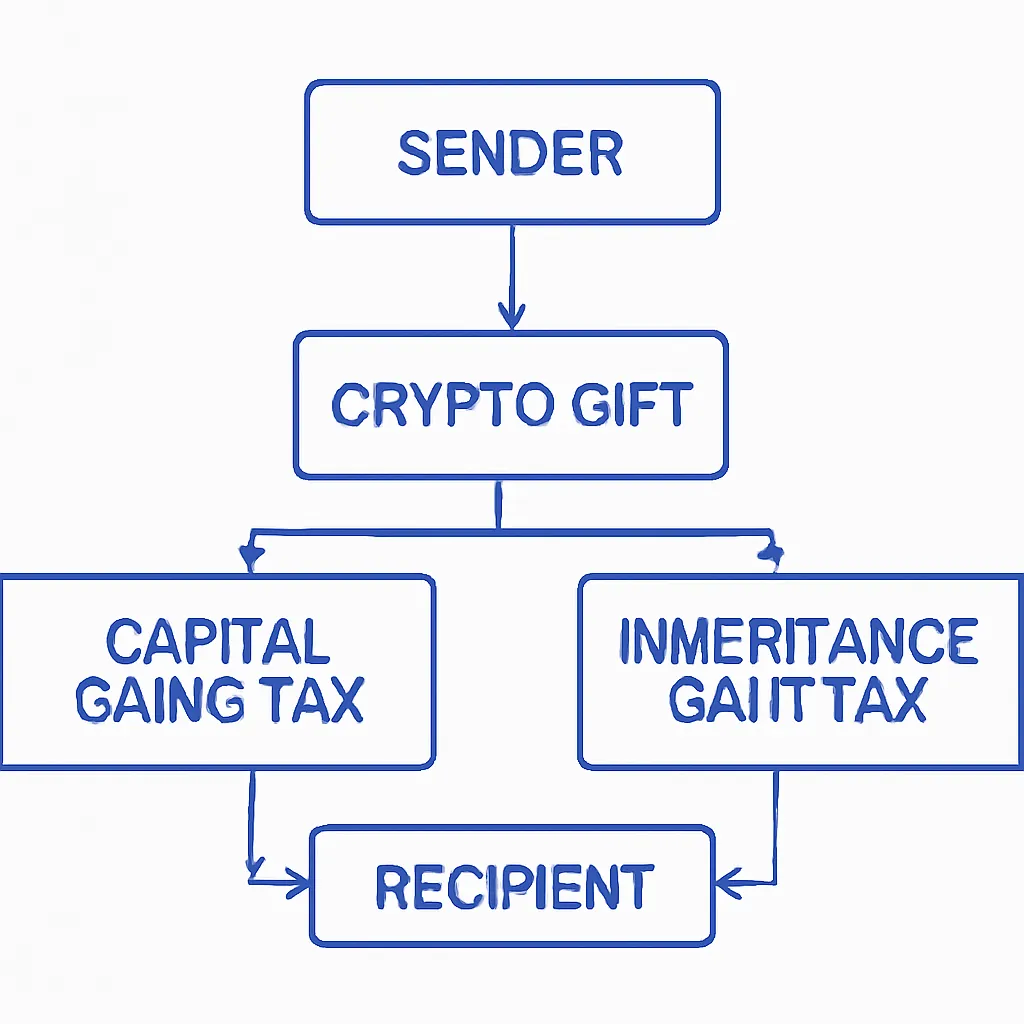
How a Crypto Tax Calculator Handles Gift Disposals
A crypto tax calculator automates the process of identifying disposals, matching them to the correct acquisition cost, and computing the resulting gain or loss. When you mark a transaction as a gift, the software treats it as a disposal at the fair market value on that date. It pulls in price data, applies your jurisdiction's rules on cost basis matching, and produces a figure that feeds directly into your crypto tax report.
Software Automates Gain Calculations
Without software, you would need to find the exact price of the asset at the moment of the gift, calculate the gain against your original purchase price, account for any fees paid, and apply the correct tax rate based on your holding period. Do that once and it is manageable. Do it across dozens of transactions or multiple tax years and the risk of error rises sharply. Crypto tax software keeps each transaction linked to its full history, so the calculation is traceable and consistent.
The table below shows how the disposal calculation typically works at the sender's end across different scenarios.
Disposal Calculation Scenarios
| Scenario | Cost Basis (Sender) | Fair Market Value at Gift Date | Taxable Gain |
|---|---|---|---|
| BTC bought at £10,000, gifted when worth £25,000 | £10,000 | £25,000 | £15,000 |
| ETH bought at £2,000, gifted when worth £1,500 | £2,000 | £1,500 | £500 loss |
| SOL bought at £500, gifted when worth £500 | £500 | £500 | Nil |
Gifts Between Spouses and Civil Partners
Many countries offer relief when crypto moves between spouses or civil partners. In the United Kingdom, transfers between spouses are made on a no-gain, no-loss basis. That means no capital gains tax arises at the point of transfer. The receiving spouse takes on the original acquisition cost, so the gain is deferred rather than eliminated entirely. When the receiving spouse eventually sells, the gain is calculated from the original purchase price, not from the value on the date of the gift.
US and Australia Rules Differ
The United States does not have an equivalent no-gain, no-loss rule for interspousal crypto transfers in the same way, though gifts between spouses who are both US citizens are generally exempt from gift tax. Australia broadly follows a similar deferral approach for transfers to spouses in certain circumstances. The specific rules vary, and they change depending on whether you are married, in a civil partnership, or simply cohabiting. Cohabiting partners are rarely afforded the same treatment.
The table below summarises how major jurisdictions treat gifts between spouses at a high level.
Spousal Gift Treatment by Jurisdiction
| Jurisdiction | Spousal Gift Treatment | Recipient's Cost Basis |
|---|---|---|
| United Kingdom | No-gain, no-loss transfer | Donor's original cost basis |
| United States | Gift tax exemption for US citizen spouses | Donor's cost basis (carryover basis) |
| Australia | CGT rollover available in some circumstances | Donor's original cost base |
| Germany | Gift tax thresholds apply; CGT deferred | Donor's acquisition cost |
Donating Crypto to Charity: Is It Tax-Free?
Donating cryptocurrency to a registered charity is one area where the rules can work in your favour, but the relief available depends entirely on the jurisdiction and the structure of the donation. In the United States, donating appreciated crypto directly to a qualifying charity can be particularly efficient. The donor avoids recognising the capital gain that would otherwise arise on a sale, and may also claim a charitable deduction based on the fair market value of the donated asset at the time of the donation, subject to adjusted gross income limits.
UK Gift Aid Rules Apply
In the United Kingdom, donating crypto to a charity registered with HMRC under Gift Aid does not generate a capital gains tax liability for the donor. The charity itself, being exempt from tax, can reclaim the basic rate tax element. However, the UK rules are specific about which entities qualify, and donating to an overseas charity may not attract the same relief.
Australia allows deductions for donations to deductible gift recipients, but the rules on whether a capital gain arises on the donation itself are nuanced and depend on whether the gift is made at market value or below. Getting this wrong is easy, particularly if the charity is not properly registered in the relevant category.
Run Numbers Before Donating
For anyone who wants to use their crypto holdings philanthropically, running the numbers through a crypto capital gains calculator before donating is a practical first step. You need to know the gain you would be avoiding, or crystallising, before you decide how to structure the donation.
Annual Gift Allowances and Thresholds
Some jurisdictions allow individuals to gift a certain value of assets each year without triggering a tax charge. In the United Kingdom, the annual exemption for capital gains tax applies regardless of the nature of the asset, so small crypto gifts that fall within the annual exempt amount may produce no tax liability at all. There is also a separate annual gift allowance for inheritance tax purposes, which allows individuals to make gifts of up to a certain value per year free from inheritance tax consideration.
US and Germany Have Allowances
The United States has an annual gift tax exclusion that allows donors to give assets up to a specified value per recipient per year without filing a gift tax return. Amounts above that threshold require a return, though gift tax is not necessarily owed immediately because of the lifetime exemption. Germany operates a system of personal allowances for gift tax, with the threshold varying based on the relationship between the donor and recipient. Gifts between parents and children benefit from higher allowances than gifts between unrelated individuals.
The table below illustrates the general structure of annual gift allowances in selected jurisdictions, based on publicly available rules. Always verify the current thresholds with a qualified adviser or via the relevant tax authority, as these figures are updated periodically.
Annual Gift Allowance Examples
| Jurisdiction | Type of Allowance | Who Benefits |
|---|---|---|
| United Kingdom | CGT annual exempt amount; IHT annual gift allowance | All individuals |
| United States | Annual gift tax exclusion per recipient | All individuals |
| Germany | Personal allowance varies by relationship | Close relatives benefit most |
| Australia | No annual gift exemption for CGT purposes | Not applicable |
Keeping Records When You Gift or Donate Crypto
Record-keeping is where most people fall short. When you gift crypto, you need to retain the date of the gift, the amount of crypto gifted, the fair market value on that date, your original acquisition cost and date, any transaction fees, and the identity of the recipient where relevant. That is a significant amount of data for what feels like a simple act of generosity.
Tax Authorities Track Crypto Gifts
Tax authorities are increasing their ability to identify crypto transactions. Exchange data is increasingly shared across borders under frameworks like the OECD's Common Reporting Standard and its crypto extension, CARF. Blockchain analytics tools mean that an on-chain gift is not invisible. If you cannot produce records to support your filing, you are exposed.
Software Captures Audit Trail
Using crypto tax software that integrates directly with your wallets and exchanges means the transaction history is captured automatically. When a gift transaction is flagged and categorised correctly, the software retains the full audit trail. That is exactly what you need if HMRC, the IRS, or another authority ever asks you to explain a transfer that did not generate sale proceeds.
Illustrative Scenario
This scenario is illustrative. It does not describe a real person or client, and the figures are examples only.
To illustrate how this applies in practice, consider the following scenario:
Sarah is a freelance graphic designer based in Manchester. Over the past three years she has accumulated a modest portfolio of cryptocurrency, buying ETH and BTC at various points. In December, she decides to gift 0.5 ETH to her adult daughter as a birthday present and donate a separate amount of BTC to a UK-registered charity as part of her end-of-year giving.
Sarah knows she needs to file a self-assessment return and wants to understand what the gift and donation mean for her tax position. She connects her wallets to CryptaTax, which automatically identifies both transactions and flags them for review. The platform calculates the gain on the ETH gift against her original acquisition cost, confirms the disposal value using the price on the date of transfer, and notes that the BTC donation to a qualifying UK charity does not generate a capital gains tax charge. Within a few minutes, Sarah has a draft crypto tax report she can hand to her accountant, with every transaction evidenced and the correct treatment applied. She does not have to search through old exchange emails or guess at historical prices.

Frequently Asked Questions
Do I pay tax when I give crypto to a friend or family member?
In most jurisdictions, yes. Gifting crypto is typically treated as a disposal at the fair market value on the date of the gift. If the value has risen since you bought it, you may owe capital gains tax on the increase. Whether you actually pay tax depends on your annual exemptions and the size of the gain.
Does a crypto tax calculator work out the tax on gifts automatically?
A good crypto tax calculator will identify gift transactions and treat them as disposals at the fair market value on the transfer date. It matches the gift to your original acquisition cost, calculates the gain, and includes it in your crypto tax report. You need to categorise the transaction correctly in the software for this to work.
Is donating crypto to charity tax-free?
It can be, but it depends on the jurisdiction and the charity's registered status. In the UK, donating to a qualifying charity does not trigger capital gains tax. In the US, donating appreciated crypto to a qualifying charity can allow you to avoid recognising the gain and may generate a charitable deduction. Always check the charity qualifies under the relevant rules.
What is the recipient's cost basis when they receive gifted crypto?
This varies by country. In the UK and US, the recipient generally inherits the donor's original cost basis, meaning the deferred gain is passed on. In some jurisdictions the recipient's cost basis is set at the fair market value on the date they received the gift. This has significant implications for the recipient's future tax liability when they sell.
How do I file crypto taxes when I have made gifts across multiple tax years?
You need to report each gift as a disposal in the tax year it occurred. A crypto tax report generated by crypto tax software will organise disposals by tax year, so gifts made in prior years appear in the correct return period. If you have not filed correctly for past years, you may need to amend previous returns.
Are gifts between spouses taxed differently?
In many jurisdictions, yes. The UK operates a no-gain, no-loss rule for spousal transfers, so no capital gains tax arises at the point of the gift. The US generally exempts gifts between spouses who are both US citizens from gift tax. Germany applies personal allowances that vary by relationship. The treatment for unmarried couples is usually less favourable.
Do I need to report a crypto gift even if no tax is owed?
In many cases, yes. In the UK, disposals above the annual exempt amount must be reported even if no tax is due after allowances. In the US, gifts above the annual exclusion require a gift tax return regardless of whether gift tax is owed. Failing to report can create compliance problems later even if the amount owed is zero.
What records do I need to keep for a crypto gift?
You need the date of the gift, the quantity and type of crypto gifted, the fair market value on that date, your original acquisition cost and date, and any fees associated with the transfer. This information supports both your own tax return and any future enquiry. Crypto tax software that connects to your wallets captures most of this automatically.
Can I use a crypto capital gains calculator to plan gifts in advance?
Yes, and it is a practical way to manage your position. By entering a hypothetical gift transaction, you can see the estimated gain before committing to the transfer. This lets you consider timing, for example gifting after a market dip reduces the gain, or using remaining annual exempt amounts before the tax year ends.
How to file crypto taxes when you have both gifts and regular trades?
Crypto tax software handles both in the same report. It treats gifts as disposals alongside any sales, applies the same cost basis rules, and separates them only where the tax treatment differs, such as charitable donations. The output is a single crypto tax report covering all disposable events across the tax year.
Source: CryptaTax