
Crypto Capital Gains Tax in Ireland: How to Calculate and File
If you have bought, sold, swapped, or spent cryptocurrency in Ireland, you almost certainly have a capital gains tax liability to declare to Revenue. Irish CGT applies to crypto disposals in the same way it applies to shares or property. The rate is 33%, and the rules around what counts as a disposal, how to calculate your gain, and when to pay are specific enough that mistakes are common. A reliable crypto tax calculator takes the complexity out of the process, but you still need to understand the underlying rules to make sure the numbers going in are correct. This guide covers everything from the basic CGT framework through to cost basis methods, allowable deductions, filing deadlines, and the mistakes that most commonly trip up Irish crypto holders.

How Irish CGT Applies to Cryptocurrency
Revenue treats cryptocurrency as a chargeable asset for capital gains tax purposes. That classification has been in place for several years and is now well established. Every time you dispose of a crypto asset, a taxable event occurs. Disposal is a broad concept here. Selling crypto for euros is an obvious disposal, but so is swapping one token for another, using crypto to pay for goods or services, gifting crypto to someone other than a spouse, or civil partner, and in most cases transferring crypto to a different wallet you control if there is a change in beneficial ownership.
Calculating Gain on Disposal
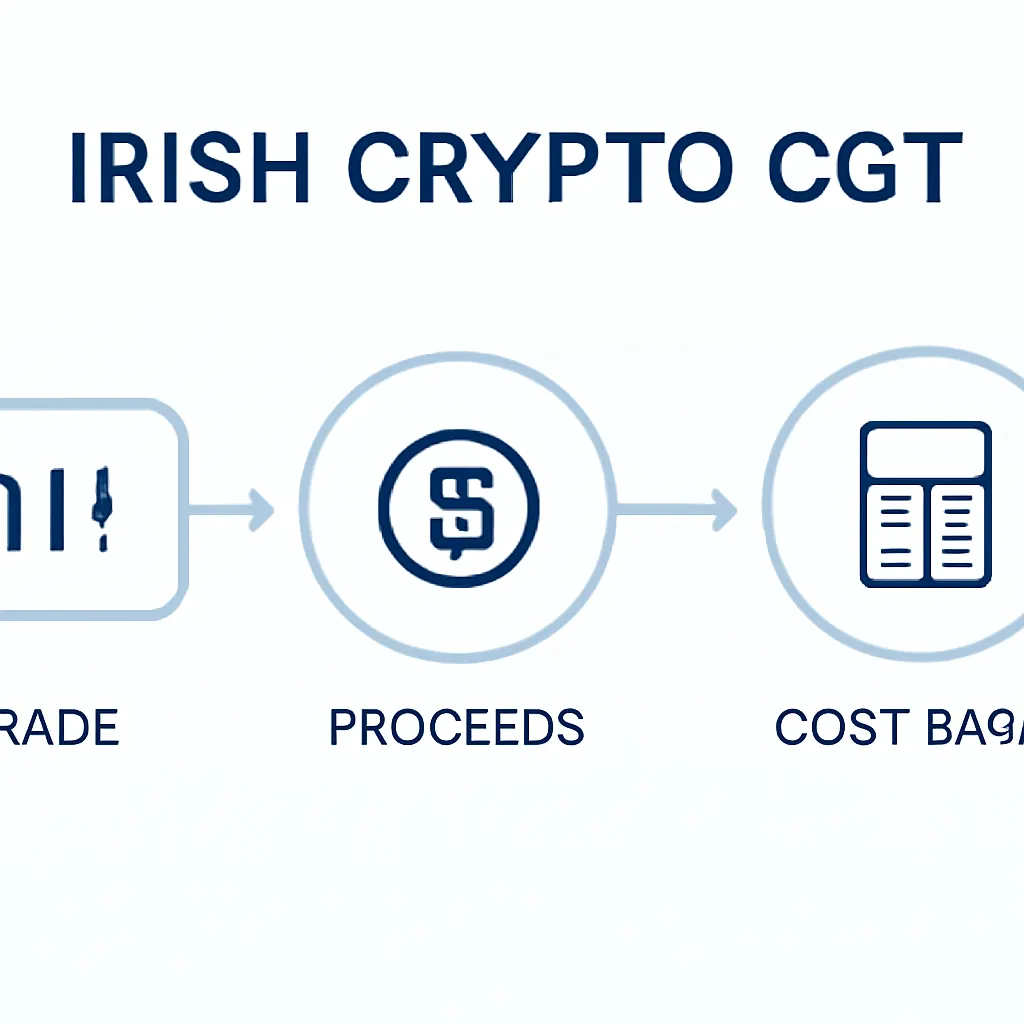
The gain on each disposal is calculated by subtracting the allowable cost from the proceeds. The allowable cost includes the original acquisition price plus any incidental costs of acquisition, such as exchange fees paid at the time of purchase. Similarly, fees paid at the point of disposal can be deducted from the proceeds before arriving at the gain. Revenue expects you to keep detailed records of every transaction: the date, the asset, the amount, the euro value at the time, and the associated fees. Without those records, calculating your liability accurately is almost impossible, and Revenue can challenge figures that cannot be evidenced.
One important nuance is that losses on crypto disposals can be set against gains in the same tax year. If you sold one token at a profit and another at a loss, only the net gain is taxable. Unused losses can also be carried forward to future years, which makes accurate record-keeping doubly valuable over time.
The 33% CGT Rate and Your Annual Exemption
Ireland charges capital gains tax at a flat rate of 33% on chargeable gains above the annual exempt amount. Every individual is entitled to a personal exemption of €1,270 per tax year. That exemption cannot be transferred between spouses for CGT purposes, though each person in a married couple or civil partnership can use their own exemption against their own gains.
Exceeding the Annual Exemption
The exemption sounds modest and, for active crypto traders, it often is. If you made multiple profitable trades in a year, the €1,270 threshold is easily exceeded. Once exceeded, the full gain above that threshold is taxed at 33%. There is no taper relief for crypto in Ireland, unlike some other jurisdictions, and there is no lower rate for long-term holding. The rate is the same whether you held a token for one week or five years.
| Detail | Irish CGT Rule |
|---|---|
| Tax rate on gains | 33% |
| Annual personal exemption | €1,270 per individual |
| Losses offsetting gains | Allowed in same year; excess carried forward |
| Long-term holding relief | Not available for crypto |
| Spouse/civil partner exemption | Each party has their own €1,270 |
What Counts as a Disposal: Common Taxable Events
Many Irish crypto holders underestimate how many taxable events they trigger each year. A straightforward sale to a bank account is easy to spot, but the rules go further. Token swaps are disposals. If you exchange ETH for USDC on a decentralised exchange, you have disposed of ETH at its market value in euros at the moment of the swap. That euro value becomes both your proceeds from ETH and your cost basis for USDC. The same logic applies to wrapping tokens, providing liquidity to a pool in exchange for LP tokens, and in most cases receiving staking rewards that are immediately traded or swapped.
Income Events and Dual-Layer Tax
Receiving crypto as income, whether from staking, mining, airdrops, or employment, introduces a slightly different treatment. Revenue generally taxes the receipt as income first, at the euro value when received. When you later dispose of those tokens, CGT applies to any further gain above the income value that was already taxed. This dual-layer treatment means a good crypto tax calculator must handle income events separately from pure capital events.
Transfers between your own wallets, where you retain full beneficial ownership and nothing is exchanged, are not disposals. But you do need to be able to demonstrate that continuity of ownership to Revenue if asked, which again points to the importance of maintaining thorough records across every wallet address you use.
Cost Basis Methods and How to Calculate Crypto Taxes
Ireland uses a specific identification approach combined with a same-day and 30-day matching rule, broadly similar to the UK's share identification rules. When you dispose of a crypto asset, you first match it against any acquisitions on the same day, then against acquisitions in the 30 days following the disposal, and finally against the remaining pool on a first-in, first-out basis. This matching order matters because it affects the cost basis applied to each disposal and therefore the size of the gain or loss.
Challenges of Self-Filing
To calculate crypto taxes accurately under these rules, you need a complete chronological record of every acquisition and disposal. This is where many self-filers run into problems. Spreadsheet-based approaches work for simple portfolios, but once you have hundreds of transactions across multiple exchanges and wallets, the matching calculations become prone to error. A dedicated crypto capital gains calculator applies the correct matching rules automatically once you have imported your transaction history.
| Matching Rule | Priority | Description |
|---|---|---|
| Same-day rule | 1st | Disposals matched against acquisitions on the same day |
| 30-day rule | 2nd | Disposals matched against acquisitions in the following 30 days |
| FIFO pool | 3rd | Remaining disposals matched against the earliest unmatched acquisitions |
Irish CGT Filing Deadlines You Cannot Miss
Ireland splits its CGT payment deadlines across the tax year. Gains made between 1 January and 30 November must be paid by 15 December of the same year. Gains made in December must be paid by 31 January of the following year. These are payment deadlines, not filing deadlines. The actual filing of your tax return happens through your Form 11 (if you are self-assessed) or via a CG1 return, which is due by 31 October of the year following the tax year. Miss the payment deadline and interest accrues automatically, even if your return is filed correctly later.
December Payment Deadline
For most individual traders, the December payment deadline is the one that catches people off guard. If you made significant gains between January and November, a substantial payment is due before the end of the calendar year, months before you formally file your return. Planning ahead, using a crypto tax report generated from your actual transaction history, is the only reliable way to avoid a cash-flow surprise in December.
| Gains Period | Payment Deadline | Return Filing Deadline |
|---|---|---|
| 1 January to 30 November | 15 December (same year) | 31 October (following year) |
| 1 to 31 December | 31 January (following year) | 31 October (following year) |
Using a Crypto Tax Calculator to Produce a Compliant Report
A crypto tax calculator does more than add up your gains. It imports transaction data directly from exchanges and wallets, applies the correct Irish matching rules automatically, separates income events from capital events, converts all values to euros at the time of each transaction, and produces a formatted crypto tax report that you or your accountant can use to complete the return. The key is data quality. If your transaction history has gaps, because you used an exchange that has since closed or you lost access to a wallet, the calculator cannot fill those gaps with estimates. You need to reconstruct missing data as accurately as possible before relying on the output.
Evaluating Crypto Tax Software
When evaluating crypto tax software for Irish use, check that it handles token swaps as disposals, correctly processes staking and airdrop income, supports the Irish matching order rather than a generic FIFO approach, and outputs figures in euros rather than US dollars. Many platforms are built primarily for US users and default to USD with IRS-style reporting. For Irish filers, euro-denominated output aligned with Revenue requirements is not optional.
Once you have a complete and accurate crypto tax report, how to file crypto taxes through Revenue Online Service is relatively straightforward. The challenge is always the calculation, not the submission mechanics. Getting the numbers right before you hit submit is where the real work lies, and that is precisely what good crypto tax software is designed to help with.
Illustrative Scenario
This scenario is illustrative. It does not describe a real person or client, and the figures are examples only.
To illustrate how this applies in practice, consider the following scenario:
Conor is a software engineer based in Dublin who has been investing in crypto since early in the last bull cycle. Over a single tax year, he made around 80 separate trades across three exchanges, including several token-to-token swaps and a small amount of staking income from a proof-of-stake protocol. He assumed his overall position was roughly breakeven and did not think much about his tax position until October.
When Conor imported all three exchange histories into CryptaTax, the platform applied Irish matching rules to his full transaction history, identified that several of his token swaps had generated taxable gains he had not recognised, and separated out his staking income as an income event rather than a capital event. His actual CGT liability was higher than he had estimated informally, but crucially it was still manageable because he caught it before the 15 December payment deadline for his January-to-November gains. The platform produced a complete crypto tax report with euro-denominated figures, which his accountant used to file his return. Without running the calculation in advance, Conor would have missed the December deadline and faced automatic interest charges.
Frequently Asked Questions
Do I need to pay tax on crypto in Ireland?
Yes. Revenue treats cryptocurrency as a chargeable asset. Any gain you make when you dispose of crypto, whether by selling, swapping, or spending it, is subject to capital gains tax at 33% above the annual €1,270 personal exemption. You are required to report all disposals, even if you ultimately owe no tax after applying losses or the exemption.
What is the CGT rate on crypto in Ireland?
The rate is 33% on net chargeable gains above the annual exempt amount of €1,270. There is no reduced rate for long-term holding and no taper relief. The same 33% rate applies regardless of how long you held the asset before disposing of it.
Is swapping one crypto for another a taxable event in Ireland?
Yes. Revenue treats a token swap as a disposal of the asset you give up and an acquisition of the asset you receive. The disposal proceeds are based on the euro market value of the asset you give up at the time of the swap. This means swapping ETH for another token triggers CGT on any gain made on the ETH since it was acquired.
How does a crypto tax calculator help with Irish CGT?
A crypto tax calculator imports your full transaction history, converts each transaction to euros at the historical exchange rate, applies the correct Irish cost basis matching rules, and separates income events from capital events. It then produces a crypto tax report with the figures you need to complete your Revenue return accurately and on time.
What records do I need to keep for crypto CGT in Ireland?
Revenue expects you to keep records of every transaction: the date of acquisition and disposal, the asset type and quantity, the euro value at the time of each event, and any fees paid. You should retain these records for at least six years. Exchange statements, wallet export files, and transaction history CSVs all serve as supporting evidence if Revenue queries your return.
Can I offset crypto losses against gains in Ireland?
Yes. Losses realised on crypto disposals in the same tax year can be offset against gains from other crypto disposals or other chargeable assets in that year. If your losses exceed your gains in a given year, the unused losses can be carried forward indefinitely to offset future gains. You cannot carry losses back to a previous year.
When do I need to pay crypto CGT in Ireland?
Gains made between 1 January and 30 November must be paid to Revenue by 15 December of the same tax year. Gains made in December are due by 31 January of the following year. These are payment deadlines, not return filing deadlines. The formal return is due by 31 October of the year after the tax year in question.
What happens if I miss the Irish CGT payment deadline?
Interest accrues automatically on late payments, calculated from the date the payment was due. The interest rate Revenue applies is set by statute and compounds over time, so even a short delay can add a meaningful amount to what you owe. Filing your return on time does not cancel the interest if the underlying payment was late.
Does Revenue know about my crypto transactions?
Revenue has access to data-sharing frameworks and has signalled its intention to increase scrutiny of crypto asset holdings. Irish exchanges operating under EU regulatory requirements collect customer identity information. As DAC8 and the OECD Crypto-Asset Reporting Framework roll out across jurisdictions, automatic exchange of information between tax authorities will make undisclosed crypto gains increasingly visible. Voluntary compliance is both legally required and, practically, the lower-risk path.
Can I use a crypto capital gains calculator if I used multiple exchanges?
Yes. Most crypto tax software, including CryptaTax, supports imports from multiple exchanges and wallets simultaneously. The platform consolidates all transactions into a single timeline, applies the matching rules across the combined history, and calculates your overall position. Using multiple exchanges does not change the underlying rules; it just makes accurate calculation harder to do manually.
Source: CryptaTax