
Crypto Capital Gains Tax in Canada: How to Use a Crypto Tax Calculator
Canada taxes cryptocurrency. That is the short answer most people wish they had received before their first big trade. The Canada Revenue Agency treats crypto as a commodity, which means selling it, swapping it, or spending it can all trigger a taxable event. Working out exactly what you owe used to mean building sprawling spreadsheets, hunting down historical prices, and hoping the maths added up. A dedicated crypto tax calculator changes that process entirely. It pulls in your transaction history, applies the correct cost-basis method, separates capital gains from business income, and produces a report you can hand directly to your accountant or paste into your tax return. This guide explains how Canadian crypto tax actually works, what the CRA expects from you, and why the right crypto tax software makes an otherwise painful obligation a manageable one.
How the CRA Classifies Crypto
The CRA does not treat Bitcoin or any other digital asset as currency. It treats crypto as a commodity, sitting alongside gold or oil in tax terms. That classification has real consequences. When you sell a commodity at a profit, you realise a capital gain. When you sell at a loss, you realise a capital loss that can offset gains elsewhere. The classification also means crypto is subject to GST/HST rules when it is exchanged for goods or services in certain commercial contexts, though most individual traders are primarily concerned with the capital gains side.
Two Main Classifications
There is a second classification the CRA uses that catches many traders off guard: business income. If the agency decides your trading activity looks more like a business than passive investing, it can tax your entire profit as income rather than applying the capital gains inclusion rate. Factors it considers include how frequently you trade, whether you are trading on account of capital or inventory, and whether you have specialised market knowledge. Most occasional traders fall on the capital gains side, but high-frequency traders and those running arbitrage strategies should take advice before assuming they do.
The table below summarises the two main tax treatments and their key differences.
Capital Gain vs. Business Income
| Classification | Who It Typically Applies To | Tax Treatment | Inclusion Rate |
|---|---|---|---|
| Capital gain / loss | Occasional investors, long-term holders | Only a portion of the gain is included in income | 50% for individuals (on gains below the annual threshold) |
| Business income | High-frequency traders, commercial miners | Full profit included in income | 100% |
What Counts as a Taxable Event When You Calculate Crypto Taxes
Many people assume tax only applies when they sell crypto for Canadian dollars. The CRA takes a wider view. Almost any disposal of a crypto asset can trigger a gain or loss, and understanding that list is the first step to using a crypto capital gains calculator accurately.
Common Taxable Events
Selling crypto for fiat currency is the obvious one. But swapping one token for another is also a disposal: you are treated as having sold the first asset at its fair market value on the date of the swap, then purchased the second. Spending crypto on goods or services works the same way. You are deemed to have sold the crypto at its fair market value at the moment of the transaction, and if that value exceeds your cost base, you have a gain.
Receiving crypto as payment for work is treated as employment or self-employment income at the fair market value on the date of receipt. That same value then becomes your cost base for the asset going forward, so a future disposal is only taxed on any appreciation above that starting point. Gifts of crypto are also deemed disposals at fair market value for the person giving the gift, even though no money changed hands.
The table below lists common transactions and whether they trigger a taxable event.
Taxable Event Reference Table
| Transaction Type | Taxable Event? | Tax Type |
|---|---|---|
| Selling crypto for CAD | Yes | Capital gain or loss |
| Swapping one crypto for another | Yes | Capital gain or loss |
| Spending crypto on goods or services | Yes | Capital gain or loss |
| Receiving crypto as payment for work | Yes | Employment / self-employment income |
| Gifting crypto | Yes (for the giver) | Capital gain or loss |
| Transferring between your own wallets | No | Not applicable |
| Buying crypto with CAD | No | Not applicable |
The Adjusted Cost Base: Core of Every Crypto Tax Report
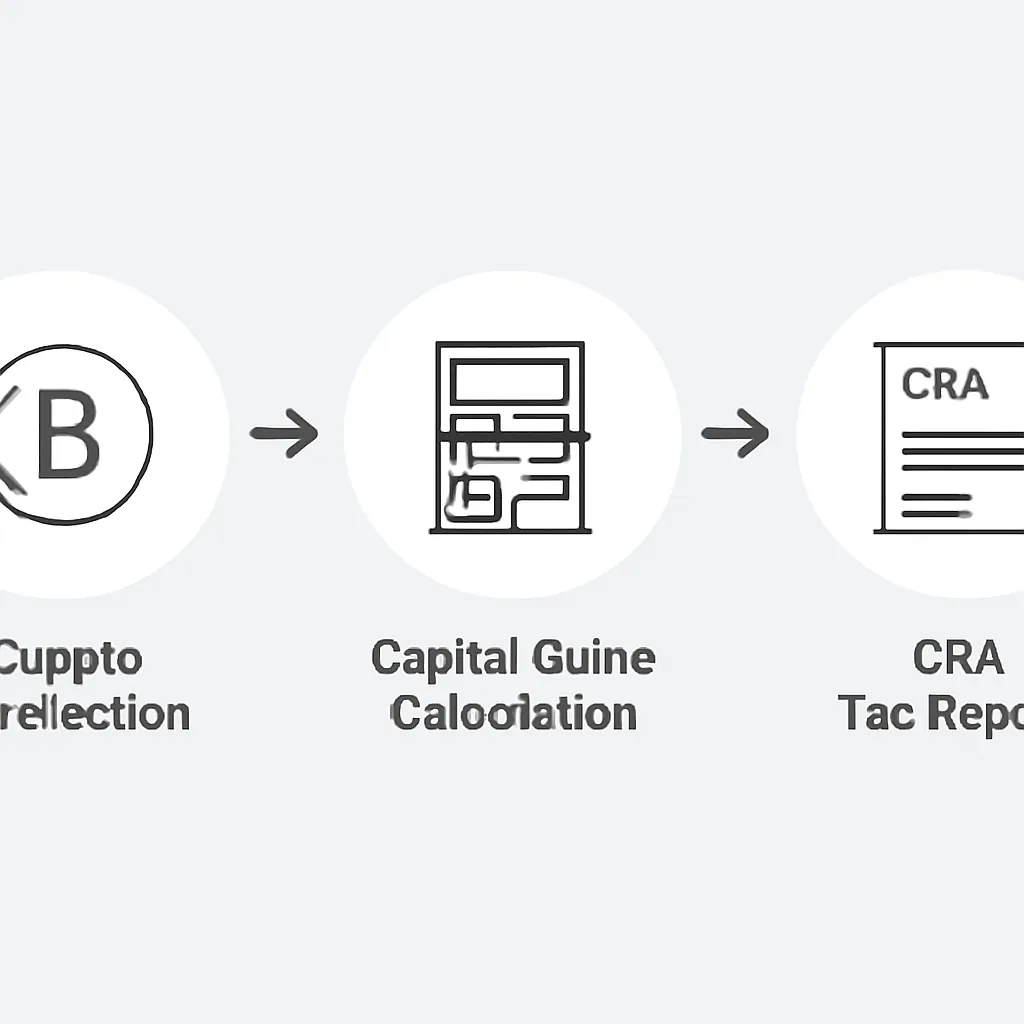
To calculate your capital gain on any disposal, you subtract your adjusted cost base (ACB) from your proceeds. The ACB is essentially what you paid for the asset, including any fees paid at the time of purchase. Simple enough when you bought once and sold once. Considerably more complex when you have bought the same token dozens of times at different prices across multiple exchanges and wallets.
Averaging Method for ACB
Canada uses an averaging method for identical properties. Each time you acquire more of a particular coin, you recalculate the average cost per unit across your entire holding of that coin. When you dispose of some units, you apply that average cost to determine your gain. This is sometimes called the pooling method, and it differs from the first-in-first-out (FIFO) or specific identification methods used in some other jurisdictions.
Fees matter here. Transaction fees paid when buying add to your ACB and reduce future gains. Transaction fees paid when selling reduce your proceeds and therefore also reduce the gain. A good crypto tax calculator tracks both automatically. If you are doing this by hand, forgetting fees is one of the most common errors that leads people to overpay.
Superficial Loss Rule
The superficial loss rule is another ACB consideration. If you sell an asset at a loss and buy the same or an identical asset within 30 days before or after the sale, the CRA may deny the loss. This is designed to prevent artificial loss harvesting, and it applies to crypto the same way it applies to shares.
Mining, Staking, and DeFi: How to File Crypto Taxes on Complex Income
Not all crypto arrives through a purchase. Mining rewards, staking yields, liquidity pool returns, and airdrops all represent inflows of value, and the CRA has views on each of them.
Mining and Staking Income
Mining at a commercial scale is generally treated as business income. Hobby miners may be treated differently, but the line between hobby and business is blurry and the CRA uses similar criteria to those it applies to trading frequency. Staking rewards are typically treated as income at the fair market value on the date they are received. The same principle applies to most DeFi yields: when tokens arrive in your wallet, their value at that moment is income. That value also becomes your ACB for future disposals.
Airdrops are treated as income at fair market value on receipt, assuming they are not compensation for a prior action. Hard forks are more nuanced: new coins received through a fork are generally treated as having a nil cost base, meaning the entire eventual sale price is a gain.
Airdrops and Hard Forks
All of these edge cases create complexity that manual spreadsheets handle poorly. A crypto tax calculator that connects to DeFi protocols and supports staking integrations removes a significant part of that burden, automatically tagging income events and recording the right values.
Canadian Crypto Tax Deadlines and Filing Requirements
Individual Canadians file their income tax returns by the end of April each year for the prior tax year. If you or your spouse are self-employed, the filing deadline extends to mid-June, though any tax owed is still due by the end of April to avoid interest charges. These deadlines apply to crypto gains exactly as they apply to any other income or capital gain.
Reporting on Schedule 3
Capital gains and losses are reported on Schedule 3 of your T1 personal income tax return. You report the proceeds, the ACB, any selling expenses, and the resulting gain or loss for each disposal. You do not need to attach transaction-by-transaction records to your return, but you are required to keep them. The CRA can reassess returns for up to three years in normal circumstances and longer if it suspects misrepresentation. Keeping detailed records, including exchange statements, wallet addresses, and transaction timestamps, is not optional.
T1135 Foreign Property Filing
If you are holding crypto in a foreign exchange or wallet that qualifies as a foreign property, you may also need to file a T1135 Foreign Income Verification Statement if the total cost of your foreign-held property exceeded a certain threshold at any point during the year. This is a separate obligation from your capital gains reporting and carries its own penalties for non-compliance.
Why Crypto Tax Software Reduces Risk and Saves Time
The case for using dedicated crypto tax software in Canada comes down to accuracy and audit readiness. Manually tracking the ACB across dozens of wallets and exchanges, applying the 30-day superficial loss rule, correctly classifying staking income, and keeping records that satisfy CRA scrutiny is genuinely difficult work. Errors in any one of those areas can result in either an overpayment or an understatement that attracts penalties.
Benefits of Crypto Tax Software
Good crypto tax software connects directly to exchanges via API or CSV import, reconciles transfers between your own wallets so they are not mistakenly treated as disposals, applies Canadian cost-basis rules automatically, and generates a crypto tax report in a format that is useful for both self-filing and accountant review. The output typically includes a summary of capital gains and losses, an income summary for staking or mining receipts, and a full transaction-level audit trail.
Choosing Canadian-Compliant Software
When choosing a crypto tax calculator, look for explicit support for Canadian ACB rules, the superficial loss calculation, and the ability to handle DeFi and staking events. Not all tools are built with Canadian tax law in mind, and using a tool calibrated for US or UK rules can produce incorrect results even if the interface looks similar.
Illustrative Scenario
This scenario is illustrative. It does not describe a real person or client, and the figures are examples only.
To illustrate how this applies in practice, consider the following scenario:
Priya is a graphic designer based in Toronto. She bought Ethereum at various points over two years, using two different exchanges and a hardware wallet for long-term storage. She also received a small amount of a new token through an airdrop and earned staking rewards on a proof-of-stake asset. When tax season arrived, she had over 200 transactions spread across three platforms and had no clear view of her ACB.
Priya used CryptaTax to connect her exchange accounts and import her wallet history. The software identified which transfers between her own wallets were non-taxable moves, calculated the running ACB for each asset using the Canadian averaging method, flagged her airdrop as an income event at the fair market value on the day it arrived, and applied the superficial loss rule to a trade she had almost forgotten about. Within an hour she had a complete crypto tax report showing her net capital gains, her staking income, and a transaction log ready for her accountant. She filed Schedule 3 with confidence and kept the full audit trail archived in case the CRA ever asked questions.
Frequently Asked Questions
Do I need to report crypto if I did not cash out to Canadian dollars?
Yes. The CRA considers any disposal of crypto a taxable event, including swaps between tokens and spending crypto on purchases. You do not need to convert to CAD for a gain or loss to exist. The fair market value of the asset in CAD at the time of the transaction determines your proceeds.
How does a crypto tax calculator work out my adjusted cost base?
A crypto tax calculator imports your full transaction history and applies the Canadian averaging method to each asset. Every time you buy more of a token, it recalculates the average cost per unit across your total holding. When you sell, it uses that average to determine your gain or loss. It also factors in fees paid at acquisition and disposal.
Is transferring crypto between my own wallets a taxable event in Canada?
No. Moving the same asset between wallets you own does not constitute a disposal. No gain or loss arises from an internal transfer. You should still record the transfer clearly so that a crypto tax calculator can distinguish it from a sale or trade.
What is the superficial loss rule and does it apply to crypto?
The superficial loss rule denies a capital loss if you repurchase the same or an identical asset within 30 days before or after selling at a loss. The CRA applies this rule to crypto. The denied loss is added to the ACB of the reacquired asset, so it is not permanently lost, just deferred.
How do I file crypto taxes in Canada as a self-employed person?
If your crypto activity constitutes business income rather than capital gains, you report it on the self-employment section of your T1 return rather than Schedule 3. You may also need to register for GST/HST if your revenues exceed the registration threshold. Using crypto tax software that can separately identify business income events makes the filing process clearer.
What records do I need to keep for CRA crypto compliance?
The CRA expects you to keep records that support every figure on your return. For crypto, that means exchange statements, transaction IDs, wallet addresses, dates, amounts in both crypto and CAD at time of transaction, and records of any fees paid. These should be retained for at least six years from the end of the tax year they relate to.
Does staking income count as capital gains or regular income in Canada?
Staking rewards are generally treated as income at the fair market value of the tokens on the date you receive them. That value then becomes your cost base for those tokens going forward. If you later sell the tokens at a higher price, the additional appreciation is a capital gain on top of the income already reported.
Can I use a crypto capital gains calculator designed for the US or UK for my Canadian taxes?
You can use such a tool, but you risk getting incorrect results. Canada uses an averaging method for cost basis rather than FIFO or specific identification, and it applies the superficial loss rule differently from both the US wash-sale rule and UK bed-and-breakfasting rules. A crypto tax calculator that explicitly supports Canadian tax law will produce more reliable output and a report your accountant can trust.
Source: CryptaTax