
Tax Treatment of Lost or Stolen Crypto: What Your Crypto Tax Calculator Needs to Know
Losing access to crypto or having it stolen is devastating. What makes it worse is discovering that the tax treatment is far from straightforward. A reliable crypto tax calculator can help you document these events and work out your position, but only if you understand the rules behind it. The treatment of lost and stolen crypto varies significantly between jurisdictions. Some allow a deduction or loss claim. Others do not recognise the event as a taxable disposal at all unless you can prove the asset is genuinely gone forever. Getting this wrong can mean either paying tax you do not owe or filing an incomplete return that attracts scrutiny later. This guide covers what the major approaches look like, what evidence you need, and how to avoid the most common mistakes.

Why Lost and Stolen Crypto Creates a Tax Problem
When you hold crypto, tax authorities generally treat it as a capital asset. A disposal, which triggers a capital gain or loss, usually happens when you sell, swap, or gift that asset. But what happens when it simply disappears? A hardware wallet lost in a house move, a seed phrase written on a piece of paper that no longer exists, an exchange hack, a rug pull, a phishing attack. None of these fit neatly into the disposal frameworks most tax codes were written around.
The Core Tax Tension
The core tension is this: most tax authorities do not want to grant a loss deduction unless they are confident the asset is genuinely and permanently gone. Crypto complicates that judgment because, technically, the private keys may still exist somewhere. A wallet you cannot access today might theoretically be recovered. That theoretical possibility is why several jurisdictions take a conservative position, refusing to allow any loss claim until it is crystal clear there is no prospect of recovery.
Understanding this tension is the first step. The second is knowing which rules apply where you are tax-resident, because the answer varies considerably.
How the UK Treats Lost and Stolen Crypto
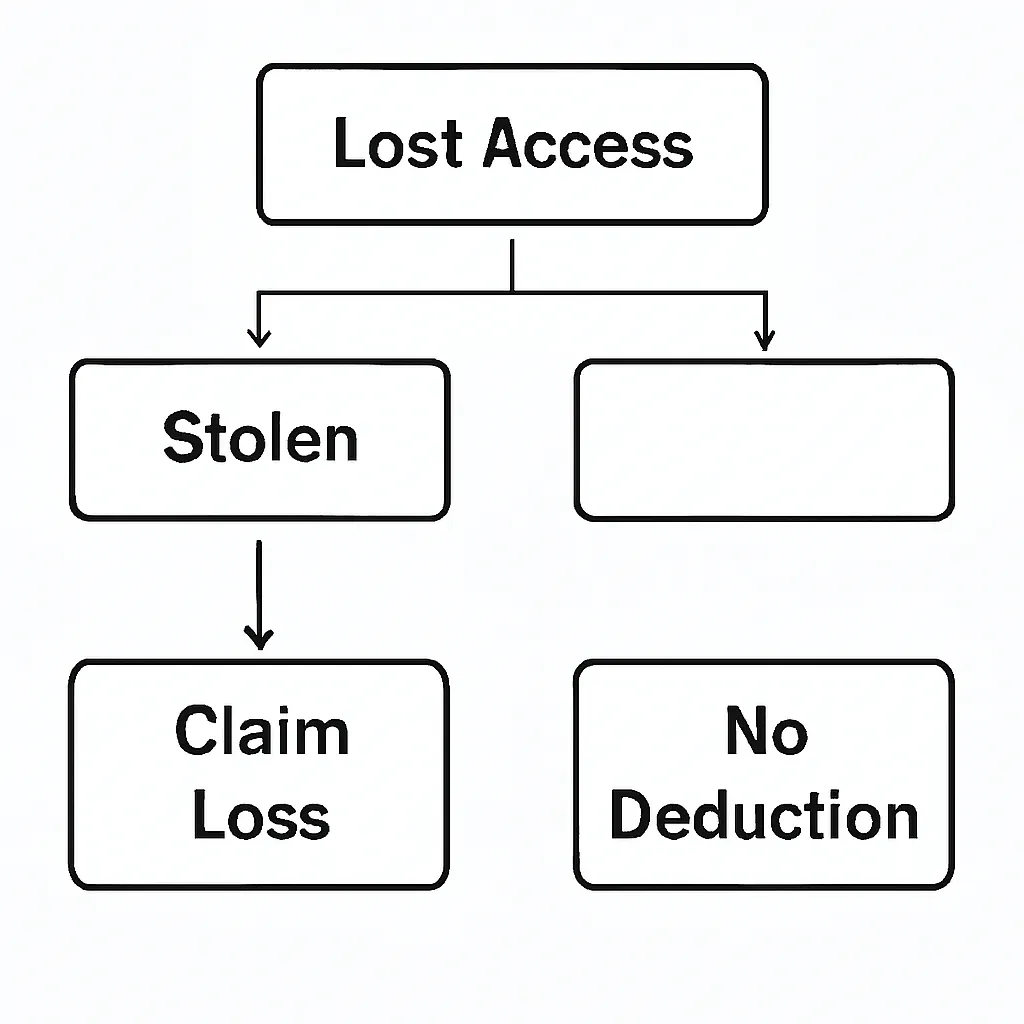
HMRC has published guidance that distinguishes between different scenarios. For genuinely lost crypto where the private keys are permanently inaccessible, HMRC allows you to make a negligible value claim. This treats the asset as if it were disposed of for zero proceeds at the date you make the claim, crystallising a capital loss you can offset against gains in the same or future tax years. You must make the claim formally, and HMRC must be satisfied that the asset truly has negligible value, meaning recovery is realistically impossible.
Stolen Crypto: Not a Disposal
Stolen crypto is treated differently. HMRC's position is that theft does not itself constitute a disposal for capital gains tax purposes. The asset was taken from you without a transaction occurring. That means you cannot automatically crystallise a capital loss just because crypto was stolen. However, if you then make a negligible value claim on the same stolen assets, and HMRC accepts it, a loss can be established. The practical implication is that you need to document the theft clearly, report it to the relevant authorities where possible, and keep records of any communications with exchanges or wallet providers.
The US Approach: A Stricter Position Since 2018
US taxpayers face one of the more restrictive frameworks globally. Before the Tax Cuts and Jobs Act of 2017 took effect in 2018, individuals could potentially claim a casualty or theft loss on personal property, which included crypto. The TCJA suspended those deductions for personal casualty and theft losses until at least 2026, with narrow exceptions for federally declared disaster events.
TCJA Suspension Impact
That means a US taxpayer who lost crypto to a scam, a hack, or a failed exchange generally cannot claim a theft loss deduction for the tax years the suspension covers. The IRS has not issued comprehensive guidance on every scenario, and some tax professionals argue that certain exchange collapses or investment fraud losses may qualify under a separate provision, but this remains an area of active debate and the rules are fact-specific.
What a US taxpayer can do is ensure that any genuinely worthless crypto, where the asset has gone to zero through a project collapse rather than being stolen, is treated correctly as a capital loss disposal. If you held tokens in a project that ceased to exist and the tokens are objectively worthless, disposing of them for zero proceeds crystallises the loss. A crypto capital gains calculator can help you model the effect of that disposal on your overall tax position before you file.
Reporting Worthless Tokens
| Jurisdiction | Lost Crypto Treatment | Stolen Crypto Treatment | Key Condition |
|---|---|---|---|
| UK | Negligible value claim allowed | Not a disposal; negligible value claim possible | Asset must be genuinely unrecoverable |
| US | Generally no deduction (TCJA suspension) | Generally no deduction (TCJA suspension) | Suspension runs to at least 2026 |
| Australia | Capital loss possible if permanent loss proven | Capital loss possible with evidence | Evidence of loss required |
| Germany | No established specific relief | No established specific relief | Seek jurisdiction-specific advice |
Australia and Other Common Jurisdictions
The Australian Tax Office takes a more permissive position than the IRS. Australian taxpayers who have permanently lost access to crypto, or who can demonstrate that crypto was stolen with no prospect of recovery, may be able to claim a capital loss. The critical word is permanently. The ATO expects you to have taken reasonable steps to recover the asset, and to have evidence that those steps were unsuccessful. A declaration or statutory statement about the circumstances of the loss, combined with records from exchanges or wallets, supports the claim.
Canada and EU Differences
In Canada, the Canada Revenue Agency treats crypto as a commodity for tax purposes. Lost or stolen crypto does not automatically trigger a capital loss, but where the loss is permanent and documented, a disposition may be recognised. Canadian taxpayers are advised to keep detailed records and obtain professional advice, as the CRA has not published exhaustive guidance on every lost-asset scenario.
Across the EU, treatment varies by member state. Germany, for example, does not have a specific published framework for lost or stolen crypto losses in the same way the UK does, and taxpayers should seek local advice. The broader point is that no single global rule applies, which makes jurisdiction-aware crypto tax software essential for anyone filing across borders or uncertain about their home rules.
What Evidence You Need to Support a Claim
Regardless of jurisdiction, evidence is the foundation of any lost or stolen crypto tax position. Tax authorities will not accept a bare assertion. They want to see a paper trail that makes the loss credible, specific, and permanent.
Evidence for Lost Crypto
For lost crypto, you should preserve records of the wallet address, any unsuccessful recovery attempts, correspondence with hardware wallet manufacturers or software providers, and any professional attempts to retrieve the private key. A written declaration setting out the timeline and circumstances, signed and dated at the time, is far more persuasive than a claim made years later.
For stolen crypto, a police report or official report to a financial crimes authority is important even if the chances of recovery are slim. Exchange incident reports, phishing emails, on-chain transaction records showing the unauthorised transfer, and any communications with the platform are all relevant. If the theft happened via a centralised exchange that subsequently collapsed, keep records of account balances, withdrawal freezes, and any correspondence from administrators or liquidators.
Evidence for Theft and Collapse
| Event Type | Evidence to Retain | Why It Matters |
|---|---|---|
| Lost private key | Wallet address, recovery attempt records, professional assessment | Proves permanent inaccessibility |
| Theft via hack | Police report, on-chain transaction ID, exchange incident report | Establishes theft occurred and asset is gone |
| Exchange collapse | Account balance screenshots, withdrawal freeze notices, administrator correspondence | Documents that recovery is not forthcoming |
| Scam or rug pull | Transaction records, project communications, market data showing zero value | Supports worthlessness or fraud claim |
How a Crypto Tax Calculator Handles These Events
A crypto tax calculator does not make legal judgments for you, but it does make the reporting process significantly less error-prone. When you use crypto tax software to calculate crypto taxes, the best platforms allow you to flag specific transactions or wallet addresses as lost or stolen, exclude them from gain calculations where appropriate, and generate a crypto tax report that reflects the position you have taken with a clear audit trail.
Practical Workflow in Software
The practical workflow matters. You import your transaction history across wallets and exchanges, identify the event that caused the loss, classify it correctly within the platform, and review the effect on your overall gain and loss position. If the software supports jurisdiction-specific rules, it can apply the relevant treatment automatically, flagging where a negligible value claim is available or where a loss cannot be recognised under current rules. This is especially useful when you have multiple years of activity across several exchanges, because manually tracking cost basis and identifying affected lots is where mistakes happen.
When you come to file, a well-structured crypto tax report showing your methodology, the evidence you hold, and the specific transactions affected is far more defensible than a summary figure with no supporting detail. Tax authorities increasingly have access to blockchain data. A clean, well-documented report is your best protection.
Illustrative Scenario
This scenario is illustrative. It does not describe a real person or client, and the figures are examples only.
To illustrate how this applies in practice, consider the following scenario:
Sarah is a freelance designer based in Manchester who has been investing in crypto for several years. In one tax year she lost access to a hardware wallet containing a meaningful amount of Bitcoin after a house move. She also had tokens stolen from a decentralised exchange through a phishing attack. Sarah was unsure whether either event needed to go on her self-assessment return.
She used CryptaTax to import her full transaction history and flag both events. The platform identified the hardware wallet address and allowed her to mark those holdings as lost, generating the documentation needed to support a negligible value claim with HMRC. For the stolen tokens, it captured the on-chain outgoing transaction and helped her record the circumstances alongside a police reference number she had obtained.
When Sarah filed, her crypto tax report clearly separated her realised gains from her loss claims, with the supporting transaction data attached. She was able to offset the negligible value loss against gains elsewhere in the same year, reducing her CGT bill materially. Without a structured approach, she would likely have either ignored the losses entirely or reported them incorrectly.
Frequently Asked Questions
Can I claim a tax deduction for stolen crypto?
It depends on your jurisdiction. In the UK, theft does not automatically count as a disposal, but you may be able to make a negligible value claim if the asset is unrecoverable. In the US, personal theft loss deductions have generally been suspended under the TCJA until at least 2026. Always check the rules in your country of tax residence and seek professional advice for significant amounts.
Does losing access to a wallet count as a capital loss?
In some jurisdictions, yes. The UK allows a negligible value claim if you can demonstrate the asset is permanently inaccessible, effectively treating it as disposed of for nil proceeds. Australia takes a similar approach with evidence. In the US, no general deduction applies during the current TCJA suspension period. Documentation of your recovery attempts is essential regardless of where you live.
What evidence do I need to claim a loss on lost crypto?
You need records showing the wallet address, the balance at the time of loss, any steps taken to recover the private key, and a clear statement of why recovery is impossible. A written declaration made close to the time of the event carries more weight than one reconstructed years later. Professional assessments from wallet recovery services can also support the claim.
How do I use a crypto tax calculator to report a lost or stolen asset?
Most crypto tax software lets you import your full transaction history and flag specific wallets or transactions as lost or stolen. The platform then adjusts your gain and loss calculations based on the treatment you have selected. You should review the output alongside the rules in your jurisdiction to make sure the classification is correct before you generate your crypto tax report.
What happens if I recover crypto I previously claimed as lost?
If you successfully recover assets that formed the basis of a loss claim, you will likely need to reverse that claim or report the recovery as a new acquisition at the relevant value. The specific treatment depends on your jurisdiction. In the UK, recovering assets subject to a negligible value claim would typically mean revisiting the earlier filing. Keep records of the recovery date and the value at that point.
Does a rug pull or project collapse count as a tax loss?
It can, but the mechanics differ from simple theft or loss. If the tokens still technically exist on-chain but have a market value of zero, disposing of them for nil proceeds can crystallise a capital loss in many jurisdictions. In the US, a disposal for worthless crypto is one of the few routes available during the TCJA suspension. You need evidence of worthlessness, such as the project ceasing operations and market data confirming zero value.
Do I need to report lost or stolen crypto even if I cannot claim a deduction?
In most cases you do not need to report an event that produces no tax consequence, but the obligation varies by jurisdiction. Where no loss is allowable, there is generally no reportable disposal. However, keeping records is still advisable in case rules change or questions arise later. If you are unsure whether an event triggers a reporting obligation, use crypto tax software to model the position or consult a qualified tax adviser.
Can I use crypto tax software to calculate crypto taxes across multiple jurisdictions?
Some platforms support multiple jurisdiction rule sets within a single account, which is useful if you have relocated or have filing obligations in more than one country. You should verify that the software applies the correct rules for each jurisdiction, particularly for edge cases like lost or stolen assets where local guidance varies. A jurisdiction-specific crypto tax report reduces the risk of applying the wrong treatment.
What is the deadline for making a negligible value claim in the UK?
In the UK you can make a negligible value claim for an asset in the current tax year or backdate it to either of the two preceding tax years, provided the asset had negligible value at the date you specify. Claims are made through self-assessment. Missing the window means you lose the ability to crystallise the loss in that year, so acting promptly once you are satisfied the asset is unrecoverable is important.
How do I file crypto taxes correctly when some assets are missing or stolen?
Start by gathering all your transaction records across every wallet and exchange, including records for the lost or stolen assets. Use a crypto tax calculator to reconcile your full history, flag the affected assets, and generate a report that clearly separates recoverable and unrecoverable positions. Attach supporting evidence to your filing records. When you file, follow the specific disclosure rules for your jurisdiction, and consider a note in your return explaining the position taken if the amounts are material.
Source: CryptaTax